
What Causes Label Adhesive Failure at Work?




What Can We Help You With?
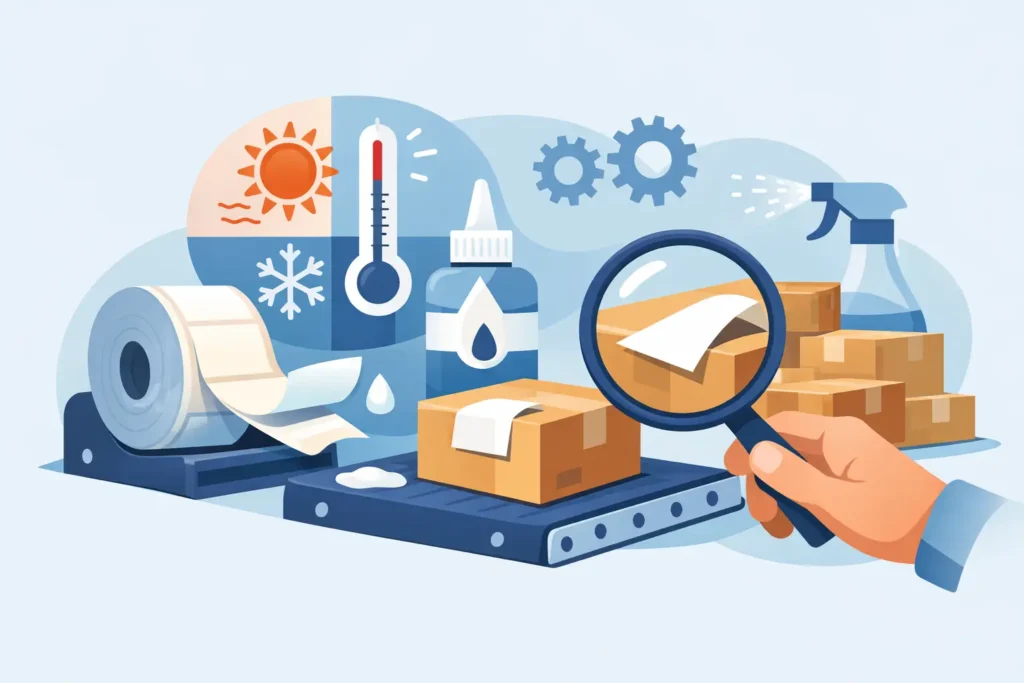
A label that lifts at the corner, falls off a tote, or leaves a barcode unreadable is not a minor materials issue. It can interrupt receiving, create inventory discrepancies, slow a production line, or compromise traceability. So, what causes label adhesive failure? Usually, it is a mismatch between the label construction and the real conditions of the application – including the surface, environment, handling, and time in service.
Adhesive performance is often judged only after a failure occurs. A more reliable approach is to evaluate the entire labeling system before deployment: the facestock, adhesive, liner, print method, ribbon, application process, and the conditions the labeled item will encounter. The right combination depends on the job.
What Causes Label Adhesive Failure?
Pressure-sensitive labels bond when adhesive makes sufficient contact with the application surface. That sounds simple, but industrial environments introduce variables that can prevent that bond from forming or cause it to weaken over time.
The most common causes are contaminated or difficult surfaces, incorrect application temperature, exposure to extreme temperatures or chemicals, mechanical abrasion, label and adhesive mismatch, and application practices that prevent the adhesive from setting properly. In many cases, more than one factor is involved.
A warehouse label may fail because it was applied to a cold corrugated case with dust on the surface. An asset tag may lift because it was placed on low-surface-energy plastic. A chemical drum label may remain attached but become unreadable because the facestock or print system was not designed for solvent exposure. Looking only at the adhesive can miss the actual source of the problem.
The Surface Determines More Than Most Teams Expect
Every adhesive needs a surface it can wet out and grip. Smooth, clean, high-energy surfaces such as glass, steel, and certain painted metals are generally easier to label. Rough, porous, textured, dirty, oily, recycled, or low-energy surfaces are more demanding.
Dust, Oil, Moisture, and Release Agents
Surface contamination is one of the most frequent reasons a label fails prematurely. Warehouse dust, cutting oils, condensation, powder residue, and fingerprints can create a barrier between the adhesive and the substrate. In manufacturing, molded plastic parts may also carry release agents that are nearly invisible but interfere with adhesion.
Cleaning the application area can improve performance, but the cleaning method matters. A cloth that redistributes oil or leaves lint behind does not solve the issue. For critical applications, teams should establish a repeatable surface-preparation step and verify that it fits production speed and safety requirements.
Rough and Corrugated Materials
Adhesive must flow into the valleys of a rough surface to form a durable bond. On corrugated cartons, unfinished lumber, concrete, or textured powder-coated metal, a general-purpose adhesive may contact only the high points. The label can appear secure at first, then release during transport or temperature changes.
A heavier adhesive coat weight or a construction designed for rough surfaces may be required. Label size also matters. A small label has less total bonding area and may be more likely to lift when the substrate flexes or receives impact.
Low-Surface-Energy Plastics
Polypropylene, polyethylene, and other low-surface-energy plastics are common in bins, containers, drums, and consumer packaging. They resist bonding by design. A label that adheres well to steel may peel easily from these plastics, especially when the container is flexed or exposed to cold.
This is not a situation where applying more pressure always fixes the problem. The adhesive must be formulated to bond to the specific substrate. When the plastic type is unknown, sample testing on actual parts is far more dependable than choosing based on a product description alone.
Temperature Can Prevent a Bond Before It Begins
Application temperature and service temperature are related, but they are not the same thing. Application temperature is the temperature of the label and surface when the label is applied. Service temperature is the range the label must tolerate after it has bonded.
A label applied in a freezer, on a cold pallet, or to a refrigerated product may not make enough initial contact for the adhesive to anchor. Even an adhesive rated for freezer service can have a minimum application temperature. If the label is applied below that threshold, it may fail before it has the chance to perform in cold storage.
Heat presents a different challenge. Elevated temperatures can soften adhesives, cause edge lifting, or accelerate chemical interactions with plasticizers and oils. In applications involving hot parts, outdoor equipment, autoclaves, or heat-treated materials, the label construction must be evaluated for sustained exposure rather than a single peak temperature.
Temperature cycling can be especially hard on labels. A container that moves from a hot production floor to a cold warehouse expands and contracts, as do the label and adhesive. Repeated cycling can gradually break the bond, particularly on curved or flexible surfaces.
Chemical Exposure May Attack the Adhesive, the Label, or the Print
Chemical resistance is not a single property. A label exposed to water has different requirements than one exposed to diesel, alcohol, cleaners, lubricants, acids, or sterilization chemicals. The chemical may soften the adhesive, wick under the label edge, discolor the facestock, or remove the printed image.
This distinction matters because a label can remain attached while still failing its operational purpose. If a barcode smears after routine cleaning, scanners cannot read it. If a hazardous-material label becomes illegible, the business may face compliance and safety concerns even if the label has not peeled away.
For chemical environments, the label, adhesive, thermal transfer ribbons, and printing process should be selected as a complete system. Thermal transfer printing with a matched resin ribbon, for example, often provides better durability than a general-purpose print method, but the best choice depends on the exposure and required lifespan.
Handling, Flexing, and Friction Create Mechanical Failure
Labels are often specified around environmental exposure but overlooked in terms of handling. Forklift contact, conveyor rails, tote stacking, repeated bin washing, product abrasion, and manual handling can all damage a label.
A rigid label on a flexible surface can lift as the item bends. A label placed too close to a container seam, radius, recess, or molded texture may experience constant edge stress. Labels on returnable totes and reusable assets face repeated cycles of impacts, washing, and relabeling, which typically calls for a more durable construction than a one-way shipping label.
Placement is part of the specification. A well-matched label can still fail if it is applied over a sharp curve or in a high-contact area. Where possible, choose a flat, protected location that remains accessible for scanning and inspection.
Application Practices Affect Long-Term Performance
Pressure-sensitive adhesive needs firm, consistent contact…
Many adhesives build bond strength over hours or days. If labeled products are immediately exposed to cold, washdown, abrasion, or heavy handling, the adhesive may not have time to reach its intended performance level.
A Better Way to Diagnose and Prevent Adhesive Failure
Then test candidate constructions on real samples under actual conditions. If labels will be washed, frozen, transported outdoors, or handled repeatedly, test those conditions. Include the barcode printers, ribbon, and application method used in production.
Operations that rely on consistent warehouse labeling standards often experience fewer identification errors because approved label materials, printer settings, and application procedures are documented across facilities.
Reliable identification starts with treating a label as an engineered component.
Need Help Choosing the Right Labeling Solution?
At PaladinID, we understand that every labeling application is different.
That’s why companies across the country trust us to help identify the right labeling, barcode, and identification solutions for their operations. With more than 40 years of experience and one of the industry’s largest selections of labels, thermal transfer ribbons, barcode printers, barcode scanners, and identification products, we make it easy to find the right solution for your business.
Whether you need stock products, custom labels, or a fully engineered identification solution, our experienced team is ready to help. Browse our online catalog, email us, or call 888.972.5234 to discuss your application with one of our labeling specialists.
PaladinID delivers label solutions that stick!


Got Labeling Questions? Our AI Assistant Has Answers - Chat Now!
For more information on PaladinID
Get Help With Your Next Label Project
We have over 35 years of providing exceptional service and labeling products to the world. Take the first step to an easy, stress-free solution for your label needs by contacting us.
Schedule a call below or email [email protected]
Make Your Mark
“Making companies more competitive by offering the correct label printing solution, on time, within budget, while creating unmatched value”.
About PaladinID, LLC
PaladinID develops and supports high-performance barcode labeling applications. We work with our clients to “Make Your Mark” by providing the expertise and tools necessary to create an entire product label printing solution. Located in central New Hampshire, PaladinID has been serving Massachusetts, Vermont, Maine, Connecticut, Rhode Island, New England, and beyond for over 30 years, and in 2017, became an RFID-certified company. We look forward to working with you.
You may be interested in our other services:
Product Labels
Product Labels
Labels for every type of application: Blank, Pre-printed, Variable data
Label Printers
Label Printers
We sell and support: Direct/thermal transfer, Inkjet, Laser
Printer Ribbons
Printer Ribbons
We sell ribbons for ALL barcode printers including: Zebra, Datamax, Sato, Intermec
Flexible Packaging
Flexible Packaging
We offer a wide variety of packaging containers for your products.
Label Software
Label Software
Software for all barcode printing and product labeling.
Label applicators
Label Applicators
Wide selection of applicators: Desktop/Mobile, Applicator only, Print & apply
