
RFID Labels Versus Barcodes: Which Fits?




What Can We Help You With?
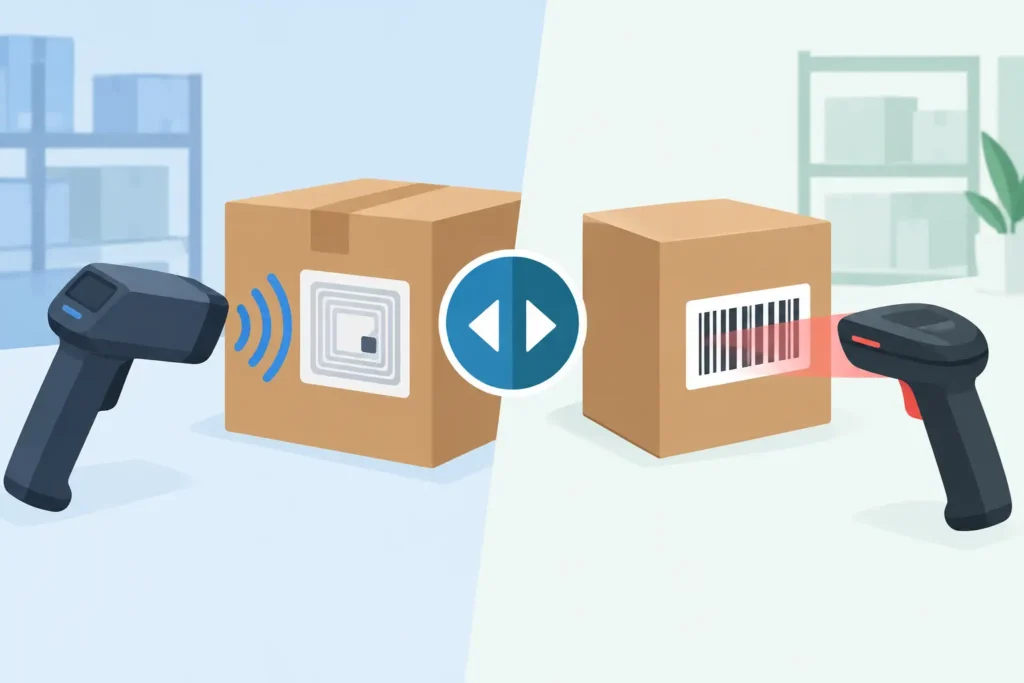
A receiving dock can process hundreds of pallets before lunch. But when every item must be carefully positioned for a scan, identification can quickly become a bottleneck. On the other hand, equipping every item with an RFID tag when there is no clear business need can introduce unnecessary costs and complexity.
So, when it comes to RFID labels versus barcodes, which technology actually makes the most sense for your operation?
For many businesses, barcodes are still the best choice. They are cost-effective, proven, and compatible with nearly every warehouse management, manufacturing, and shipping system. RFID, however, can offer significant advantages when higher volumes, faster read speeds, hands-free identification, or item-level visibility justify the investment.
Ultimately, the right solution depends on what you’re tracking, how items move through your operation, where identification takes place, and what an error could cost your business.
RFID Labels Versus Barcodes: The Core Difference
The biggest difference between barcodes and RFID comes down to how information is captured.
A barcode stores identification data in a printed pattern that must be visible to a scanner or camera to be read accurately. Depending on the application, it can contain a simple SKU, serial number, lot number, location, date, or a more data-rich 2D code such as a QR code or Data Matrix.
One of the biggest advantages of barcodes is their affordability. They are inexpensive to print and can be produced using materials suited to different environments, from a basic paper shipping label to a chemical-resistant synthetic asset label.
An RFID label takes a different approach. It contains a small integrated circuit and antenna embedded within the label material. Instead of relying on a visible printed pattern, an RFID reader communicates with the chip using radio frequency.
The chip can be encoded with a unique identifier and, in some applications, additional data. Fixed readers, handheld devices, portals, or conveyor-mounted antennas can detect tags within their read zones without requiring a direct line of sight.
This difference can significantly change how work gets done.
Barcode scanning is generally a deliberate, one-at-a-time process. RFID, on the other hand, can identify multiple tagged items simultaneously, often while they are moving through a designated process point.
However, RFID performance isn’t automatic. Tag placement, item materials, reader positioning, antenna configuration, and software rules all influence whether the system delivers reliable results.
Where Barcodes Continue to Make Business Sense
Despite advances in identification technology, barcodes remain one of the most practical solutions for shipping, work-in-process identification, bin labeling, product labeling, and asset tracking.
Consider a typical warehouse operation. An associate scans a case label during picking, verifies a carton at pack-out, and scans a shipping label during manifesting. These familiar processes can be completed with relatively low hardware costs and minimal disruption.
Barcodes also offer something RFID cannot replace: a visible, human-readable identifier.
If a scan fails, an employee can often read the printed item number, lot code, or serial number and continue working through an approved exception process. For compliance labels, safety labels, laboratory labels, and product packaging, printed information is often just as important as the machine-readable code.
When properly implemented, barcode systems can deliver excellent accuracy. Quality label materials, proper ribbon selection, consistent print quality, scanner verification, and disciplined scanning procedures all help reduce misreads and duplicate transactions.
A barcode isn’t inherently less accurate than RFID. The primary difference is that it requires an operator or automated system to present the code for scanning.
Cost is another important consideration. Barcode labels, scanners, and printer infrastructure are generally less expensive to implement.
If your business tracks thousands of low-value items, only needs a few scans per item, and already has dependable scanning procedures, an RFID investment may not deliver enough return to justify the additional equipment and integration costs.
When RFID Delivers a Clear Advantage
RFID becomes especially valuable when manual scanning creates delays, limits visibility, or requires more labor than an operation can afford.
Imagine a busy receiving dock. Instead of scanning every individual case, an RFID portal can capture tagged cases or pallets as they pass through an opening. A handheld RFID reader can help employees locate a specific asset or complete inventory counts without individually aiming at every label.
In manufacturing and distribution, conveyor-mounted readers can identify products moving through production or shipping at speeds that would make manual barcode scanning impractical.
The strongest RFID applications typically involve situations where large quantities of items need to be identified quickly and repeatedly.
Common examples include:
- Reusable containers
- Rental equipment
- High-value tools
- Apparel inventory
- Returnable transport items
- Healthcare assets
- Large quantities of boxed or palletized inventory
In these environments, the ability to read multiple tags without line of sight can reduce cycle-count labor and improve the timeliness of inventory transactions.
RFID also provides more precise item identification. A unique electronic product code can distinguish individual units, even when they share the same product number.
This is particularly valuable for serialized assets, warranty tracking, maintenance histories, chain-of-custody records, and loss-prevention programs.
However, RFID should be evaluated as an entire identification system, not simply an upgrade to your labels.
The tag must be appropriate for the item and its environment. Standard UHF RFID labels may work well on corrugated cartons, but tools, equipment, and steel containers may require specialized on-metal tags.
Liquids, dense packaging, stacked products, and nearby metal surfaces can also interfere with read performance. That’s why testing in the actual operating environment is essential before committing to a full deployment.
Compare the Operational Trade-Offs
When comparing RFID labels and barcodes, the decision often comes down to how items need to be read and identified.
Barcodes require line of sight and are generally scanned one item at a time. RFID does not require line of sight and can read multiple tags within a reader’s field.
This can dramatically improve identification speed, but it introduces another consideration: controlling which tags should be read at a particular moment.
For example, an RFID portal installed at a dock door must distinguish inventory moving through the opening from inventory sitting nearby.
Reader power, antenna direction, shielding, portal design, and software filtering all play a role in determining whether the resulting transaction is accurate.
Barcode scanning may take longer, but it is naturally intentional because an employee points the scanner directly at a specific label.
Label durability is another important consideration, and it is separate from the data-capture technology itself.
Both barcode and RFID labels can be manufactured with materials designed to withstand:
- Heat and moisture
- Abrasion and UV exposure
- Chemicals
- Freezer conditions
- Outdoor environments
The important factors are whether the face stock, adhesive, ribbon, printing method, and tag construction are appropriate for the application.
Even a durable RFID inlay can fail when placed inside an unsuitable label construction, just as a poorly specified barcode label can fail under demanding conditions.
Integration deserves just as much attention.
Barcode data may already flow seamlessly through an existing ERP, WMS, MES, or shipping application. RFID introduces reader events that must be filtered, interpreted, and converted into meaningful business transactions.
Before implementing RFID, teams should establish exactly what a successful read means.
Does it update inventory status? Confirm a production step? Create a maintenance event? Alert employees to an exception?
Without clearly defined business rules, RFID can generate more data without necessarily giving the business better control.
A Practical Selection Framework
Before choosing between RFID and barcodes, start by evaluating your existing workflow rather than selecting a technology based on its features alone.
Identify where items are labeled, where they are scanned or read, who performs each transaction, and what happens when identification fails.
Then, determine the actual cost of your current process.
Are you experiencing excessive labor time, inventory inaccuracies, missing assets, shipping errors, compliance exposure, or limited visibility?
These questions help identify where a different identification solution could make a measurable difference.
Barcodes are generally the better fit when:
- Employees already handle items individually.
- Products or locations are scanned at specific points in a process.
- A low-cost, visible identifier is important.
- The existing scanning process is reliable.
- The environment makes RFID difficult or unnecessary.
- Only occasional tracking is required.
RFID deserves serious consideration when:
- Employees are skipping manual scans.
- Inventory counts require too much labor.
- Assets are difficult to locate.
- Throughput depends on identifying groups of items in motion.
- Customers, retailers, government programs, or industry requirements specify RFID data standards.
Before committing to either technology, test it using actual products, packaging, racks, containers, and movement patterns.
Testing should reflect the distances and speeds used in your real operation. Include challenging conditions such as wet products, metal surfaces, densely packed cartons, damaged labels, and mixed loads.
A successful pilot should evaluate read rates, exception handling, software transactions, and employee procedures. Simply demonstrating that an RFID tag can be read on a tabletop isn’t enough to prove that the technology will perform reliably in your facility.
The Case for a Hybrid Identification Strategy
For many organizations, choosing between RFID and barcodes doesn’t have to be an either-or decision.
A hybrid label can combine a printed barcode with an RFID inlay, giving businesses the advantages of both technologies.
The barcode provides visible identification and compatibility with existing scanners, while RFID enables automated or bulk reading wherever it adds value.
This approach is especially useful for businesses implementing RFID in phases.
For example, a company might begin using RFID at a single dock door, within a high-value asset program, or for selected customers while continuing to use barcodes throughout the rest of its operation.
The printed barcode remains available for manual exceptions, downstream partners, and locations that have not yet adopted RFID readers.
However, maintaining accurate data across both technologies is essential.
The barcode identifier, RFID identifier, and corresponding system record must all reference the correct item or asset. Label printing and encoding processes should include verification to prevent incorrectly encoded tags, poorly printed barcodes, or mismatched identifiers.
Ultimately, a successful identification program starts with understanding the process and then selecting the labels, printers, readers, software, and support structure needed to maintain it.
Choose barcodes when controlled scanning delivers the accuracy and efficiency your operation needs. Choose RFID when faster, less manual identification creates measurable improvements. And when your workflow benefits from both, a hybrid system can provide dependable identification today while creating opportunities to scale tomorrow.
Need Help Finding the Right Labeling Solution?
At PaladinID, we bring more than 35 years of labeling experience to businesses looking for reliable, practical identification solutions. Whether you need traditional barcode labels, RFID-compatible labeling, or a customized approach, we’re here to help you find the right fit for your operation.
PaladinID — Make Your Mark.


Got Labeling Questions? Our AI Assistant Has Answers - Chat Now!
For more information on PaladinID
Get Help With Your Next Label Project
We have over 35 years of providing exceptional service and labeling products to the world. Take the first step to an easy, stress-free solution for your label needs by contacting us.
Schedule a call below or email [email protected]
Make Your Mark
“Making companies more competitive by offering the correct label printing solution, on time, within budget, while creating unmatched value”.
About PaladinID, LLC
PaladinID develops and supports high-performance barcode labeling applications. We work with our clients to “Make Your Mark” by providing the expertise and tools necessary to create an entire product label printing solution. Located in central New Hampshire, PaladinID has been serving Massachusetts, Vermont, Maine, Connecticut, Rhode Island, New England, and beyond for over 30 years, and in 2017, became an RFID-certified company. We look forward to working with you.
You may be interested in our other services:
Product Labels
Product Labels
Labels for every type of application: Blank, Pre-printed, Variable data
Label Printers
Label Printers
We sell and support: Direct/thermal transfer, Inkjet, Laser
Printer Ribbons
Printer Ribbons
We sell ribbons for ALL barcode printers including: Zebra, Datamax, Sato, Intermec
Flexible Packaging
Flexible Packaging
We offer a wide variety of packaging containers for your products.
Label Software
Label Software
Software for all barcode printing and product labeling.
Label applicators
Label Applicators
Wide selection of applicators: Desktop/Mobile, Applicator only, Print & apply
