
How to Standardize Warehouse Labeling




What Can We Help You With?
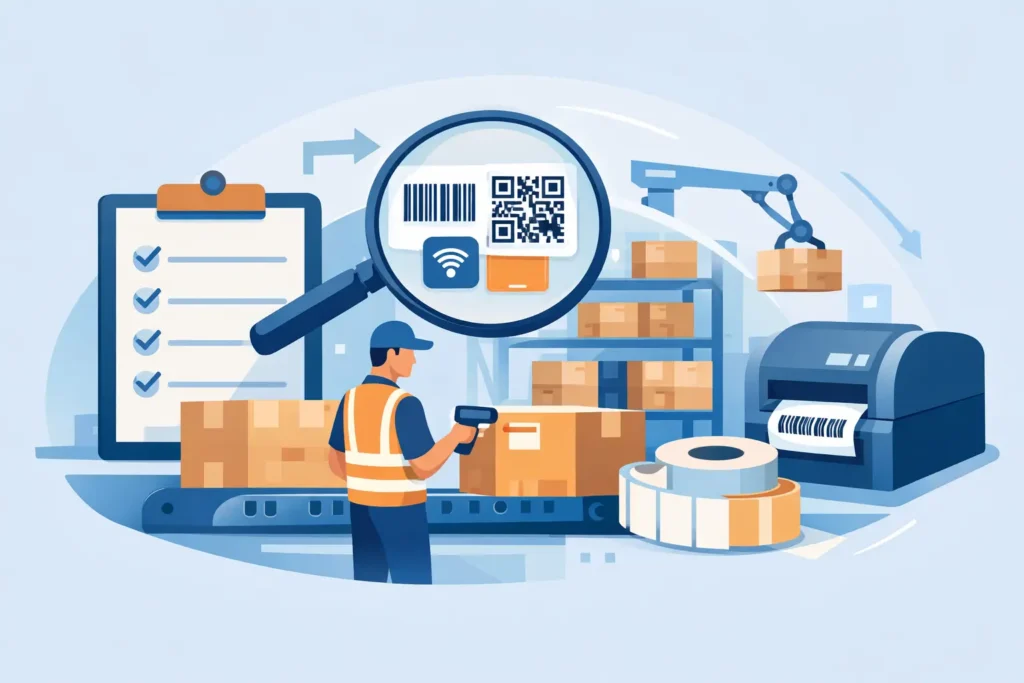
A warehouse usually tells you where labeling broke down before anyone says it out loud. Pick paths get slower. New hires ask more questions than they should. The same pallet gets relabeled twice. A barcode scans fine at receiving but fails at packing. If you are figuring out how to standardize warehouse labeling, the real goal is not prettier labels. It is building a system people can follow consistently across locations, shifts, and workflows.
Why warehouse labeling becomes inconsistent
Most labeling problems do not start with print quality. They start with decisions made at different times by different teams. Operations may create location signs one way, IT may define barcode data another way, and purchasing may source labels based on cost without knowing the application. Over time, the warehouse ends up with mixed label sizes, mixed naming conventions, and mixed durability levels.
That inconsistency creates more than visual clutter. It slows picking, increases training time, causes scan failures, and makes cycle counts less reliable. In a busy operation, even small differences matter. If one aisle uses large rack labels with human-readable text and another relies solely on small codes, the burden shifts to labor. People compensate for a labeling system that should have done the work for them.
Standardization fixes that by giving every label a job, a format, and a defined place in the workflow.
How to standardize warehouse labeling without creating new confusion
The best approach is to treat labeling as infrastructure, not an isolated supply purchase. That means defining what needs to be identified, how it should be identified, and what equipment and materials will support that standard over time.
Start with a warehouse-wide audit. This does not need to be overly complex, but it does need to be honest. Document every label type currently in use, including rack labels, bin labels, floor markers, pallet labels, product labels, shipping labels, overpack labels, and any temporary labels created on demand by teams. Note the size, material, adhesive, print method, barcode symbology, data structure, and actual placement in the facility.
At this stage, patterns usually appear quickly. You may find that receiving uses one naming logic while replenishment uses another. You may also find labels that are technically readable but operationally weak because they are too small, placed at poor scan angles, or printed on materials that fail in the presence of dust, cold storage, abrasion, or chemical exposure.
Once the current state is clear, define a labeling standard by application rather than trying to force a single label format everywhere. That trade-off matters. Total uniformity sounds efficient, but warehouses rarely run a single use case. A rack label has different visibility and durability requirements than a pallet label. A floor marker has different adhesive needs than a label applied to corrugated or shrink wrap. Standardization works when each category is consistent within its purpose.
Build a warehouse labeling standard that people can actually use
A workable standard has a few essential parts. The first is naming and location logic. Every aisle, row, rack, level, and bin should follow a clear structure that is easy to read and to train on. If location IDs are too long or inconsistent, errors increase. If they are too abbreviated, teams may invent their own shortcuts. The right structure depends on your layout, but it should be obvious, scalable, and documented.
The second is barcode standardization. Choose the symbology and data format that fit your WMS, ERP, scanners, and print environment. Many operations use Code 128 for its flexibility, while others rely on 2D barcodes when more data must fit in less space. The key is not choosing what is most advanced. It is choosing what scans reliably across your actual devices and workflows.
The third is visual consistency. Labels should use defined font sizes, text hierarchy, barcode placement, color usage, and quiet zones. Human-readable information still matters in warehouses, especially during exception handling, replenishment, and training. Teams should not need to guess which line is the location number and which barcode belongs to which field.
The fourth is material and print consistency. This is where many warehouse projects either hold up well or fail early. Paper labels may work for short-term pallet tracking or shipping, but they may not hold up on long-term rack identification or in harsher conditions. Synthetic materials, the right adhesive, and an appropriate ribbon-and-printer combination often make the difference between a label that lasts and one that becomes a maintenance problem.
Standardization depends on the full print system
A warehouse label standard is only as reliable as the system producing it. That includes printers, ribbons, printheads, software, and label stock. If departments use mismatched printer models or unsupported media, output quality will vary even when the template is correct.
This is why implementation needs to go beyond designing label artwork. Printer settings should be locked down where possible. Label templates should be version-controlled. Media specifications should be approved by application. If one site substitutes a cheaper stock label with a weaker adhesive, the standard starts to fracture.
It also helps to define which labels are printed on demand and which are preprinted. On-demand printing gives flexibility for variable data and fast operational updates, but it depends on proper software integration and user controls. Preprinted labels offer strong consistency for static location identification, but changes are slower and can create waste if warehouse layouts shift. Many operations need both.
For organizations with multiple warehouses, the challenge grows. A standard should accommodate site-specific realities without altering core data logic, barcode rules, or visual structure. That means a cold storage site may need different materials than a dry goods warehouse, but location labels should still follow the same naming convention and scan behavior.
How to standardize warehouse labeling across teams
Labeling projects often stall because ownership is scattered. Operations cares about speed. IT cares about systems compatibility. Procurement cares about sourcing and cost control. Safety and compliance may have their own requirements. Standardization moves faster when one team leads the framework, but all stakeholders approve the rules.
Create a documented label governance process. It does not need to be bureaucratic, but it should answer basic questions. Who approves a new label format? Who controls barcode data rules? Who tests material performance? Who manages template revisions? Without that structure, local workarounds reappear.
Training matters too, but not in the usual checkbox sense. Your teams need to know which labels can be created locally, which must follow a central template, and what to do when a label fails in the field. A standardized system should reduce improvisation, not rely on it.
This is also where an experienced labeling partner can be useful. Warehouses do not just need labels. They need compatibility between software, printers, media, scan requirements, and environmental conditions. Companies like PaladinID often support standardization projects by helping operations teams align materials and print systems with real warehouse demands rather than relying on generic assumptions.
Measure whether the standard is working
Standardization should show up in performance, not just documentation. After rollout, track scan success rates, relabeling frequency, pick accuracy, receiving exceptions, training time for new associates, and the volume of location-related errors. If those numbers do not improve, the standard may be technically correct but operationally weak.
It is also worth reviewing how labels age in the field. A label that scans on day one but curls, smudges, or fades after 60 days is not standardized in any meaningful sense. Warehouses are physical environments, and labeling systems need to withstand movement, abrasion, temperature fluctuations, and frequent handling.
There is always some balancing involved. The most durable material may cost more upfront. The most information-rich label may slow readability. The most rigid standard may frustrate teams if exceptions are common. Good warehouse labeling standards are disciplined, but they are not blind to how work actually happens.
If you want a practical benchmark, aim for this: a person new to the building should be able to understand location labels quickly, scanners should read barcodes consistently, replacement labels should match the original spec every time, and every warehouse team should know where the standard lives and how changes are made. That is what standardization looks like when it is working.
Warehouse labeling does not need to be complicated, but it does need to be intentional. When the label format, barcode structure, materials, printers, and workflow all support the same operating standard, the warehouse gets easier to run one scan at a time.
At PaladinID, we understand that every labeling application is different.
That’s why companies across the country trust us to help them identify the right solution for their business. With over 40 years of experience and one of the industry’s largest selections of labeling products, we make it easy to find the right fit for your operation. Whether you need stock products or a custom-built solution, our team is ready to help. Visit our online catalog, Email us, or call us today at 888.972.5234.
PaladinID delivers label solutions that stick!


Got Labeling Questions? Our AI Assistant Has Answers - Chat Now!
For more information on PaladinID
Get Help With Your Next Label Project
We have over 35 years of providing exceptional service and labeling products to the world. Take the first step to an easy, stress-free solution for your label needs by contacting us.
Schedule a call below or email [email protected]
Make Your Mark
“Making companies more competitive by offering the correct label printing solution, on time, within budget, while creating unmatched value”.
About PaladinID, LLC
PaladinID develops and supports high-performance barcode labeling applications. We work with our clients to “Make Your Mark” by providing the expertise and tools necessary to create an entire product label printing solution. Located in central New Hampshire, PaladinID has been serving Massachusetts, Vermont, Maine, Connecticut, Rhode Island, New England, and beyond for over 30 years, and in 2017, became an RFID-certified company. We look forward to working with you.
You may be interested in our other services:
Product Labels
Product Labels
Labels for every type of application: Blank, Pre-printed, Variable data
Label Printers
Label Printers
We sell and support: Direct/thermal transfer, Inkjet, Laser
Printer Ribbons
Printer Ribbons
We sell ribbons for ALL barcode printers including: Zebra, Datamax, Sato, Intermec
Flexible Packaging
Flexible Packaging
We offer a wide variety of packaging containers for your products.
Label Software
Label Software
Software for all barcode printing and product labeling.
Label applicators
Label Applicators
Wide selection of applicators: Desktop/Mobile, Applicator only, Print & apply
