
Choosing Inkjet Labels for the Chemical Industry


What Can We Help You With?
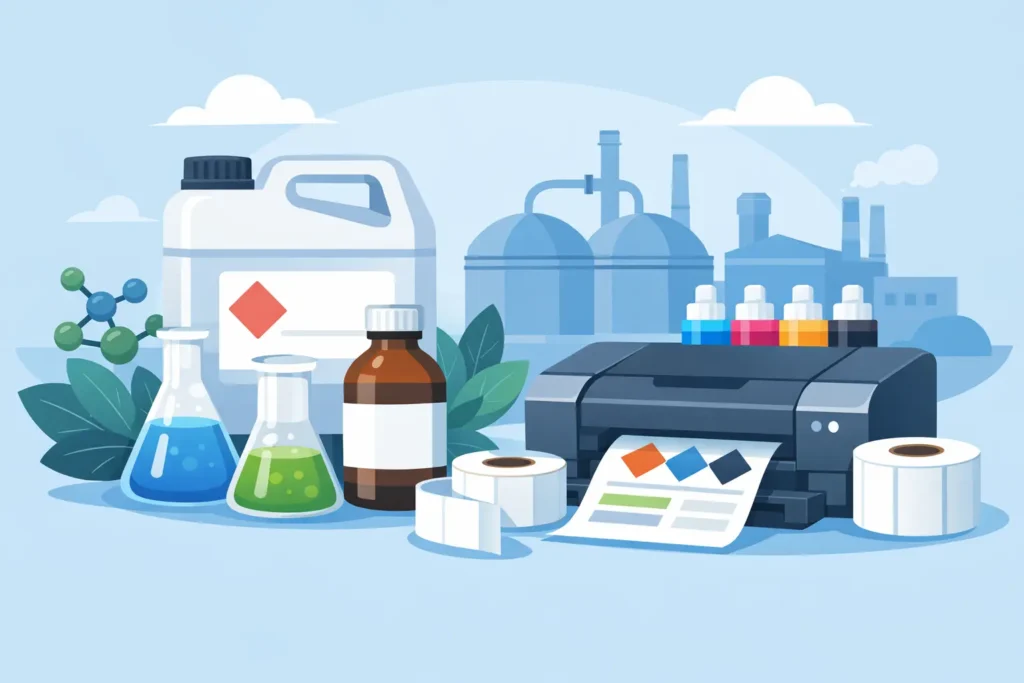
A chemical label can look acceptable when it leaves the printer and still fail where it matters most: after a drum is moved through a washdown area, a tote sits in outdoor storage, or a technician handles a container with solvent-contaminated gloves. Inkjet labels for the chemical industry must do more than carry variable information. They must preserve clear identification, hazard communication, traceability, and barcode scan performance throughout the product’s expected handling conditions.
For chemical manufacturers, blenders, contract packagers, and distributors, that requirement makes label selection a system decision. The label face stock, adhesive, ink, printer, artwork, data source, and application process all affect the result. Selecting only for print quality or only for initial cost can create relabeling work, compliance exposure, shipment delays, and avoidable inventory errors.
What Chemical Labeling Must Withstand
Chemical operations place labels under a different kind of pressure than typical office or retail applications. A label may encounter moisture, abrasion, temperature swings, ultraviolet exposure, oil, cleaning agents, and the very chemicals identified on the container. It may also need to remain readable on curved bottles, rigid pails, HDPE jugs, steel drums, or flexible packaging.
The first question is not simply whether an inkjet label is waterproof. It is which exposure conditions the finished label must survive. Water resistance may be enough for an indoor product stored in a controlled warehouse. It will not necessarily predict performance against alcohols, acids, alkalis, oils, or aggressive solvents. Similarly, an adhesive that bonds well to clean glass may fail on a textured plastic container, a dusty drum, or a package applied in a cold production area.
A practical evaluation begins with the full handling path: filling, curing time, warehouse storage, transport, customer use, and disposal. If the label must remain in place and legible for years, the material and print process need to be evaluated for that service life, not just for the first shipment.
When Inkjet Is the Right Fit
Inkjet printing is especially useful when chemical labeling requires high-resolution color, variable data, short-to-medium runs, or frequent artwork changes. It can produce sharp text, detailed graphics, color-coded product families, warning panels, batch information, and barcodes without maintaining large inventories of preprinted label versions.
This is valuable when a product line includes multiple formulations, package sizes, customer-specific private labels, or changing regulatory and shipping information. On-demand production can reduce obsolete inventory and give operations more control over version changes. For a manufacturer that needs different labels for a dozen blends across several container sizes, printing the current label at the point of use can be more efficient than ordering every possible combination in advance.
However, inkjet is not automatically the best answer for every chemical application. Thermal transfer printing may be the stronger choice for certain durable monochrome variable-data requirements, particularly where ribbon and label constructions are proven for the exposure. Preprinted flexographic labels may make sense for very high-volume, stable artwork. The right approach depends on run length, color needs, variable data, chemical exposure, container material, and required certifications.
Dye Ink Versus Pigment Ink
The ink chemistry matters as much as the label material. Dye-based inks are known for vivid color but can be more vulnerable to water, light, and chemical contact, depending on the media and protective construction. Pigment-based inks generally offer better resistance to moisture and fading, making them a more appropriate starting point for many industrial labeling applications.
That said, no ink should be selected in isolation. Pigment ink on an unsuitable paper stock is still an unsuitable chemical label. The label face material needs a compatible ink-receptive coating that holds detail without allowing the image to smear, bleed, or scuff during use. In harsher applications, a protective laminate or overprint layer may be necessary to shield the printed surface.
Build Inkjet Labels for the Chemical Industry as a Complete Construction
A durable label is a construction, not a single product. The face stock provides the printable surface and physical durability. The adhesive holds the label to the container. The ink and coating create the image. A laminate, when required, adds another level of protection. Each element must work with the others.
Synthetic film materials such as polypropylene, polyester, and vinyl are common starting points for applications where paper will not hold up. The best choice depends on the container and environment. Polypropylene can be a practical option for many bottles and containers because it is flexible and moisture resistant. Polyester is often selected where dimensional stability, high-temperature performance, or increased durability is required. Vinyl can conform well to some curved or irregular surfaces, though its suitability depends on the specific exposure and application requirements.
Adhesive selection deserves the same attention. Permanent acrylic adhesives are widely used, but the needed formulation changes with the surface and conditions. Low-surface-energy plastics such as HDPE and polypropylene can be difficult to label reliably. Cold-temperature application, outdoor exposure, moisture, rough surfaces, and container condensation also affect bond performance. A label applied to a clean, dry container at room temperature may behave very differently from one applied on a fast-paced line to a cold, slightly damp jug.
For applications involving marine transport or prolonged water exposure, buyers may also need to assess whether the finished label construction meets applicable durability standards, including BS 5609 requirements where relevant. That evaluation must cover the finished printed label, not merely a claim about the base material.
Keep GHS Content Clear and Controlled
Chemical labels often carry safety and compliance information that cannot be compromised by a poor layout or degraded print. Depending on the product and market, this may include product identifiers, supplier information, signal words, hazard statements, precautionary statements, pictograms, net quantity, and supplemental handling instructions.
Color inkjet printing can support clear GHS pictograms and visual hierarchy, but design discipline still matters. Pictograms must reproduce cleanly at the required size, small type must remain readable, and the label must provide enough contrast for fast recognition. A densely packed label may technically contain the required information while remaining difficult to use on the production floor or at the receiving dock.
Variable fields introduce another risk. Lot codes, manufacture dates, expiration dates, UN numbers, formulation codes, and customer-specific information should be controlled through approved templates and connected data sources. Manual entry may be appropriate for a low-volume exception process, but it is a weak foundation for routine production. Labeling software with role-based controls, approved formats, and database integration can reduce the chance that an operator prints a label with a correct design but incorrect data.
Barcode Quality Is an Operational Requirement
A barcode that prints but does not scan consistently is not a successful barcode. Chemical facilities rely on barcode identification for receiving, inventory moves, quality records, sample tracking, shipping, and customer traceability. Inkjet labels can produce high-quality barcodes, but print resolution, ink spread, substrate coating, barcode size, contrast, and scanner capability all affect read performance.
Test barcodes with the scanners used in the actual workflow. A code that scans with a smartphone or desktop scanner under ideal lighting may not perform the same way on a forklift-mounted device in a warehouse aisle. If labels will be exposed to abrasion or moisture, test after exposure as well. The goal is not simply to create a readable code at print time. It is to retain dependable scanning after normal handling.
Barcode design should also account for placement. A code wrapped around a tight-radius container, positioned across a seam, or placed where operators grip the package may become difficult to scan even when print quality is excellent. Label size and container geometry are part of the identification system.
Validate Before Full Production
The most reliable way to select a chemical label is to test the actual label on the actual package. Lab data and material specifications are useful, but they do not replace application testing. Run samples through the printer intended for production, apply them using the expected process, allow the adhesive to dwell, and expose them to representative conditions.
A practical test plan can include chemical splash or wipe exposure, water contact, temperature cycling, abrasion, UV exposure, freezer or cold-room storage, and barcode verification. Evaluate edge lift, adhesive transfer, image smearing, fading, laminate separation, and scan reliability. If the product is shipped in cases or pallets, include rub testing against corrugated packaging and normal transport handling.
Testing should also examine process consistency. A material that performs well only when a skilled operator applies it perfectly may not be the right choice for a high-throughput line. The best solution is one that produces repeatable results with the equipment, staff, and production conditions already in place.
Match the Printer and Workflow to the Job
Printer selection affects more than speed. It determines usable ink types, supported media, maximum print width, color capability, maintenance requirements, and integration options. Industrial inkjet systems may be appropriate for facilities producing a range of high-color labels on demand, while a mixed environment may require both inkjet and thermal transfer capabilities for different label classes.
Consider how labels will be created and released to production. Operators need a straightforward workflow for selecting the right approved template, pulling current product data, and printing the required quantity. IT and quality teams need confidence that templates are protected, changes are documented, and printer settings remain consistent. Procurement needs a reliable source for matched labels, inks, service, and replacement components.
That is why a complete labeling program is more effective than buying a printer and media separately. PaladinID helps organizations evaluate the complete application, from label materials and print technology to barcode requirements, software workflow, and ongoing supply support. This approach helps prevent a common failure point: components that perform individually but do not work reliably together.
The strongest chemical labeling decision is usually made at the intersection of compliance, durability, and daily usability. Start with the conditions your labels will actually face, validate the finished construction on real containers, and build a workflow that keeps every printed label accurate long after it leaves the production line.
At PaladinID, we understand that every labeling application is different.
That’s why companies across the country trust us to help them identify the right solution for their business. With over 40 years of experience and one of the industry’s largest selections of labeling products, we make it easy to find the right fit for your operation. Whether you need stock products or a custom-built solution, our team is ready to help. Visit our online catalog, Email us, or call us today at 888.972.5234.
PaladinID delivers label solutions that stick!

Got Labeling Questions? Our AI Assistant Has Answers - Chat Now!
For more information on PaladinID
Get Help With Your Next Label Project
We have over 35 years of providing exceptional service and labeling products to the world. Take the first step to an easy, stress-free solution for your label needs by contacting us.
Schedule a call below or email [email protected]
Make Your Mark
“Making companies more competitive by offering the correct label printing solution, on time, within budget, while creating unmatched value”.
About PaladinID, LLC
PaladinID develops and supports high-performance barcode labeling applications. We work with our clients to “Make Your Mark” by providing the expertise and tools necessary to create an entire product label printing solution. Located in central New Hampshire, PaladinID has been serving Massachusetts, Vermont, Maine, Connecticut, Rhode Island, New England, and beyond for over 30 years, and in 2017, became an RFID-certified company. We look forward to working with you.
You may be interested in our other services:
Product Labels
Product Labels
Labels for every type of application: Blank, Pre-printed, Variable data
Label Printers
Label Printers
We sell and support: Direct/thermal transfer, Inkjet, Laser
Printer Ribbons
Printer Ribbons
We sell ribbons for ALL barcode printers including: Zebra, Datamax, Sato, Intermec
Flexible Packaging
Flexible Packaging
We offer a wide variety of packaging containers for your products.
Label Software
Label Software
Software for all barcode printing and product labeling.
Label applicators
Label Applicators
Wide selection of applicators: Desktop/Mobile, Applicator only, Print & apply
