
Best Labels for Cold Storage That Stay Scannable




What Can We Help You With?
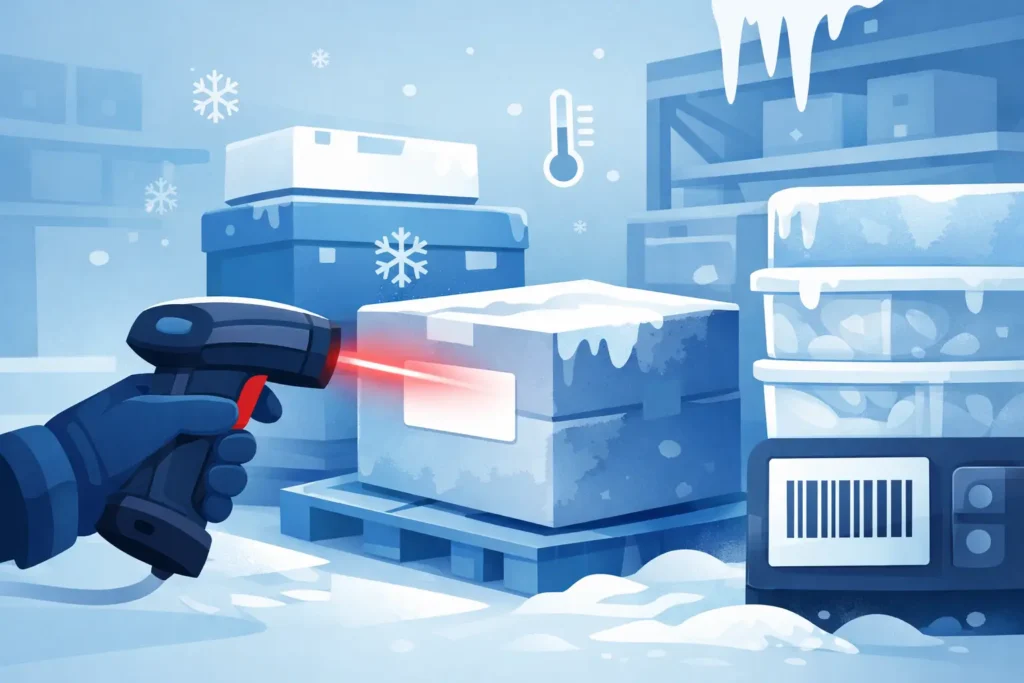
A barcode that scans perfectly at room temperature can become unreadable within hours of entering a freezer. Condensation can loosen adhesives, frost can cover printed information, and freezing temperatures can make label materials brittle or prevent adhesives from bonding properly.
Choosing the best labels for cold storage requires more than ordering something advertised as “freezer-grade.” You need to consider the entire labeling application, from the material and adhesive to the printing method and conditions where the label will be applied.
For warehouse, food processing, healthcare, life sciences, and distribution operations, dependable cold-storage labeling is essential for maintaining inventory accuracy and keeping receiving, picking, traceability, and compliance processes running smoothly.
The right combination of label material, adhesive, printing technology, and application process makes all the difference.
Why Cold Storage Labels Fail
Cold environments create several challenges for labels, and those challenges don’t always happen at the same time.
A label might be applied at room temperature before a product enters a freezer. It could be applied directly to a refrigerated carton, or it may need to stick to packaging already covered in frost, moisture, or condensation.
Each situation requires a different label construction.
Adhesive performance is often the first problem. Standard permanent adhesives can lose tack at low temperatures, become too rigid to conform to a surface, or fail to bond properly when applied to a cold package.
Wet corrugated cases can be particularly challenging because moisture weakens the bond between the adhesive and the carton fibers.
Print durability is another concern. Thermal transfer printing can smear, fade, or scratch when the ribbon and label face stock aren’t properly matched. Direct thermal labels can work well for short-term refrigerated applications, but their heat-sensitive images may darken, fade, or become difficult to scan depending on handling conditions and exposure.
Finally, the packaging surface itself matters.
Plastic bags, shrink wrap, corrugated cases, reusable totes, glass containers, and metal racks all have different surface-energy and texture characteristics. A label that performs well on a dry, smooth plastic bag may not stay attached to a rough, damp corrugated carton.
Best Labels for Cold Storage by Application
There isn’t one label material that works best for every cooler, freezer, or blast-freezing application.
The right choice depends on when the label is applied, the temperatures it will experience, the surface being labeled, and how long the identification needs to remain readable.
Freezer Labels for Dry, Room-Temperature Application
When labels are applied to clean, dry packaging before products enter cold storage, a durable paper or synthetic label with a freezer-capable permanent adhesive is often a practical choice.
These label constructions are designed to maintain adhesion after products are moved into refrigerated or frozen environments.
This approach works well for many carton, case, and inventory identification applications. It also offers a wider selection of printable materials and can be more cost-effective than specialized wet-application products.
However, application temperature is an important limitation. A label designed to survive temperatures of -20°F may still need to be applied at a much warmer temperature to form a proper bond.
Cold-Temperature Labels for Refrigerated Products
For products stored in coolers rather than deep freezers, labels with cold-temperature acrylic adhesives are commonly used.
These adhesives can handle refrigerated temperatures and short periods of moisture exposure while supporting dependable barcode printing.
They are often suitable for:
- Produce.
- Dairy products.
- Beverages.
- Pharmaceutical products.
- Laboratory applications.
- Refrigerated distribution.
However, cooler environments aren’t automatically easy environments for labels. Repeated condensation cycles can be more demanding than steady, dry freezer storage, especially on plastic containers and waxed or coated corrugated packaging.
Wet-Application Freezer Labels
If labels need to be applied to packaging that is damp, chilled, or lightly frosted, a standard freezer label may not be enough.
These applications require adhesives specifically engineered for wet and cold application. More aggressive adhesive formulations are designed to bond at lower application temperatures and perform better on moisture-affected surfaces.
This is one of the most important differences to understand when selecting cold-storage labels.
A standard freezer label may remain attached after freezing but fail immediately when applied to a case fresh from a cooler.
Operations that apply labels in receiving areas, processing lines, or cold rooms should specify both the minimum application temperature and the in-service temperature range.
Synthetic Labels for High Handling and Long Life
Polypropylene, polyester, and other synthetic face stocks are typically better choices when labels must withstand abrasion, moisture, chemical exposure, repeated handling, or long-term storage.
They’re especially useful for:
- Reusable totes.
- Freezer racks.
- Plastic bins.
- Pallets.
- Laboratory containers.
- Assets that move between cold storage and ambient environments.
Synthetic labels generally cost more than paper alternatives, but they can reduce relabeling, picking errors, and barcode scanning failures.
For permanent asset identification, the higher upfront cost is often justified. A durable synthetic material should also be paired with an appropriate thermal transfer ribbon to help keep the printed image readable through handling and temperature changes.
Match the Adhesive to Application Temperature
The temperature at which a label is applied deserves just as much attention as the temperature at which it will be stored.
Procurement specifications often focus on freezer performance while overlooking this important distinction.
Before selecting an adhesive, ask three questions:
- What is the surface temperature when the label is applied?
- Is the surface dry, damp, or covered in frost?
- What is the lowest temperature the labeled item will experience?
The answers help determine whether a standard permanent, cold-temperature, freezer, or wet-application adhesive is appropriate.
Allow sufficient dwell time whenever the process permits. Adhesives need time and pressure to develop a proper bond, particularly on corrugated cases.
Labeling a dry case at ambient temperature and allowing the adhesive to set before freezing generally produces better results than applying the same label to a cold case at the loading dock.
Surface preparation is equally important. Dust, oil, ice, loose carton fibers, and excessive moisture can interfere with even an aggressive adhesive.
Whenever possible, standardize the labeling point before products reach the coldest part of the workflow.
Choose a Print Method That Protects Barcode Quality
Thermal transfer printing is usually the preferred method for cold-storage labels that require durable barcodes, variable data, lot numbers, expiration dates, or long-term traceability.
The printer ribbon transfers a durable image onto the label, and the ribbon formulation can be selected to match the label material and expected handling conditions.
Different ribbon types offer different levels of performance:
- Wax ribbons: An economical option for general paper labeling.
- Wax-resin ribbons: May be needed when greater smudge, scratch, or moisture resistance is required.
- Resin ribbons: Frequently used with synthetic labels when image durability is critical.
The best combination depends on the label material and performance requirements—not simply the price of the ribbon.
Direct thermal labels can also be effective for short-life applications, such as rapid inventory movement within a refrigerated facility. They eliminate the need for ribbon and simplify supply management.
However, they should be tested carefully if labels will experience significant friction, extended storage periods, direct sunlight during transportation, or heat exposure after leaving cold storage.
Printer settings are another important part of the system. Print darkness, speed, printhead condition, and label calibration all affect barcode contrast and scanning performance.
Even the right label material cannot compensate for a worn printhead or an incorrect ribbon setting.
Test Cold Storage Labels in the Actual Workflow
Product specifications and laboratory testing are useful, but real-world testing is where a cold-storage labeling system proves its performance.
Test potential label materials on the actual packaging, using the real printer, ribbon, barcode symbology, and handling process.
Include the temperature transitions that commonly cause problems:
- Moving products from ambient temperatures into refrigerated storage.
- Moving products from a freezer to a loading dock.
- Moving products from cold storage into delivery environments.
A practical test should evaluate:
- Adhesion during application.
- Adhesion after temperature cycling.
- Print legibility.
- Barcode scan rates.
- Abrasion resistance.
- Removal performance, if labels must eventually be removed from reusable containers.
Check labels at the expected end of their service life, not just immediately after application.
It’s also important to involve the employees who receive, print, pick, and scan the labels. They’ll often identify problems that a specification sheet cannot reveal, such as labels peeling at carton corners, printers struggling with liner release, or scanning failures caused by glare on glossy film.
Build a Complete Cold-Storage Labeling System
The most reliable cold-storage labeling programs connect every material and piece of equipment to the broader workflow.
Label dimensions must accommodate available package space and barcode requirements. Printer capabilities must match the label stock and production volume. Ribbon selection must support the chosen face stock, while labeling software and data integration must ensure product, lot, date, and location information is accurate every time.
This systems-based approach is especially valuable for operations using multiple storage zones or packaging types.
A dry warehouse pallet label, freezer case label, and reusable tote label may all require different constructions, even when they carry related inventory information.
Standardizing where possible while maintaining application-specific performance helps reduce complexity without introducing weak points into the labeling process.
PaladinID helps organizations evaluate these connected requirements, from label and adhesive selection to printers, ribbons, barcode quality, and implementation support.
The goal isn’t simply to find a label that sticks for one shipment. It’s to build a dependable identification process that performs under real warehouse conditions.
Before committing to a large order, define the coldest temperature, application temperature, packaging surface, required label life, and expected handling conditions.
A small, controlled trial based on these factors can prevent widespread relabeling and protect the barcode accuracy your operation depends on.
Find the Right Cold-Storage Labeling Solution
Cold-storage environments put labels through demanding conditions, but the right combination of materials, adhesives, and printing technology can help maintain reliable identification from the warehouse to the freezer and beyond.
WE DON’T JUST SELL LABELS. WE SOLVE LABELING PROBLEMS.


Got Labeling Questions? Our AI Assistant Has Answers - Chat Now!
For more information on PaladinID
Get Help With Your Next Label Project
We have over 35 years of providing exceptional service and labeling products to the world. Take the first step to an easy, stress-free solution for your label needs by contacting us.
Schedule a call below or email [email protected]
Make Your Mark
“Making companies more competitive by offering the correct label printing solution, on time, within budget, while creating unmatched value”.
About PaladinID, LLC
PaladinID develops and supports high-performance barcode labeling applications. We work with our clients to “Make Your Mark” by providing the expertise and tools necessary to create an entire product label printing solution. Located in central New Hampshire, PaladinID has been serving Massachusetts, Vermont, Maine, Connecticut, Rhode Island, New England, and beyond for over 30 years, and in 2017, became an RFID-certified company. We look forward to working with you.
You may be interested in our other services:
Product Labels
Product Labels
Labels for every type of application: Blank, Pre-printed, Variable data
Label Printers
Label Printers
We sell and support: Direct/thermal transfer, Inkjet, Laser
Printer Ribbons
Printer Ribbons
We sell ribbons for ALL barcode printers including: Zebra, Datamax, Sato, Intermec
Flexible Packaging
Flexible Packaging
We offer a wide variety of packaging containers for your products.
Label Software
Label Software
Software for all barcode printing and product labeling.
Label applicators
Label Applicators
Wide selection of applicators: Desktop/Mobile, Applicator only, Print & apply
