
Inkjet Labels for the Food Industry That Perform


What Can We Help You With?
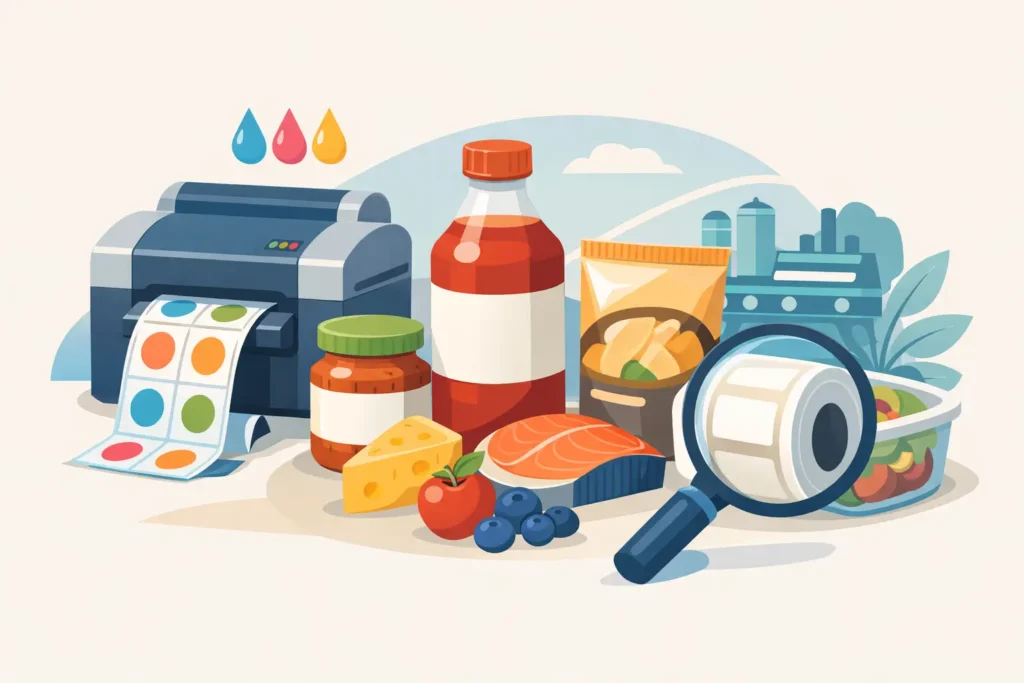
A food label can look perfect when it leaves the production line and still fail before the customer even opens the package.
Condensation in refrigerated displays, oil on containers, freezer storage, frequent handling, and transportation can all affect label adhesion, print quality, and barcode readability.
That’s why choosing inkjet labels for the food industry requires more than finding the right size or appearance. Your labels need to be designed around the entire packaging and production environment to ensure they perform long after printing.
For food manufacturers and packaging teams, the goal is straightforward: produce clear, consistent labels that strengthen brand presentation, communicate required product information, scan reliably, and stay securely attached throughout distribution.
Achieving that requires selecting the right combination of label material, adhesive, ink technology, finishing method, and application process.
Start With the Actual Food Packaging Environment
Before choosing a glossy, matte, or full-color label, consider one important question: Where will the package go after it’s labeled?
A dry, shelf-stable snack pouch has very different labeling requirements from a prepared-food container stored under refrigeration or a frozen product that encounters moisture as it thaws.
Temperature exposure is important at every stage, including:
- Label application
- Product storage
- Transportation and shipping
- Retail display
- Consumer use
For example, an adhesive that performs well on a clean, room-temperature bottle may not bond consistently when applied to a cold container with surface moisture.
Similarly, a paper face stock may be perfectly suitable for dry goods but can wrinkle, stain, or lose its appearance in high-humidity environments.
The packaging material itself also plays a major role.
Glass, polyethylene, polypropylene, PET, corrugated cases, flexible film, and textured containers all present different bonding surfaces. Curved containers create additional challenges because they place stress on the label, particularly when the label is large or the package diameter is small.
The best approach is to test the complete material and adhesive combination on the actual packaging surface and at the real application temperature before committing to full-scale production.
Inkjet Labels for the Food Industry Need the Right Construction
Not all inkjet labels are created equal. An inkjet label is made up of three primary components: a printable face stock, an adhesive, and a release liner.
Each component affects how the label prints, dispenses, applies, and performs once it reaches the package.
Choosing the right construction is essential for achieving consistent results throughout your operation.
Face Stock and Ink Compatibility
Inkjet-printable coatings are specifically designed to receive ink in a controlled manner.
The coating influences several important performance factors, including:
- Color density and reproduction
- Fine-detail printing
- Ink drying time
- Rub resistance
- Sharp edges for small text and machine-readable codes
Using uncoated materials or materials designed for a different printing process can lead to poor ink absorption, smudging, or weak barcode quality.
Paper remains a practical and cost-effective choice for many dry packaged foods, promotional labels, short-duration applications, and carton identification.
Film materials, such as polypropylene and polyester, are often better suited to applications involving moisture, condensation, or a greater need for tear resistance.
The right choice depends on the package, the expected lifespan of the label, and the desired appearance.
It’s important to remember that a premium film isn’t automatically the best solution. If a quality paper stock meets the application’s requirements, it may provide a lower total cost without sacrificing performance.
Ink chemistry also deserves attention.
Water-based dye inks can produce vibrant colors but may offer limited moisture resistance without a suitable label material or protective finish.
Pigment inks generally provide better resistance to water and fading, although performance still depends on the printer, coating, and intended application.
UV inkjet systems can produce durable print results on appropriate materials, but they require equipment and label constructions specifically designed for that printing process.
Adhesive Selection Is an Operational Decision
The adhesive determines whether your label stays where it belongs.
General-purpose permanent adhesives work well for many clean, dry packaging surfaces. However, applications involving refrigeration, freezer storage, damp containers, recycled-content packaging, or low-surface-energy films may require a specialty adhesive.
Cold-temperature adhesives deserve particular attention.
It’s not just about whether a label can survive inside a freezer. The temperature at which the label is applied is often the more important specification.
If your production line applies labels to containers that have already been chilled, the adhesive must be capable of forming a bond at that temperature.
Applying a standard adhesive to a cold surface and assuming it will strengthen later can result in edge lifting, label loss, and unnecessary rework.
Removable adhesives can also be useful for temporary production labels, meal-kit fulfillment, and short-term traceability applications.
However, they shouldn’t automatically be considered suitable for consumer-facing packaging without testing. Removal performance can change depending on the surface, temperature, time, and exposure to moisture or oils.
Finishes Protect the Printed Message
A varnish, laminate, or other protective finish can help improve resistance to scuffing, moisture, and repeated handling.
This is especially valuable for food labels on products handled in refrigerated retail environments or throughout fulfillment and distribution.
Protective finishes can also help preserve the appearance of color graphics and maintain the readability of variable data.
However, there are trade-offs to consider.
Additional protection may increase costs, affect recyclability considerations, change the package’s look and feel, or introduce extra production steps.
For labels exposed only to normal dry handling, an additional finish may not be necessary. For labels exposed to abrasion, condensation, or frequent contact, it can prevent avoidable quality issues.
Build for Variable Data and Traceability
Food labeling involves much more than displaying a company’s logo and product name.
Many food operations need to include variable information such as:
- Lot codes
- Production dates
- Use-by dates
- Ingredients
- Nutrition panels
- UPCs
- QR codes
- Internal batch information
- Shipping data
Inkjet technology can support high-quality variable-content printing, but the workflow must control the information just as carefully as it controls print quality.
Small text and barcodes should be tested at the intended print resolution and speed.
A barcode that looks sharp to the naked eye may not meet scanner requirements once ink spread, package curvature, or protective coatings are taken into account.
Contrast is particularly important for UPC and other retail scanning applications. Dark bars against a light, nonreflective background remain a reliable starting point.
Version control is equally important.
Food labels frequently change because of formulation updates, retailer requirements, seasonal packaging, or regulatory reviews.
A managed labeling workflow helps ensure the correct approved artwork and current product information are being used on the production line. This reduces the risk of costly mislabeling, product holds, and manual correction work.
For on-demand printing, printer capabilities, label software, database connectivity, and operator procedures should all be considered together.
Even a capable printer cannot prevent an incorrect lot date if data entry and approval controls are inadequate.
Likewise, well-managed data won’t solve a printing problem caused by label stock that’s incompatible with the printer’s ink system.
Do Not Treat Food Contact as an Assumption
A label applied to the outside of a sealed package is very different from a material intended for direct contact with food.
That distinction affects the materials, inks, adhesives, and compliance documentation required for the application.
Procurement and quality teams should clearly identify how each label will be used:
- Primary packaging
- Secondary packaging
- Shipping cases
- Production environments where incidental food contact is possible
They should also determine whether migration concerns, retailer specifications, or internal quality standards apply.
Once these requirements are established, material suppliers can provide relevant technical documentation for the intended use.
This is where general descriptions such as “food safe” aren’t enough.
Compliance depends on the complete label construction and how it’s used. Always confirm the intended application with qualified material and packaging partners rather than assuming requirements from one product line automatically apply to another.
Test the Full Process Before Scaling
A label that looks great on a desk is only the beginning.
Before committing to full production, test the label throughout the actual packaging workflow.
That means evaluating its performance during:
- Printing
- Curing or drying
- Dispensing
- Application
- Packing
- Cold storage
- Shipping
- Retail handling
- Barcode scanning
Whenever possible, test multiple lots of packaging materials. Even small differences in surface construction can affect adhesive performance.
Your evaluation should include:
- Label placement consistency
- Edge lifting
- Print rub resistance
- Moisture exposure
- Legibility of required text
- Barcode scan results
- Performance after reaching the expected storage temperature
If labels are applied automatically, testing should take place at normal production speeds rather than only during a slower setup run.
Documenting the approved label construction, printer settings, artwork version, and application conditions creates a repeatable standard for your operation.
It also makes troubleshooting much easier when a new packaging material, printer, or product format is introduced.
Choose a Partner That Understands the Whole System
The most reliable food labeling programs consider how packaging, consumables, printing equipment, variable data, and production employees all work together.
Purchasing labels separately from the printer, software, and overall workflow can create gaps that may not become apparent until production is already under pressure.
PaladinID helps organizations evaluate these connected requirements, from label materials and print compatibility to barcode performance and long-term supply continuity.
The right labeling solution isn’t simply the one that looks best when it comes off the printer. It’s the one that keeps product information clear, accurate, and dependable from the production floor all the way into the consumer’s hands.
Looking for the Right Inkjet Labeling Solution for Your Food Products?
At PaladinID, we bring more than 35 years of labeling experience to businesses looking for reliable, application-specific labeling solutions.
Whether you need custom inkjet labels, specialized adhesives, durable materials, or help improving your existing labeling process, we’re here to help you find the right fit for your products and production environment.
PaladinID — Make Your Mark.


Got Labeling Questions? Our AI Assistant Has Answers - Chat Now!
For more information on PaladinID
Get Help With Your Next Label Project
We have over 35 years of providing exceptional service and labeling products to the world. Take the first step to an easy, stress-free solution for your label needs by contacting us.
Schedule a call below or email [email protected]
Make Your Mark
“Making companies more competitive by offering the correct label printing solution, on time, within budget, while creating unmatched value”.
About PaladinID, LLC
PaladinID develops and supports high-performance barcode labeling applications. We work with our clients to “Make Your Mark” by providing the expertise and tools necessary to create an entire product label printing solution. Located in central New Hampshire, PaladinID has been serving Massachusetts, Vermont, Maine, Connecticut, Rhode Island, New England, and beyond for over 30 years, and in 2017, became an RFID-certified company. We look forward to working with you.
You may be interested in our other services:
Product Labels
Product Labels
Labels for every type of application: Blank, Pre-printed, Variable data
Label Printers
Label Printers
We sell and support: Direct/thermal transfer, Inkjet, Laser
Printer Ribbons
Printer Ribbons
We sell ribbons for ALL barcode printers including: Zebra, Datamax, Sato, Intermec
Flexible Packaging
Flexible Packaging
We offer a wide variety of packaging containers for your products.
Label Software
Label Software
Software for all barcode printing and product labeling.
Label applicators
Label Applicators
Wide selection of applicators: Desktop/Mobile, Applicator only, Print & apply
