
8000T Void Gloss Labels for Tamper Evidence




What Can We Help You With?
toA tamper-evident label is only effective if an attempted removal is immediately noticeable—and the printed information remains readable under real-world handling conditions.
That’s why 8000T void gloss needs to be evaluated for more than its appearance. Operations teams need to understand how the material performs on the actual surface, what evidence it leaves behind when removed, and whether the print, adhesive, and application process support reliable identification.
For asset tags, warranty seals, electronics, regulated products, and controlled inventory, a label can be an important part of the security and identification process. A glossy, tamper-evident construction may be the right solution, but only when it matches the application environment, printer technology, ribbon, and expected service life.
So, what should you consider before choosing 8000T void gloss? Let’s look at where it adds value, how to evaluate its performance, and what to test before putting it into use.
What 8000T Void Gloss Is Designed to Address
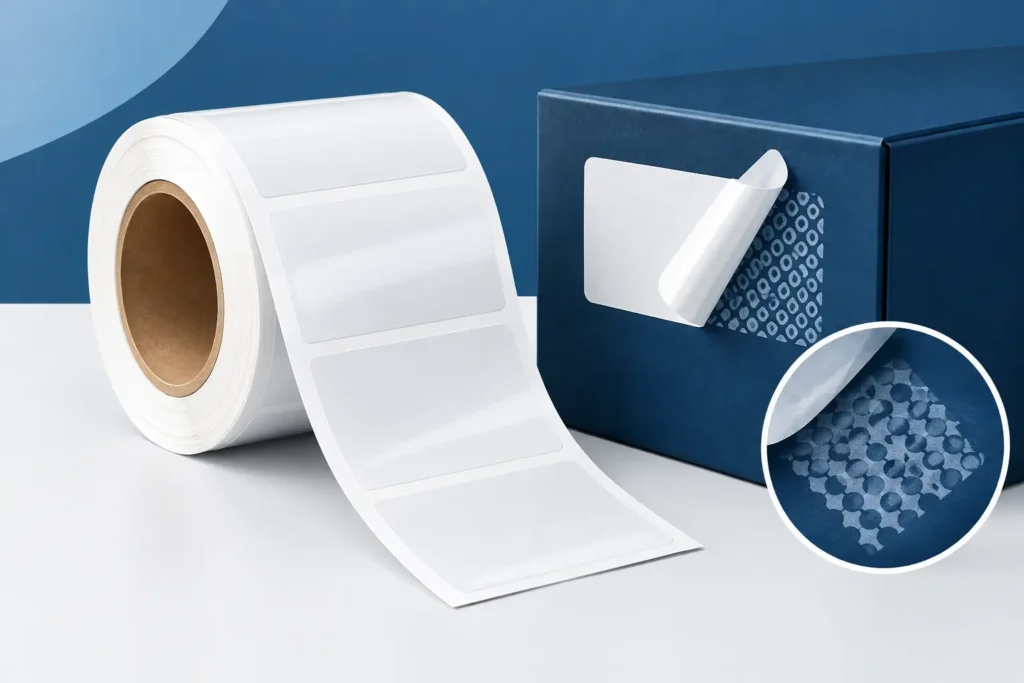
8000T void gloss generally refers to a glossy tamper-evident label material designed to reveal a visible VOID message or pattern when someone attempts to remove it.
Depending on the specific construction, the message may remain on the labeled surface, appear in the label’s face stock, or leave evidence in both places. The objective isn’t necessarily to make the label impossible to remove. It’s to make removal difficult to conceal.
That distinction matters. Tamper evidence can support inspection, accountability, and chain-of-custody controls, but it doesn’t replace physical security, access controls, serialized records, or a documented investigation process. Someone may still remove a label, cover it, or damage the item. The advantage is that the original seal should no longer appear intact.
The gloss finish can also provide a clean, professional appearance for applications where presentation matters. Product teams may use glossy labels on housings, cartons, instruments, or high-value components that need identification as well as a security feature.
However, gloss alone doesn’t determine durability. Chemical exposure, abrasion, heat, moisture, and surface texture can all affect label performance.
Because product names and material designations can vary by manufacturer, buyers should confirm the exact 8000T void gloss construction in the relevant technical documentation. Don’t assume adhesive type, temperature rating, substrate compatibility, or printing method based on the name alone.
Where Void Gloss Labels Add Operational Value
Tamper-evident labels are most useful when their condition communicates something meaningful about a product, asset, or process.
For example:
- Electronics and warranty seals: A label on an electronics enclosure can indicate whether the housing has been opened.
- Serialized assets: A tamper-evident asset label can reveal an attempt to transfer, replace, or alter an identification tag.
- Calibration-sensitive devices: A seal can provide a visual cue that a device may require further inspection.
- Pharmaceutical packages and controlled kits: A label can help receiving personnel identify packages that may have been opened or altered.
- Returned products: A visible VOID pattern can help flag an item for additional inspection before it reenters inventory.
In warehouse and manufacturing environments, this evidence can reduce uncertainty. Without a tamper-evident feature, a missing or damaged label might be attributed to normal wear, a rework error, or routine handling. A visible VOID pattern provides a clearer reason to investigate.
Instead of relying on assumptions, the team can follow a defined exception process.
But the label must be applied in a way that supports its intended purpose. A label placed across a carton flap can help indicate whether the package has been opened. The same label placed on a broad, flat carton panel may provide no sealing function at all.
Likewise, a label applied over a service-panel seam can indicate possible access to an asset. Applied beside the seam, it may simply identify the unit.
The placement decision is just as important as the material selection.
Evaluate the Surface Before Selecting 8000T Void Gloss
The surface a tamper-evident label contacts can significantly affect its performance.
A clean, smooth, high-surface-energy substrate may produce a very different result from rough powder coating, textured plastic, corrugated fiberboard, oily metal, or low-surface-energy polyethylene.
The first question is whether the adhesive can establish a sufficient bond before anyone attempts removal. If the label lifts too easily, it may fail to create the intended evidence.
On the other hand, if the adhesive bonds aggressively to a fragile finish, removal may damage the product surface or leave residue that’s unacceptable for the application.
There isn’t one universally correct level of adhesion. The right balance depends on whether the label is intended to remain permanently, whether the asset may be refurbished, and what the organization considers acceptable evidence of removal.
Surface preparation matters, too. Dust, release agents, oil, moisture, and cleaning chemicals can interfere with adhesion. A label that performs well during a controlled sample test may behave differently on a production line where parts have been handled, stored in cold conditions, or exposed to machining fluids.
Test the label on actual parts—not just representative material samples.
Include the oldest, dirtiest, most textured, and otherwise most challenging surfaces likely to be encountered. Allow the adhesive to dwell for the planned period, then test removal at normal and elevated operating temperatures.
Document what remains on the substrate, what appears on the label, and whether the evidence is clear enough for an inspector to recognize.
Consider the Full Service Environment
A label may need to withstand shipping, cleaning, outdoor storage, repeated handling, or contact with oils and solvents before its tamper-evident feature is ever evaluated.
In these situations, the question isn’t simply whether the label sticks on day one. It’s whether the label remains readable and intact until the security event it’s designed to reveal.
Temperature is especially important. Application temperature and service temperature are not the same. A label applied in a warm production area may later be stored in a freezer, loaded into a hot trailer, or installed near a heat-generating component.
Adhesive performance can change substantially across these conditions. Evaluate the full temperature range the label will experience, not just the conditions present during application.
Printing 8000T Void Gloss for Reliable Identification
Barcodes, serial numbers, lot codes, and inspection data often provide the information that gives the VOID evidence its operational meaning. If a barcode becomes unreadable or variable data smears, the label may no longer support reliable tracking.
Start by confirming that the selected label construction is suitable for your planned printing technology.
Many glossy, durable label materials are used with thermal transfer printing, but the appropriate ribbon depends on the face stock, required print density, and expected exposure conditions. A ribbon that produces an attractive black image in the printer may not provide enough resistance to abrasion, chemicals, or repeated scanning in the field.
Printer condition and settings also affect results. Printhead condition, darkness settings, printing speed, and label sensor calibration all need attention.
- Too much heat can cause distorted barcodes, reduced edge definition, or material damage.
- Too little heat can produce faint print and poor scanning performance.
The goal is a stable print setting that produces crisp, readable variable data without applying more heat than the material requires.
Verification should go beyond a visual inspection. Scan the barcode using the scanners deployed on the warehouse floor. Inspect small text, serialized fields, and 2D codes after rubbing, handling, and any relevant cleaning exposure.
If the label will be read under warehouse lighting or with a mobile device, test it under those conditions as well.
Build the Label Into the Process, Not Around It
One common mistake is treating a tamper-evident label as a purchasing item rather than a controlled part of the workflow.
The label needs a clearly defined role:
- Who applies it?
- Where should it be placed?
- What information must be printed?
- How long must it remain intact?
- What should happen when the VOID feature is observed?
For serialized assets, label application should be tied to the asset record before the unit enters service.
When it comes to warranty seals, the process should specify whether removal affects coverage, who can authorize removal, and how approved service work is documented.
For shipping seals or controlled inventory, receiving teams need clear instructions on what to inspect and how to quarantine a questionable item.
Consistency is essential to reliable tamper evidence.
If one shift applies labels across seams while another places them on flat surfaces, the organization may see inconsistent results. If technicians replace damaged labels without documenting the original serial number, the identification trail can break.
Standard work instructions, sample images, and practical training are often more valuable than adding unnecessary complexity to the label design.
Questions to Answer Before Ordering
Before committing to 8000T void gloss, define the requirements of the application. Choosing the right construction starts with understanding the label’s intended job and the conditions it must withstand.
Establish the following:
- Label dimensions: What size is required for the available application area?
- Application surface: What material and surface condition will the label contact?
- Service environment: Will it encounter heat, cold, moisture, chemicals, abrasion, or outdoor exposure?
- Expected service life: How long must the label remain readable and intact?
- Printing method: Which printer technology and ribbon will be used?
- Variable data requirements: Will the label carry barcodes, serial numbers, lot codes, or other identification data?
- Removal evidence: What exactly should an inspector see after someone attempts to remove the label?
- Compliance and quality requirements: Must the label meet internal quality procedures, customer requirements, or industry-specific controls?
Whenever possible, request samples that represent the intended production setup.
Test labels using the planned printer and ribbon, on actual parts, with the employees and procedures that will apply them. A controlled trial can uncover issues with label placement, print settings, peel force, or scanner performance before they become ongoing operational problems.
PaladinID helps organizations evaluate labels as part of a complete identification system, including compatible printer and ribbon choices, barcode requirements, and application conditions. This approach helps reduce the risk of solving a tamper-evidence problem while creating a printing or workflow problem elsewhere.
The right void label should make attempted removal easy to recognize without making normal operations harder. When the material, print system, placement, and inspection process work together, tamper evidence becomes a practical control your team can trust.
Need help finding the right labeling solution?
PaladinID helps businesses solve labeling challenges with application-focused guidance on custom labels, printers, ribbons, and complete labeling solutions.
When others say “impossible,” we look closer.
Contact PaladinID to discuss your labeling needs and find a solution that works for your application.


Got Labeling Questions? Our AI Assistant Has Answers - Chat Now!
For more information on PaladinID
Get Help With Your Next Label Project
We have over 35 years of providing exceptional service and labeling products to the world. Take the first step to an easy, stress-free solution for your label needs by contacting us.
Schedule a call below or email [email protected]
Make Your Mark
“Making companies more competitive by offering the correct label printing solution, on time, within budget, while creating unmatched value”.
About PaladinID, LLC
PaladinID develops and supports high-performance barcode labeling applications. We work with our clients to “Make Your Mark” by providing the expertise and tools necessary to create an entire product label printing solution. Located in central New Hampshire, PaladinID has been serving Massachusetts, Vermont, Maine, Connecticut, Rhode Island, New England, and beyond for over 30 years, and in 2017, became an RFID-certified company. We look forward to working with you.
You may be interested in our other services:
Product Labels
Product Labels
Labels for every type of application: Blank, Pre-printed, Variable data
Label Printers
Label Printers
We sell and support: Direct/thermal transfer, Inkjet, Laser
Printer Ribbons
Printer Ribbons
We sell ribbons for ALL barcode printers including: Zebra, Datamax, Sato, Intermec
Flexible Packaging
Flexible Packaging
We offer a wide variety of packaging containers for your products.
Label Software
Label Software
Software for all barcode printing and product labeling.
Label applicators
Label Applicators
Wide selection of applicators: Desktop/Mobile, Applicator only, Print & apply
