
What Labels Withstand Chemicals in Industry?


What Can We Help You With?
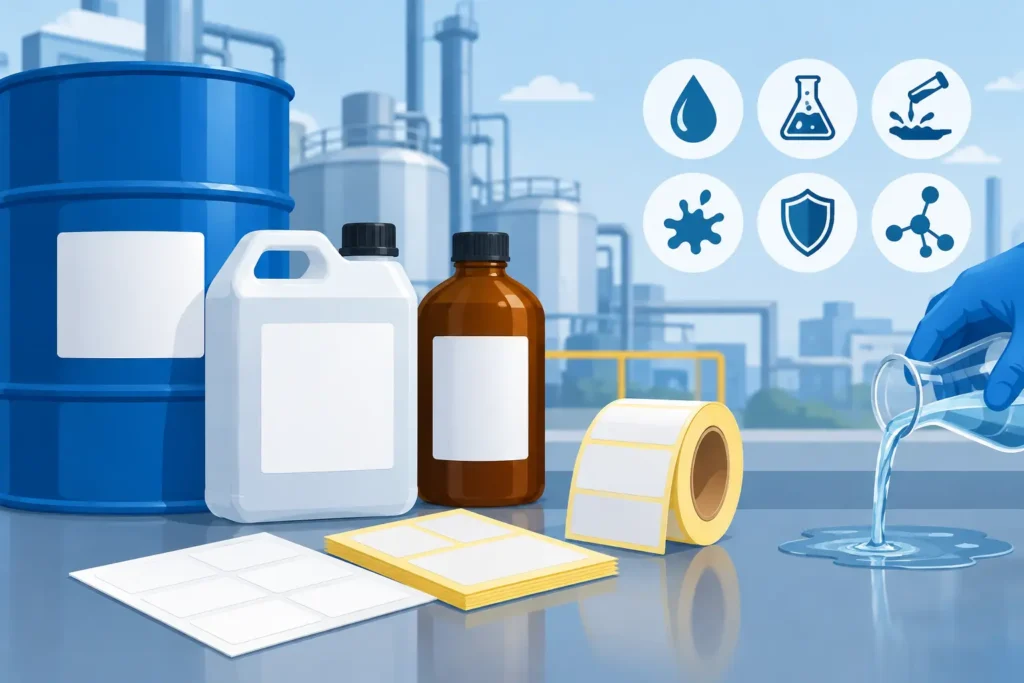
A label can look perfectly acceptable when it leaves the printer and still fail before the product reaches its destination. A solvent wipe can erase variable data. A washdown cycle can lift an edge. Oil, fuel, bleach, acids, or laboratory reagents can soften the adhesive until an otherwise durable label slides off. For operations teams asking what labels withstand chemicals, the useful answer is not a single product name. It is a tested label construction matched to the chemicals, surface, exposure time, temperature, and printing method in the actual application.
Chemical resistance is a system requirement. The facestock must resist attack, the adhesive must stay bonded, and the printed image must remain readable enough for people and scanners. A mismatch in any one of those elements can interrupt traceability, create compliance concerns, or force costly relabeling work.
What Labels Withstand Chemicals? Start With the Exposure
The word “chemical” covers a wide range of conditions. A label exposed to occasional hand sanitizer has a different requirement than one immersed in acetone, repeatedly wiped with isopropyl alcohol, or exposed to battery acid, hydraulic fluid, and outdoor weather. Before selecting a material, document what contacts the label and how it contacts it.
Ask whether exposure is a splash, a wipe, a spray, vapor, or full immersion. Identify the chemical concentration, temperature, duration, and frequency. Also consider whether the labeled item will be scrubbed or pressure-washed. Mechanical abrasion often occurs at the same time as chemical exposure, which changes the right material and print solution.
Surface type matters just as much. Smooth stainless steel and glass usually offer good adhesive bonding conditions. Low-surface-energy plastics such as polypropylene, polyethylene, and some powder-coated surfaces can require more aggressive adhesive chemistry. Curved containers, textured equipment, and oily parts add further complications.
For critical applications, a sample should be tested on the real substrate under real exposure conditions. Supplier data is valuable, but no material specification replaces an application-specific trial when the label supports safety information, hazardous material handling, serialized tracking, or regulated records.
Polyester Labels for Many Industrial Chemicals
Polyester is often the workhorse material for industrial chemical-resistant labels. It offers good dimensional stability, resists tearing, and performs well against many oils, cleaners, and common solvents when paired with the right adhesive and thermal-transfer ribbon. Polyester labels are widely used for equipment identification, asset tags, control panels, electronics, laboratory containers, and product labeling.
White polyester supports high-contrast text, barcode symbols, and variable data. Clear polyester can be useful where the underlying surface must remain visible. Silver or metalized polyester is frequently selected for rating plates and durable asset identification because it provides a durable, technical appearance while standing up to demanding environments.
However, polyester is not automatically suitable for every chemical. Concentrated acids, aggressive ketones, prolonged solvent immersion, or high heat may require a more specialized construction. The label’s topcoat and adhesive are as important as the base film.
Polypropylene and Polyethylene for Moisture and Flexibility
Polypropylene and polyethylene labels are common choices when flexibility, moisture resistance, and conformity to curved containers are priorities. They are frequently used on chemical containers, bottles, drums, and flexible packaging. These films can perform well in wet environments and against selected chemical exposures, but performance varies substantially by formulation.
Polypropylene generally provides a stiffer, more print-friendly surface than polyethylene. Polyethylene is more flexible and can follow squeezable bottles or irregular surfaces effectively. Neither should be selected solely because it is a plastic film. Certain solvents can cause swelling, stress cracking, ink damage, or adhesive failure depending on the material grade and the exposure.
When labels are applied to containers holding cleaners, lubricants, agricultural chemicals, or industrial fluids, test the label both on the outside of the container and through expected use. Vapors and residue around caps, seams, and dispensing points can be more damaging than a controlled splash test suggests.
Vinyl and Specialty Films for Demanding Surfaces
Vinyl is valued for flexibility and conformability. It can work well on curved surfaces, outdoor equipment, and some difficult-to-label substrates. Specialty vinyl constructions may offer useful chemical and moisture resistance, particularly where a rigid polyester label would lift at curves or contours.
For the most severe environments, engineered films such as polyimide, fluoropolymer, or chemically resistant specialty laminates may be appropriate. These materials are often used in electronics, aerospace, laboratory, high-temperature manufacturing, and other specialized applications. They carry a higher cost, so the business case depends on the consequence of label failure.
A low-cost paper label may be adequate for a shipping carton that sees no chemical contact. It is rarely the right choice for a returnable tote, reusable process container, chemical drum, or production asset that receives regular cleaning. The goal is not to buy the most expensive material. It is to avoid buying a material that cannot survive the job.
The Adhesive Determines Whether the Label Stays Put
A chemically resistant facestock with the wrong adhesive is still a failed label solution. Permanent acrylic adhesives are common in industrial applications because they provide good aging characteristics and resistance to many environmental conditions. High-tack adhesives can improve bonding to rough, textured, or low-surface-energy plastics. Some applications require adhesives engineered for cold application, high temperatures, or exposure to specific chemicals.
Surface preparation has a direct effect on adhesive performance. Dust, oil, condensation, release agents, and cleaner residue can prevent a bond from developing. Labels should be applied within the adhesive’s recommended temperature range and allowed appropriate dwell time before exposure. A label applied to a cold, oily metal part during a rushed production cycle may fail regardless of its published adhesive rating.
For reusable containers and returnable assets, consider the full life cycle. The label must remain attached through cleaning and handling, but it may also need to be removed cleanly during refurbishment or retirement. Permanent adhesion is not always the same as the best operational outcome.
Print Method Matters as Much as Label Material
Chemical resistance is not only about the blank label. The printed information must survive too. Direct thermal labels are convenient for short-term applications, but their image can darken, fade, or become damaged by heat, friction, oils, and chemicals. They are usually not the preferred choice when durable identification is required.
Thermal-transfer printing provides better durability because the ribbon transfers a resin-based image onto the label. Full-resin ribbons are commonly selected for chemical-resistant polyester and other synthetic labels because they offer strong resistance to solvents, abrasion, and smudging. Wax-resin ribbons may be suitable for moderate conditions, while wax ribbons are generally intended for less demanding paper applications.
Printer settings also influence performance. Print darkness, speed, and head pressure must be calibrated for the label and ribbon combination. Too little energy can produce a weak image that rubs off. Too much heat can distort fine barcode elements or damage the ribbon coating. Barcode verification after printing is especially valuable when labels must remain scannable after cleaning, handling, or field use.
A protective overlaminate can add another level of defense. Laminates shield printed content from abrasion and direct chemical contact, but they add material cost and application complexity. They are often justified for control panels, laboratory labels, outdoor assets, and other applications where legibility must last for years.
A Practical Selection Process for Chemical-Resistant Labels
Procurement and operations teams get better results when they define the application before comparing individual SKUs. Record the substrate, environmental conditions, chemicals, expected service life, label size, barcode requirements, and printer technology. Then evaluate the label construction as a complete assembly: facestock, adhesive, ribbon, print settings, and any laminate.
This process also prevents a common purchasing mistake: replacing a proven label with a visually similar alternative. Two white polyester labels may look identical on a roll but use very different topcoats and adhesives. A change that saves a small amount per roll can create downtime, rescanning labor, rejected product, or lost asset visibility.
For operations with several exposure profiles, standardization still matters. A warehouse may use one durable construction for rack and asset identification, another for chemical containers, and a third for short-term shipping labels. Defining those approved combinations simplifies replenishment, printer setup, training, and quality control.
PaladinID helps organizations assess these variables as part of the broader labeling workflow, including material selection, printer and ribbon compatibility, barcode quality, and ongoing supply support. That approach is particularly valuable when label durability affects more than appearance – it affects inventory accuracy, compliance, maintenance records, and safe operations.
The right chemical-resistant label is the one that remains attached, legible, and scannable at the end of its service life, not simply the one that looks durable at the start. A targeted application test is the most reliable next step when the cost of failure is high.
At PaladinID, we understand that every labeling application is different.
That’s why companies across the country trust us to help them identify the right solution for their business. With over 40 years of experience and one of the industry’s largest selections of labeling products, we make it easy to find the right fit for your operation. Whether you need stock products or a custom-built solution, our team is ready to help. Visit our online catalog, Email us, or call us today at 888.972.5234.
PaladinID delivers label solutions that stick!


Got Labeling Questions? Our AI Assistant Has Answers - Chat Now!
For more information on PaladinID
Get Help With Your Next Label Project
We have over 35 years of providing exceptional service and labeling products to the world. Take the first step to an easy, stress-free solution for your label needs by contacting us.
Schedule a call below or email [email protected]
Make Your Mark
“Making companies more competitive by offering the correct label printing solution, on time, within budget, while creating unmatched value”.
About PaladinID, LLC
PaladinID develops and supports high-performance barcode labeling applications. We work with our clients to “Make Your Mark” by providing the expertise and tools necessary to create an entire product label printing solution. Located in central New Hampshire, PaladinID has been serving Massachusetts, Vermont, Maine, Connecticut, Rhode Island, New England, and beyond for over 30 years, and in 2017, became an RFID-certified company. We look forward to working with you.
You may be interested in our other services:
Product Labels
Product Labels
Labels for every type of application: Blank, Pre-printed, Variable data
Label Printers
Label Printers
We sell and support: Direct/thermal transfer, Inkjet, Laser
Printer Ribbons
Printer Ribbons
We sell ribbons for ALL barcode printers including: Zebra, Datamax, Sato, Intermec
Flexible Packaging
Flexible Packaging
We offer a wide variety of packaging containers for your products.
Label Software
Label Software
Software for all barcode printing and product labeling.
Label applicators
Label Applicators
Wide selection of applicators: Desktop/Mobile, Applicator only, Print & apply
