
Wax Resin Versus Resin Ribbons for Labels




What Can We Help You With?
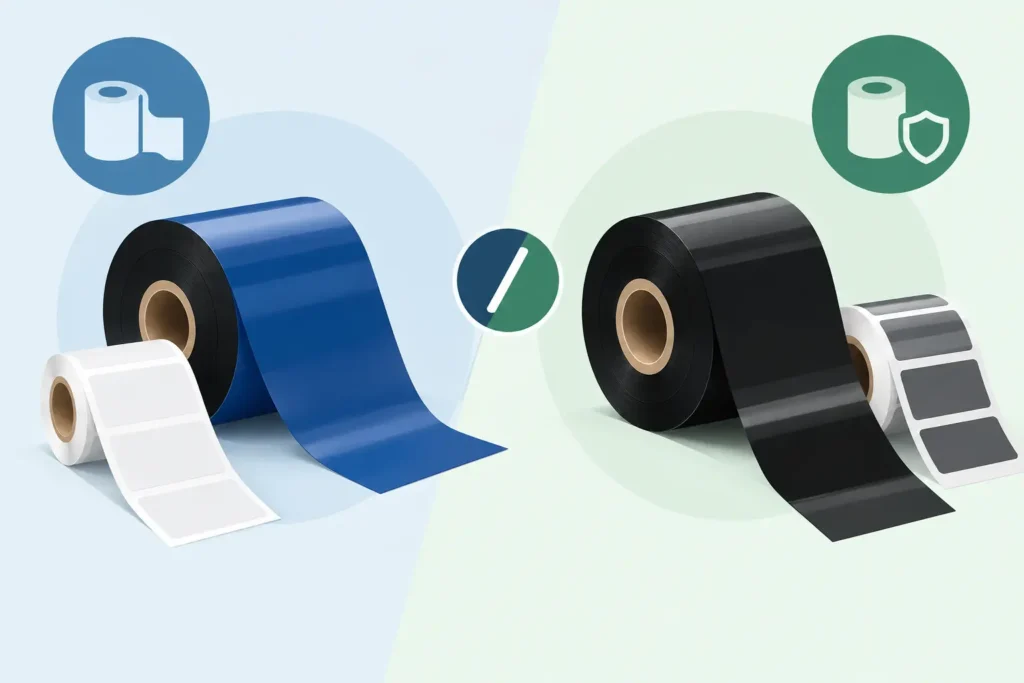
A ribbon that prints a crisp barcode on the production floor can still fail when that label reaches a freezer, loading dock, chemical area, or customer shipment.
That’s the critical difference between wax-resin vs. resin ribbons. Both are used in thermal transfer printing, but they offer different levels of durability, media compatibility, and resistance to environmental exposure.
For operations teams, printing a readable label is only the first step. The real goal is to keep variable data, barcodes, lot numbers, and handling information readable throughout the label’s required service life.
Choosing the right ribbon means looking beyond the printer. Label material, printer settings, handling conditions, regulatory requirements, and the type of information being printed all play a role.
So, which ribbon is right for your application? Here’s how to compare the options and make an informed decision.
What Separates Wax Resin and Resin Ribbons?
Thermal transfer ribbons contain an ink formulation on a film backing. During printing, heat from the printer’s printhead transfers that ink onto the label surface. The formulation determines how readily the ink transfers and how well the printed image withstands abrasion, moisture, chemicals, heat, and other environmental stresses.
Wax-resin ribbons combine wax and resin to provide a middle ground between economical wax ribbons and high-durability full-resin ribbons. The wax supports efficient transfer at relatively lower print energy, while the resin improves scratch and smudge resistance compared with standard wax.
Resin ribbons contain a much higher concentration of resin and are designed for demanding durability requirements. They typically require more heat to transfer properly, but the resulting print can withstand conditions that would quickly damage a wax-resin image.
There’s one important distinction to remember: a ribbon cannot compensate for incompatible label stock.
A resin ribbon may produce a sharp image on an uncoated paper label, but the paper itself can still tear, absorb moisture, or deteriorate. Likewise, a durable synthetic label paired with the wrong ribbon may produce a barcode that looks acceptable initially but scratches away during use.
The best results come from matching the ribbon to the label material and the conditions the finished label will face.
Wax Resin Versus Resin Ribbons at a Glance
Wax-Resin Ribbons
- Durability: Good resistance to smudging, scratching, and everyday wear.
- Best For: Shipping labels, product labels, and general-purpose applications that need moderate durability.
- Cost: More affordable than full resin ribbons.
- Print Compatibility: Works well with many coated paper labels and some synthetic materials.
Resin Ribbons
- Durability: Excellent resistance to abrasion, chemicals, heat, and harsh environments.
- Best For: Industrial labels, chemical labels, outdoor applications, and other demanding environments.
- Cost: Typically more expensive than wax-resin ribbons.
- Print Compatibility: Best suited for compatible synthetic label materials, such as polyester and polypropylene.
These comparisons are useful starting points, not absolute rules. Ribbon formulations vary by manufacturer, and actual performance depends on the specific label material and environmental exposure.
For example, a cold-storage warehouse may have different requirements from an outdoor utility operation—even when both use synthetic labels.
When Wax-Resin Is the Right Choice
Wax-resin ribbons are often a practical choice for operations that need better performance than standard wax without the additional cost of full resin.
They’re commonly used with coated paper labels for:
- Warehouse locations and inventory identification
- Carton and shipping labels
- General product labeling
- Work-in-process tracking
These applications often involve normal friction and handling without prolonged exposure to solvents, intense sunlight, or severe abrasion.
Consider a distribution center printing case labels for receiving, picking, and outbound shipping. If the labels are applied to corrugated cartons and experience routine handling, wax-resin can provide the right balance of performance and cost.
It produces dark, scan-ready barcodes and clear text while keeping consumable expenses aligned with high-volume printing.
Wax-resin can also work with certain synthetic materials, but that combination should be tested before it’s standardized across an operation. The label’s surface coating, adhesive, ribbon formulation, and intended exposure all influence the result.
A test using actual operating conditions provides much more useful information than a quick print sample produced at a desk.
Where Wax-Resin Has Limits
Wax-resin prints can scuff when labels repeatedly rub against conveyors, bins, metal surfaces, or other packages.
They’re also less suitable for labels exposed to cleaning chemicals, oils, harsh solvents, high heat, or prolonged outdoor conditions.
If a barcode becomes unreadable after a product leaves your facility, the initial savings from a lower-cost ribbon can quickly disappear through rework, lost traceability, delayed shipments, or compliance risks.
The key is to use wax-resin where its durability meets the application’s needs—not to expect it to perform like a full-resin ribbon in every environment.
When Full Resin Is Worth the Investment
Resin ribbons are designed for applications where printed information must remain legible despite demanding conditions.
They’re frequently paired with synthetic labels because the combination can provide much stronger resistance to abrasion, moisture, chemicals, and environmental exposure than paper-based labeling systems.
Asset identification is a common example. A label on a tool, medical device, returnable container, rental asset, electrical component, or industrial machine may need to remain readable through years of handling.
A full-resin ribbon paired with compatible polyester or another durable film can help protect asset numbers and barcodes throughout the label’s service life.
Resin is also a strong candidate for laboratory, healthcare, manufacturing, and chemical-related environments. Labels may encounter disinfectants, alcohols, oils, cleaners, refrigeration, or intermittent outdoor exposure.
However, “resin” alone isn’t a guarantee of durability. Some applications require a specialized resin formulation tested for resistance to particular chemicals, high temperatures, UV exposure, or sterilization processes.
Resin Requires the Correct Printer Setup
Full-resin ribbons typically require more print energy than wax-resin ribbons. If darkness, speed, and heat settings aren’t adjusted correctly, print quality can suffer.
- Too little energy may produce faint images or incomplete barcode elements.
- Too much energy can create edge-definition problems, ribbon wrinkling, excessive printhead wear, or damage to sensitive label materials.
That’s why ribbon selection must include printer configuration. The right combination of ribbon, label, printhead condition, speed, and darkness settings produces consistent scanning performance.
In high-volume environments, these details affect downtime and replacement costs just as much as the label’s appearance.
Choose Based on the Label’s Real Working Conditions
The most reliable way to choose between wax-resin and resin ribbons is to work backward from the label’s actual job.
Start by determining how long the label must remain readable and where it will travel after printing. A warehouse shelf label may need strong barcode contrast and routine scuff resistance. A pipe marker, equipment tag, or chemical container label may require a much more durable construction.
Consider whether the label will encounter:
- Friction and repeated handling
- Moisture and temperature changes
- Direct sunlight or UV exposure
- Oils, cleaners, disinfectants, or chemicals
The label surface matters, too. Coated paper, uncoated paper, polypropylene, polyester, vinyl, and specialty materials don’t accept ribbon ink in the same way.
Barcode requirements should also be part of the evaluation. A label can look dark to the eye and still scan poorly if its bar edges aren’t well defined or its print quality deteriorates after handling.
For operations using 2D codes, small text, serialized data, or compliance labels, print resolution and verification requirements may influence the ribbon decision as well.
Evaluate the Total Cost—not Just the Ribbon Price
Cost should be assessed over the application’s service life, not by ribbon price alone.
Wax-resin generally costs less and is often the smarter choice for shorter-life labels in controlled conditions. Full resin costs more, but it can help prevent relabeling, identification failures, rejected shipments, and lost asset records when durability is essential.
The right choice is the one that meets your performance requirements without introducing unnecessary consumable costs or operational risk.
Test the Complete Labeling System Before Standardizing
A controlled application test is one of the best ways to avoid an expensive ribbon mismatch.
Print representative labels using the intended printer, speed, darkness setting, label stock, and ribbon. Then evaluate them under the conditions they’ll actually face.
Depending on the application, testing may include:
- Rub and abrasion resistance
- Moisture exposure
- Freezer storage
- Cleaning agents and oils
- Sunlight or UV exposure
- Other known environmental or chemical exposures
Don’t overlook printer maintenance during testing. A worn or damaged printhead can create inconsistent output that appears to be a ribbon problem.
Ribbon width, winding direction, core size, and printer compatibility must also match the equipment. Even a suitable ribbon can cause unnecessary downtime if it doesn’t fit or track correctly.
For complex applications, document the approved label-ribbon-printer combination and its operating settings. This gives procurement, production, and warehouse teams a repeatable standard rather than leaving each location to select consumables independently.
PaladinID helps organizations evaluate these combinations as a complete labeling system, including media, ribbons, printer capabilities, and the conditions that affect performance after a label is applied.
With the application clearly defined, selecting the right combination becomes much easier.
Need Help Choosing the Right Thermal Transfer Ribbon?
The best ribbon is the one that keeps your label readable when it matters most. Wax-resin can deliver an effective balance of cost and performance for everyday applications, while full resin is often the better choice when labels must withstand demanding environments.
Before making a decision, consider the complete application: label material, printer compatibility, environmental exposure, scanning requirements, and expected service life.
At PaladinID, we don’t just sell labels. We solve labeling problems.
Our team helps businesses evaluate labeling materials, printers, ribbons, and application requirements to find solutions that work in real operating conditions.
Contact PaladinID to discuss your labeling needs and find the right combination for your application.


Got Labeling Questions? Our AI Assistant Has Answers - Chat Now!
For more information on PaladinID
Get Help With Your Next Label Project
We have over 35 years of providing exceptional service and labeling products to the world. Take the first step to an easy, stress-free solution for your label needs by contacting us.
Schedule a call below or email [email protected]
Make Your Mark
“Making companies more competitive by offering the correct label printing solution, on time, within budget, while creating unmatched value”.
About PaladinID, LLC
PaladinID develops and supports high-performance barcode labeling applications. We work with our clients to “Make Your Mark” by providing the expertise and tools necessary to create an entire product label printing solution. Located in central New Hampshire, PaladinID has been serving Massachusetts, Vermont, Maine, Connecticut, Rhode Island, New England, and beyond for over 30 years, and in 2017, became an RFID-certified company. We look forward to working with you.
You may be interested in our other services:
Product Labels
Product Labels
Labels for every type of application: Blank, Pre-printed, Variable data
Label Printers
Label Printers
We sell and support: Direct/thermal transfer, Inkjet, Laser
Printer Ribbons
Printer Ribbons
We sell ribbons for ALL barcode printers including: Zebra, Datamax, Sato, Intermec
Flexible Packaging
Flexible Packaging
We offer a wide variety of packaging containers for your products.
Label Software
Label Software
Software for all barcode printing and product labeling.
Label applicators
Label Applicators
Wide selection of applicators: Desktop/Mobile, Applicator only, Print & apply
