
When Custom Inkjet Labels Make Sense


What Can We Help You With?
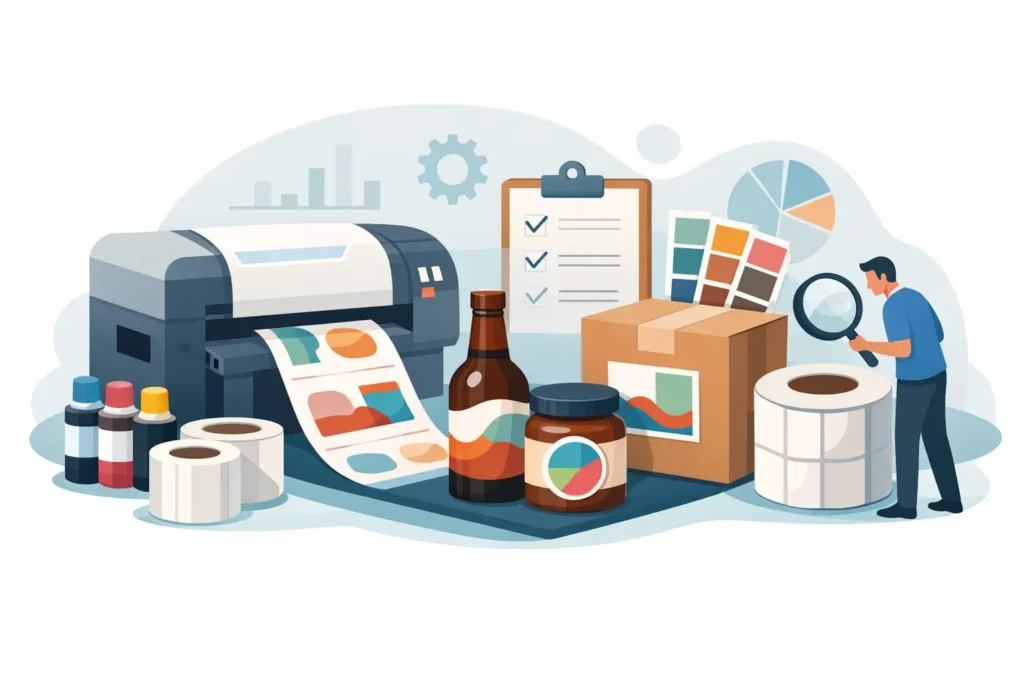
A full-color label run that looks great on day one can become a problem fast if it smears in a humid warehouse, fades in sunlight, or fails to scan after handling. That is why custom inkjet labels deserve a careful evaluation. For many businesses, they offer speed, flexibility, and strong visual impact. For others, they are only one part of a larger labeling system.
What custom inkjet labels do well
Custom inkjet labels are pressure-sensitive labels designed to be printed with inkjet technology, either in-house or through a converter using inkjet-compatible materials and coatings. Their biggest advantage is color. If your operation needs product labels with logos, warnings, branding elements, or short-run design changes, inkjet can be a practical fit.
This is especially useful when the label content changes often. A food producer updating seasonal SKUs, a nursery printing color-rich plant tags, or a cannabis retailer managing product variation may benefit from the flexibility of inkjet printing. You can produce smaller quantities without ordering large volumes of preprinted stock, and that can reduce obsolescence when products, regulations, or artwork change.
Inkjet also works well for variable information layered onto a branded template. Batch codes, lot numbers, dates, and serialized fields can be combined with predesigned graphics. In the right setup, that helps operations run faster without sacrificing label quality.
Where custom inkjet labels can fall short
The issue is not whether inkjet labels can look good. They can. The more important question is whether they will perform in your environment.
In industrial and warehouse settings, durability often matters more than appearance. Labels may be subject to abrasion, moisture, chemicals, freezer conditions, UV exposure, or frequent contact during transport and storage. Standard inkjet materials are not always built for that. Even when the label stock is strong, the printed image itself may be vulnerable if the ink and surface coating are not matched to the application.
Barcode performance is another common concern. A label can appear sharp to the eye and still scan poorly if ink spread, surface absorption, or inconsistent print density affects the barcode edges. That risk grows when labels are used for inventory, shipping, compliance, or asset tracking, where scan accuracy directly affects workflow.
There is also a speed-cost trade-off. Inkjet can be a smart choice for moderate volumes and frequent changeovers, but at higher industrial throughput, another print method may offer better consistency or lower cost per label. The right answer depends on label design, run length, environment, and how the labels connect to the rest of your operation.
How to evaluate custom inkjet labels for your operation
The best evaluation starts with the application, not the artwork. Before choosing a label format, consider where the label goes, how long it needs to last, and which systems rely on it.
Start with the surface and environment
Label performance depends heavily on the substrate. Cardboard cases, poly bags, corrugated, drums, glass, and textured plastics all behave differently. Adhesive selection matters just as much as print quality. A label that prints cleanly but lifts from a curved container or dusty surface will still fail in use.
Then consider exposure. Will the label face moisture, refrigeration, handling friction, cleaning agents, or direct sun? In office environments, standard materials may be enough. In manufacturing, warehousing, healthcare, utilities, or outdoor use, the material and coating requirements become more demanding.
Define the role of the label
Some labels are mainly visual. Others are operational tools. If the label is used for branding on consumer-facing packaging, image quality may be the deciding factor. If it is used for receiving, inventory movement, shipping, compliance, or work-in-process tracking, scan reliability and durability usually take priority.
That distinction matters because not every custom inkjet label should be expected to do every job. In many facilities, one label type is used for packaging presentation, while another is used for internal tracking. Trying to force a single construction into every use case can create avoidable problems.
Look at the full print workflow
Inkjet labels should be evaluated as part of a system that includes the printer, media, software, data source, and operator process. If variable data is pulled from an ERP, WMS, or production system, the label format must support consistent output across shifts and locations. If colors or graphics vary by SKU, file control and versioning become part of the quality process.
This is where many buyers run into trouble. They focus on label appearance and overlook how labels are triggered, printed, applied, and verified. A good label solution should reduce exceptions, not create more manual checking.
Custom inkjet labels vs. thermal printing
For business buyers, the most common comparison is between custom inkjet labels and thermal label systems. Neither is universally better. Each has a place.
Inkjet stands out when color matters, design changes are frequent, and shorter runs make preprinted inventory less efficient. It can be a strong option for branded product labeling, promotional packaging, and applications where visual presentation carries weight.
Thermal printing, especially in industrial settings, is often better suited for high-volume operational labeling. It is widely used for barcodes, shipping labels, compliance labels, shelf labels, bin labels, and asset identification because it supports repeatable output, durable media options, and straightforward integration with variable-data workflows.
The real decision often comes down to whether the label’s primary job is marketing, identification, or both. If it is both, a hybrid approach may be the right answer. Some organizations use preprinted or color label stock for branding and then add variable data through thermal printing. Others invest in color-capable systems only where the application justifies it.
Common use cases for custom inkjet labels
Custom inkjet labels make sense in several business scenarios. Product packaging is one of the clearest examples, especially when branding, ingredient panels, warnings, and SKU variation need to coexist on the same label. They are also useful for short-run private label products, pilot launches, and frequent packaging revisions.
Operations with a high number of product variants can benefit as well. Instead of carrying large inventories of preprinted labels for every version, teams can print what they need as demand changes. That can improve responsiveness and reduce waste.
Still, there are limits. If labels need to withstand rough handling in a distribution center, remain legible in a freezer, or hold up outdoors, custom inkjet labels should be tested carefully against purpose-built alternatives. The right media may solve the issue, but not always at the lowest cost.
What should buyers ask before choosing custom inkjet labels?
A supplier should be able to answer practical questions, not just provide samples that look good under office lighting. Ask how the label performs on your specific surface. Ask what happens when it gets wet, scuffed, or exposed to heat or sunlight. Ask whether the printed barcode has been verified, not just viewed. Ask how the labels behave in your printer and whether the coating, adhesive, and liner are matched to that setup.
It is also worth asking about long-term consistency. Can the same construction be supplied reliably over time? Will color and performance stay consistent across reorder cycles? If your operation depends on standardized labeling, supply stability matters almost as much as print quality.
For companies with multiple facilities or growing throughput, support matters too. A dependable partner can help align labels, printers, software, and replacement ink supplies so the entire process works as intended. That is often where organizations see the biggest difference between buying a labeled product and building a labeling system.
The best choice depends on the job
Custom inkjet labels can be an excellent fit when color, flexibility, and short-run efficiency matter. They are less effective when buyers expect them to solve harsh-environment or high-volume industrial labeling challenges without the right materials, equipment, and process controls behind them.
The most reliable approach is to evaluate labels based on the job they need to do, the environment they need to survive in, and the systems they need to support. At PaladinID, that is the standard approach because a label should not just print well. It should work where your business actually uses it.
If you are weighing options, start with the application details. The right label choice usually becomes clearer once performance requirements are on the table.
At PaladinID, we understand that every labeling application is different.
That’s why companies across the country trust us to help them identify the right solution for their business. With over 40 years of experience and one of the industry’s largest selections of labeling products, we make it easy to find the right fit for your operation. Whether you need stock products or a custom-built solution, our team is ready to help. Visit our online catalog, Email us, or call us today at 888.972.5234.
PaladinID delivers label solutions that stick!

Got Labeling Questions? Our AI Assistant Has Answers - Chat Now!
For more information on PaladinID
Get Help With Your Next Label Project
We have over 35 years of providing exceptional service and labeling products to the world. Take the first step to an easy, stress-free solution for your label needs by contacting us.
Schedule a call below or email [email protected]
Make Your Mark
“Making companies more competitive by offering the correct label printing solution, on time, within budget, while creating unmatched value”.
About PaladinID, LLC
PaladinID develops and supports high-performance barcode labeling applications. We work with our clients to “Make Your Mark” by providing the expertise and tools necessary to create an entire product label printing solution. Located in central New Hampshire, PaladinID has been serving Massachusetts, Vermont, Maine, Connecticut, Rhode Island, New England, and beyond for over 30 years, and in 2017, became an RFID-certified company. We look forward to working with you.
You may be interested in our other services:
Product Labels
Product Labels
Labels for every type of application: Blank, Pre-printed, Variable data
Label Printers
Label Printers
We sell and support: Direct/thermal transfer, Inkjet, Laser
Printer Ribbons
Printer Ribbons
We sell ribbons for ALL barcode printers including: Zebra, Datamax, Sato, Intermec
Flexible Packaging
Flexible Packaging
We offer a wide variety of packaging containers for your products.
Label Software
Label Software
Software for all barcode printing and product labeling.
Label applicators
Label Applicators
Wide selection of applicators: Desktop/Mobile, Applicator only, Print & apply
