
How to Label Returnable Containers for Tracking




What Can We Help You With?
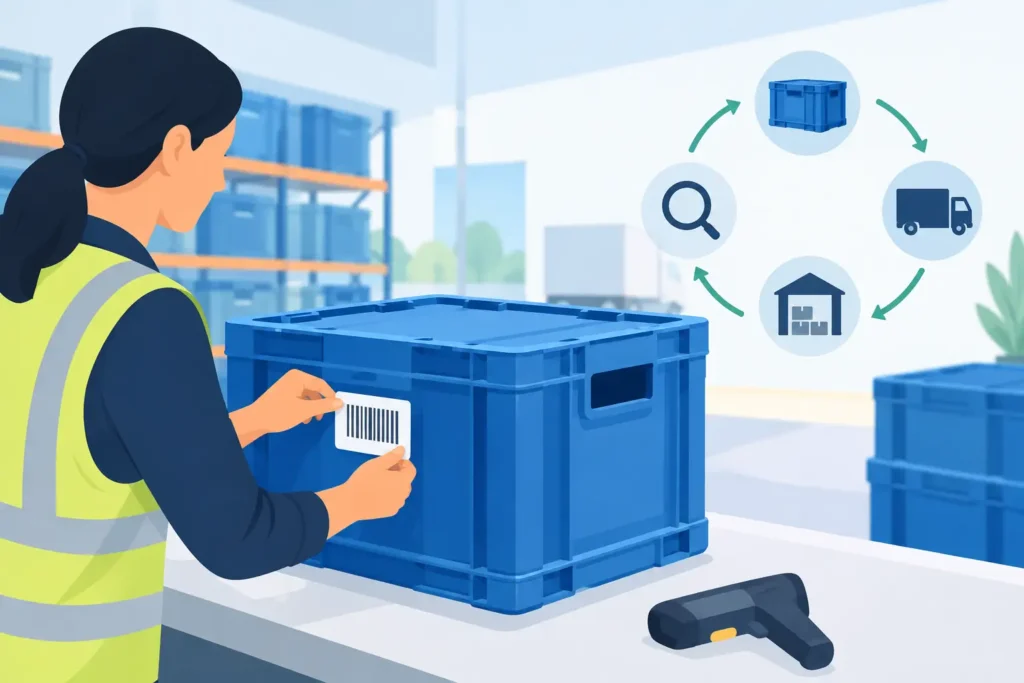
A returnable tote that disappears from circulation is more than just a missing container. It can delay shipments, create packaging shortages, increase replacement costs, and leave teams guessing where inventory was last handled.
Knowing how to label returnable containers properly can turn reusable packaging into trackable operational assets instead of an unmanaged expense.
The right labeling approach depends on several factors: the container material, how frequently it cycles, the environments it encounters, and who or what needs to identify it. A label that works perfectly on a clean plastic tote inside one warehouse may quickly fail on a wet pallet box traveling between facilities.
The goal isn’t simply to put a barcode on every container. It’s to create an identification system that remains readable, accurate, and useful throughout the entire return cycle.
Start with the tracking purpose
Before choosing label materials or printer hardware, determine exactly what each returnable container needs to communicate to your business.
Some container fleets only require a unique asset ID and scan history. Other operations need to connect each container to additional information, such as a product lot, customer location, sanitation status, maintenance record, or deposit program.
A unique identifier should remain with the container throughout its usable life. Variable information, such as the contents of a current shipment or its destination, should generally be managed through a separate temporary label or transaction record.
Combining permanent asset identification with short-term shipping information on a single label can create confusion when the container is reused.
For most operations, the permanent label should include both a human-readable container number and a machine-readable barcode.
If containers move through shared supply chains or require hands-free reads, RFID may be worth considering. The technology should support the actual workflow—not introduce complexity without a clear purpose.
Choose the right identification method
Barcodes remain a practical choice for returnable containers because they’re economical, familiar to warehouse teams, and compatible with many existing inventory systems.
Code 128 is commonly used for internal asset IDs because it supports a broad range of characters. GS1-128 may be more appropriate when an operation needs standardized data structures or works with trading partners that require them.
A 2D barcode, such as a Data Matrix or QR code, can store more information in a smaller space. This makes it useful when label space is limited or when a scan needs to reference a detailed asset record.
However, 2D codes require compatible scanners and software. When the only requirement is to identify a container quickly and reliably, a well-designed 1D barcode may be the better choice.
RFID offers different advantages. It’s particularly useful when containers move quickly through portals, pass fixed read points, or need to be counted without individual line-of-sight scanning.
In high-volume returnable-container loops, RFID can reduce manual scanning efforts. However, tag placement, reader coverage, container contents, and surrounding metal or liquids can all affect read performance.
Before deploying RFID across an entire fleet, test the technology in the actual operating environment to confirm that it performs as expected.
Match the label construction to the container and environment
Returnable containers experience considerably more wear and tear than ordinary cartons. They’re stacked, dragged, washed, exposed to temperature changes, and handled by multiple people and organizations.
A standard paper label may look perfectly acceptable when first applied, only to become unreadable after a few trips.
For plastic totes, bins, trays, and bulk containers, synthetic pressure-sensitive labels are often a good starting point.
Polyester and polypropylene face stocks can provide strong resistance to moisture, abrasion, and many common chemicals. However, the adhesive is just as important as the face stock.
Low-surface-energy plastics, textured molded surfaces, and containers exposed to cold or washdown conditions may require adhesives specifically designed for those environments.
Metal cages, kegs, racks, and containers exposed to heavy abrasion may need an even more durable identification solution. Metal tags, rigid plates, or protected labels can outperform standard pressure-sensitive constructions.
In some applications, direct marking methods may also be appropriate. However, these can be difficult to change, may not provide sufficient contrast for scanning, and can complicate repairs or redeployment.
Thermal transfer printing is generally preferred for durable returnable-container labels. It uses a ribbon to create an image that resists smudging and wear better than direct thermal printing.
Ribbon selection should depend on the label material and the conditions it will encounter.
- Wax ribbons may work well for lower-demand indoor applications.
- Wax-resin ribbons offer greater durability for applications requiring more resistance to handling and abrasion.
- Resin ribbons provide enhanced durability for compatible synthetic materials and demanding environments, including outdoor storage and chemical contact.
The key is choosing a compatible combination that meets the actual performance requirements of the application.
Place labels where people and scanners can use them
Even the most durable barcode won’t help if it’s consistently covered, scratched, or difficult to reach.
Whenever possible, choose a flat or gently curved surface for label placement. Avoid ribs, seams, handles, corners, hinge points, and areas where stacking equipment repeatedly makes contact.
Containers that can be stored or moved in different orientations may benefit from identification labels on more than one side. Two matching labels on adjacent sides can improve scanning access without introducing unnecessary redundancy.
For larger returnable pallet boxes or bins, placing labels on multiple visible sides can reduce the amount of handling required during receiving and put-away.
It’s also important to consider the normal scanning position.
A forklift operator may scan a label from a seated position, while a receiving clerk may scan it from a dock door or with a mobile device. Labels should be positioned at a consistent height and orientation throughout the fleet.
This standardization can reduce scanning time and make employee training easier.
If containers are regularly washed, consider whether labels will be exposed to direct spray, brush contact, or pooling water. Even a small adjustment in placement can significantly extend label life.
Build the data structure before printing labels
A readable barcode is only useful when the information behind it is accurate and properly controlled.
Start by assigning each container a unique ID that won’t be casually reused after the container is retired.
A simple serial number may be sufficient for smaller operations. Larger organizations may benefit from an identifier that also communicates container type, ownership group, or facility.
Keep the format short enough to support quick data entry and easy human reading. Longer strings increase the likelihood of keying errors, particularly when employees must manually enter an ID after a damaged-label exception.
If check digits or prefixes are used, document them and configure validation rules within the tracking system.
Each container record should contain the attributes that matter to the operation, such as:
- Container type and dimensions
- Ownership
- Service status
- Repair history
- Last known location
The barcode itself doesn’t need to store every detail. It can simply direct users to the correct record within a warehouse management system, enterprise resource planning system, asset-tracking platform, or custom database.
Separate permanent container IDs from shipment labels
One of the most common mistakes in reusable packaging programs is covering the permanent identification label with a shipping label.
This forces receiving teams to peel away temporary labels before scanning a container back into circulation. It also increases the risk of damaging the permanent asset label.
To avoid this problem, designate separate, consistent areas for permanent and temporary labels.
For example, the permanent barcode could be applied near the upper sidewall, while a shipping or contents label is placed on a front-facing panel.
Employees should always understand which label identifies the container itself and which label applies only to its current trip.
When shipping labels need to be removed, choose a removable adhesive that releases cleanly without leaving residue.
Adhesive buildup can interfere with future label applications and make permanent identification labels more difficult to scan.
Validate barcode quality in real conditions
Don’t approve a label based solely on how it looks immediately after printing.
Verify that the barcode scans successfully using the devices employees actually use on the floor, at normal working distances and angles.
Testing should also take place after labels have experienced the conditions they’ll encounter during regular operations, including:
- Cold storage
- Washdown
- Outdoor staging
- Abrasion
- Repeated stacking
Print quality depends on much more than the label stock itself. Printer settings, printhead condition, ribbon compatibility, darkness, speed, and label design all influence barcode performance.
Fine bars printed too small, insufficient quiet zones, low contrast, and damaged printheads can all result in codes that scan inconsistently.
A controlled pilot is usually more valuable than placing a large initial order.
Start by labeling a representative group of containers and running them through normal operations for several weeks. During that time, monitor scanning performance and inspect physical label durability.
This process helps identify potential problems with adhesion, placement, workflow adoption, or data capture before expanding the program across the entire fleet.
Establish ownership and inspection routines
Returnable-container labeling isn’t a one-time application project. It’s an ongoing identification system that needs clear ownership and maintenance.
Someone should be responsible for the label specification, ID assignment process, replacement procedure, and barcode verification standards.
Without clear ownership, teams may begin applying inconsistent replacement labels or accidentally create duplicate IDs when an existing label becomes damaged.
Establish practical inspection points during receiving, washing, maintenance, and dispatch.
Employees don’t need to inspect every label in detail at every stage, but they should understand how to identify and report a missing or unreadable ID.
A replacement process should preserve the original asset record whenever possible rather than assigning a new identity without documenting the change.
For organizations managing multiple types of containers, a standardized label program can also simplify procurement and ongoing support.
Defined materials, approved ribbons, printer settings, and label templates reduce variation between locations and make replenishment more predictable.
A returnable container only delivers its full value when it makes its way back into circulation.
When labels are designed for real operating conditions and connected to a clear tracking workflow, every scan creates another opportunity to keep assets moving, accounted for, and ready for their next trip.
PaladinID: Make Your Mark.
At PaladinID, we don’t just sell labels—we solve labeling problems. From durable custom labels and compatible ribbons to printers and complete identification solutions, we help businesses find the right approach for their unique applications.
Visit PaladinID.com to explore our labeling solutions and discover how the right identification system can help keep your operation running efficiently.


Got Labeling Questions? Our AI Assistant Has Answers - Chat Now!
For more information on PaladinID
Get Help With Your Next Label Project
We have over 35 years of providing exceptional service and labeling products to the world. Take the first step to an easy, stress-free solution for your label needs by contacting us.
Schedule a call below or email [email protected]
Make Your Mark
“Making companies more competitive by offering the correct label printing solution, on time, within budget, while creating unmatched value”.
About PaladinID, LLC
PaladinID develops and supports high-performance barcode labeling applications. We work with our clients to “Make Your Mark” by providing the expertise and tools necessary to create an entire product label printing solution. Located in central New Hampshire, PaladinID has been serving Massachusetts, Vermont, Maine, Connecticut, Rhode Island, New England, and beyond for over 30 years, and in 2017, became an RFID-certified company. We look forward to working with you.
You may be interested in our other services:
Product Labels
Product Labels
Labels for every type of application: Blank, Pre-printed, Variable data
Label Printers
Label Printers
We sell and support: Direct/thermal transfer, Inkjet, Laser
Printer Ribbons
Printer Ribbons
We sell ribbons for ALL barcode printers including: Zebra, Datamax, Sato, Intermec
Flexible Packaging
Flexible Packaging
We offer a wide variety of packaging containers for your products.
Label Software
Label Software
Software for all barcode printing and product labeling.
Label applicators
Label Applicators
Wide selection of applicators: Desktop/Mobile, Applicator only, Print & apply
