
Zebra PolyPro 4000T for Durable Label Printing


What Can We Help You With?
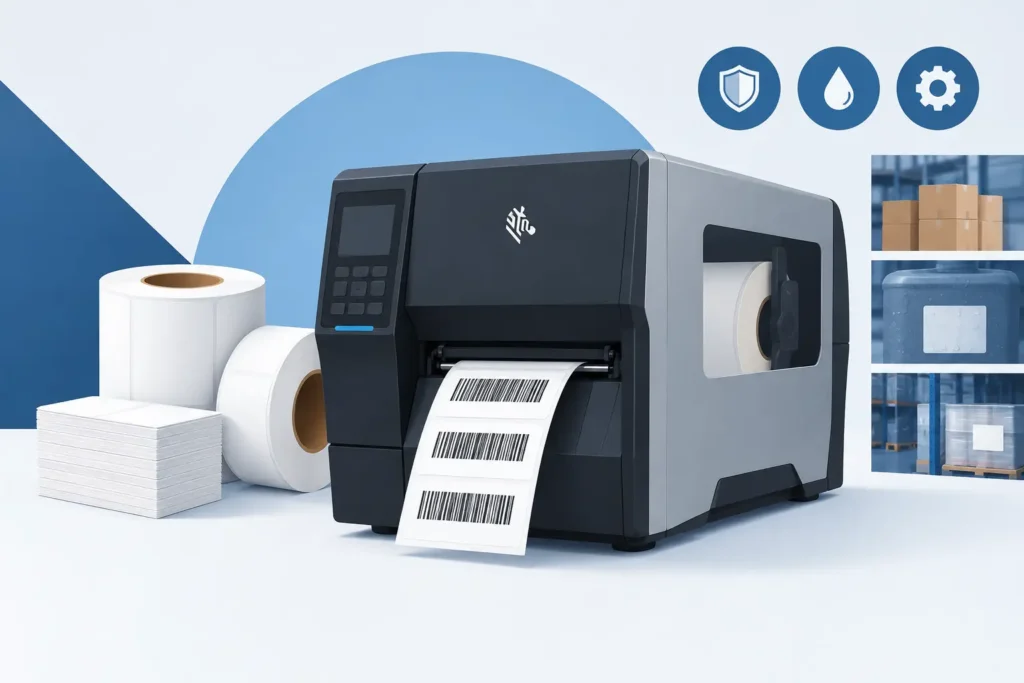
A label can look acceptable when it leaves the printer and still fail where it matters: on a pallet moving through a busy warehouse, a tote exposed to cleaning chemicals, or an asset handled repeatedly by operators. Zebra PolyPro 4000T is intended for operations that need more from thermal transfer printing than a basic paper-label application can provide. When paired correctly with a resin ribbon and compatible printer, it supports clear, durable identification that remains useful through real handling and storage conditions.
For warehouse, manufacturing, inventory, and tracking teams, the question is not simply whether a ribbon will print. The practical question is whether the ribbon, label face stock, adhesive, printer, and print settings will work as a system. That is where durable labeling projects either gain consistency or create recurring reprint, scanning, and replacement work.
What Zebra PolyPro 4000T Is Designed to Do
Zebra PolyPro 4000T is a polypropylene label materials designed to work with a resin ribbon. Polypropylene is a synthetic film used when a standard paper label is unlikely to hold up to moisture, abrasion, repeated handling, or a cleaner appearance requirement. The ribbon transfers an image to the label under heat and pressure from the printhead, producing text, barcodes, graphics, and variable data.
The material pairing matters. A polypropylene label provides the durable surface, while the ribbon determines how well the printed image adheres to that surface and resists damage. A lower-cost ribbon may be suitable for a short-term shipping label, but it can smear, scratch, or lose readability when used on synthetic stock in a demanding setting. Choosing a ribbon intended for polypropylene helps reduce that mismatch.
This does not mean every polypropylene application requires the same ribbon formulation. Exposure conditions, barcode density, label life, printer model, and acceptable replacement frequency all affect the right choice. A label on an indoor inventory tote has different requirements than a label used on a finished product, returnable container, or outdoor staging asset.
Where Zebra PolyPro 4000T Fits Best
This label is a practical fit when operations need durable printed information and expect that information to remain legible after normal handling. Common uses include warehouse location labels, work-in-process identification, inventory labels, product labels, equipment tags, logistics labels, and returnable-container tracking.
Barcode quality is central to many of these applications. A barcode that scans correctly at the printer but degrades after a few days creates delays at receiving, picking, production, or shipment verification. Thermal transfer printing with a suitable polypropylene ribbon combination can help preserve edge definition and contrast, particularly for smaller barcodes, serial numbers, and dense variable data.
Manufacturers also benefit when label performance is consistent across shifts and locations. If one facility uses a paper label and another uses a synthetic label with an incompatible ribbon, teams may see different scan rates, different reprint volumes, and different maintenance demands. Standardizing the label construction and ribbon selection makes the workflow easier to support.
Applications with frequent contact
Repeated contact is one of the clearest reasons to move beyond a basic paper-label setup. Totes, bins, racks, parts containers, rental equipment, and reusable packaging are touched, moved, and cleaned many times. The printed image must withstand friction from handling as well as contact with other surfaces.
For these uses, evaluate the entire label construction. The ribbon may provide suitable image durability, but an incorrect adhesive can still cause the label to lift or curl. Surface condition matters as well. Dust, oil, moisture, textured plastic, and low-temperature application can all affect adhesion before the ribbon has an opportunity to prove its performance.
Applications requiring a professional finish
Polypropylene labels are often selected because they present a clean, consistent appearance. They work well when product identification, component labeling, or customer-facing information needs to look controlled and readable. Zebra PolyPro 4000T can support crisp printing on that surface, but artwork, font size, and barcode design should still be chosen for the actual print resolution of the equipment.
A highly detailed logo or very small text may require a printer resolution review. It is better to confirm image quality during sample testing than to assume a high-resolution design will perform the same across every printer fleet.
Select the Label System Before Ordering Ribbon
The ribbon should never be selected in isolation. Operations teams can avoid costly trial-and-error by defining the application first, then matching the consumables and hardware to it. Before specifying Zebra PolyPro 4000T, document these factors:
- The label surface and material, including the exact polypropylene construction when known
- The expected label life and handling conditions
- Exposure to moisture, chemicals, abrasion, heat, cold, or ultraviolet light
- Barcode type, size, scanning distance, and required scan rate
- Printer model, print resolution, ribbon width, core size, and winding direction
These details determine whether the ribbon is appropriate and whether a different label material, adhesive, or print technology may serve the application better. They also help prevent a common procurement issue: ordering a ribbon that is technically high quality but physically incompatible with the printer.
Ribbon width should generally cover the printable area without extending unnecessarily beyond the label. Excessive ribbon width can waste material and may contribute to ribbon wrinkling if the setup is not well controlled. Printer compatibility also includes whether the device uses a standard thermal transfer ribbon configuration and whether the ribbon orientation matches the printer’s requirements.
Printer Settings Matter as Much as Ribbon Choice
A good ribbon and label combination can still produce poor results when printer settings are incorrect. Darkness, print speed, printhead pressure, and media calibration all influence how the image transfers to the polypropylene surface.
Too little heat can result in weak print that rubs off or scans inconsistently. Too much heat can create overly dark bars, blurred edges, or printhead wear over time. Increasing print speed can improve throughput, but it may require setting adjustments to maintain barcode definition. The correct balance depends on the specific label, ribbon, printer, and data being printed.
Test samples should be reviewed under actual operating conditions, not only at a desk near the printer. Scan the label with the same scanners used in the facility. Rub the print area, handle the container, and expose samples to the conditions they are expected to encounter. If cleaning agents, oils, or temperature swings are part of the process, test those conditions before committing to a large production run.
This approach also helps identify mechanical issues. Wrinkled ribbon, inconsistent darkness across the label, voids in printed bars, and faded areas can indicate incorrect loading, a damaged printhead, improper pressure settings, or media calibration problems. Replacing consumables without checking the printer can turn a correctable setup issue into an ongoing expense.
When Another Solution May Be Better
Zebra PolyPro 4000T is not a universal answer for every durable-label requirement. If an application demands extreme chemical resistance, long-term outdoor exposure, very high temperatures, or heavy abrasion, the operation may need a different ribbon formulation or a specialized label material. Polypropylene itself has performance limits, and the adhesive may become the deciding factor in harsh environments.
For short-life indoor labels, a less specialized label and ribbon combination may be more economical. There is no value in specifying a durable synthetic system for a label that is discarded at the end of a single shift unless the handling environment justifies it. Conversely, choosing the lowest-cost consumable for a multi-year asset label can create far more cost through relabeling and lost traceability.
Direct thermal printing may also be appropriate for temporary labels where exposure to heat, sunlight, or abrasion is limited. It eliminates the ribbon, but direct thermal media generally has different durability characteristics. The right technology depends on the intended use, not simply on the printer already on the floor.
Make Testing Part of the Implementation
The most reliable label programs are built around controlled samples and documented standards. Once a Zebra PolyPro 4000T configuration is approved, record the label stock, adhesive, ribbon part number, printer model, print settings, and inspection criteria. That documentation gives procurement, operations, and IT a common reference when adding printers, opening locations, or troubleshooting print quality.
PaladinID helps organizations evaluate those connected decisions rather than treating ribbons, labels, and printers as separate purchases. A practical review of the environment, data requirements, and equipment can identify the combination that delivers the required durability without over-specifying the job.
The next time a label failure creates a scan exception or forces an operator to relabel inventory, look beyond the label alone. The right result comes from a tested identification system that matches how the label will actually be used.
At PaladinID, we understand that every labeling application is different.
That’s why companies across the country trust us to help them identify the right solution for their business. With over 40 years of experience and one of the industry’s largest selections of labeling products, we make it easy to find the right fit for your operation. Whether you need stock products or a custom-built solution, our team is ready to help. Visit our online catalog, Email us, or call us today at 888.972.5234.
PaladinID delivers label solutions that stick!

Got Labeling Questions? Our AI Assistant Has Answers - Chat Now!
For more information on PaladinID
Get Help With Your Next Label Project
We have over 35 years of providing exceptional service and labeling products to the world. Take the first step to an easy, stress-free solution for your label needs by contacting us.
Schedule a call below or email [email protected]
Make Your Mark
“Making companies more competitive by offering the correct label printing solution, on time, within budget, while creating unmatched value”.
About PaladinID, LLC
PaladinID develops and supports high-performance barcode labeling applications. We work with our clients to “Make Your Mark” by providing the expertise and tools necessary to create an entire product label printing solution. Located in central New Hampshire, PaladinID has been serving Massachusetts, Vermont, Maine, Connecticut, Rhode Island, New England, and beyond for over 30 years, and in 2017, became an RFID-certified company. We look forward to working with you.
You may be interested in our other services:
Product Labels
Product Labels
Labels for every type of application: Blank, Pre-printed, Variable data
Label Printers
Label Printers
We sell and support: Direct/thermal transfer, Inkjet, Laser
Printer Ribbons
Printer Ribbons
We sell ribbons for ALL barcode printers including: Zebra, Datamax, Sato, Intermec
Flexible Packaging
Flexible Packaging
We offer a wide variety of packaging containers for your products.
Label Software
Label Software
Software for all barcode printing and product labeling.
Label applicators
Label Applicators
Wide selection of applicators: Desktop/Mobile, Applicator only, Print & apply
