
How to Print Cannabis Labels That Stay Compliant




What Can We Help You With?
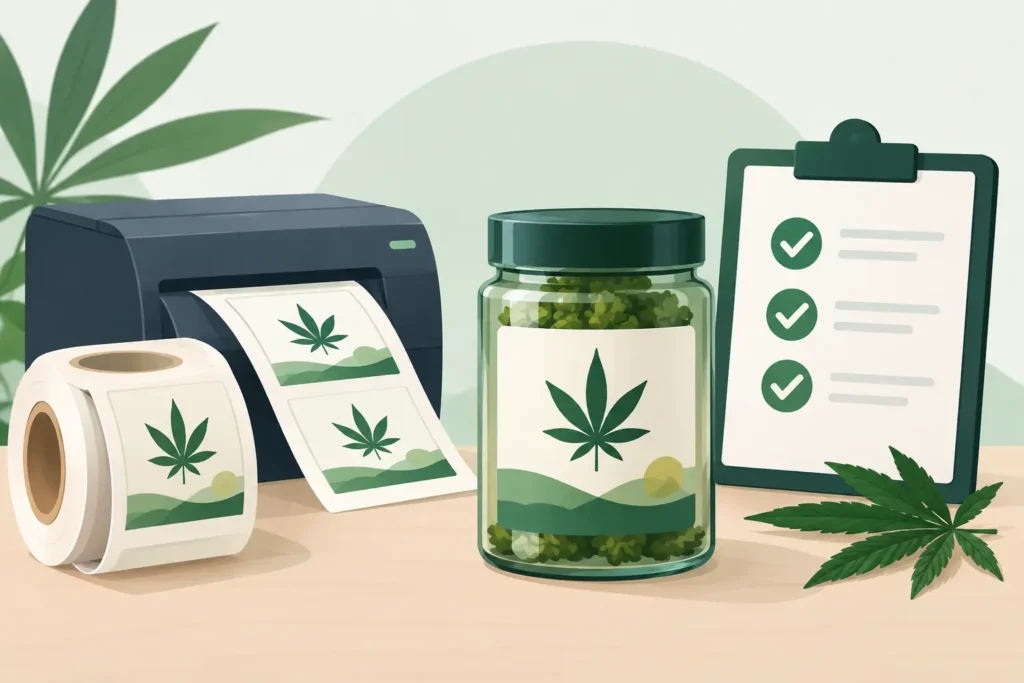
A cannabis label can look perfect when it comes off the printer and still fail when it matters most: at the point of sale, during transportation, or after just a few days in a refrigerated display case.
Smudged variable data, unreadable barcodes, peeling adhesives, and inconsistent label layouts can create unnecessary risks for your business.
Understanding how to print cannabis labels involves more than choosing a printer and pressing print. It requires a reliable, controlled labeling process that keeps every label accurate, readable, and durable throughout the product’s journey.
For dispensaries, cultivators, processors, and packaging teams, the right approach combines compliant label design, durable materials, dependable printing equipment, and a workflow that protects variable-data accuracy.
The best solution depends on your state’s requirements, package format, production volume, and operating environment, whether labels are applied in a clean packing room, a grow operation, or a high-volume retail setting.
Start With the Required Label Information
Before purchasing labels or investing in printing equipment, start with one essential question: What information is required on every package?
Cannabis labeling requirements vary by state and can change as regulations evolve. It’s important to identify exactly what must appear on each package and determine which information comes from your seed-to-sale or inventory management system.
Common labeling requirements include:
- Product name and brand
- Strain or product type
- Net weight
- Batch or lot number
- Harvest or packaging date
- Testing results
- Cannabinoid content
- Serving information
- Warning statements
- Universal symbols
- License details
- A scannable barcode or QR code
Depending on the product and applicable requirements, additional information may include child-resistance statements, allergen details, ingredients, or expiration dates.
Once you’ve identified the required information, separate it into two categories: fixed content and variable content.
Fixed content includes information that generally stays the same, such as your company logo, warning panel, or standard product instructions. This information can be preprinted on the label or flexible packaging.
Variable content includes details that change between products or production runs, such as batch numbers, weights, dates, potency, and serialized tracking data. These fields should be generated from the approved source system and printed on demand.
This distinction is important when planning your labeling process.
Preprinting too much information can leave you with outdated inventory when regulations, formulations, or branding change. Printing every element on demand provides greater flexibility but requires additional printer capacity and stronger quality controls.
Many operations find a hybrid approach works best: a preprinted, branded label with designated spaces for thermal printing of regulated and batch-specific information.
How to Print Cannabis Labels for Your Application
Choosing the right printer is only one part of the process. Your printer, label material, ribbon, and software must all work together to produce a dependable finished label.
A label that looks acceptable when printed on a desktop printer may not remain readable after exposure to handling, moisture, oils, refrigeration, or abrasion.
Here’s what to consider when selecting the right printing solution.
Select the Right Print Technology
Different printing technologies offer different advantages depending on your application, production volume, and durability requirements.
Direct thermal printing uses heat-sensitive label stock and does not require a ribbon.
It’s a practical option for short-life labels, such as temporary inventory identification or products moving quickly through a controlled environment.
However, direct thermal images can darken or fade when exposed to heat, sunlight, friction, and time. This makes direct thermal printing a less suitable choice for cannabis labels that need a longer shelf life or must remain legible after frequent handling.
Thermal-transfer printing uses a ribbon to transfer an image onto the label surface.
For most regulated cannabis packaging applications, thermal-transfer printing offers better durability, sharper barcode printing, and a wider selection of compatible materials.
The ribbon must be matched to the label face stock:
- Wax ribbons: Suitable for many paper label applications.
- Wax-resin ribbons: Offer greater resistance to smearing, chemicals, moisture, and abrasion.
- Resin ribbons: Provide the highest level of resistance for demanding synthetic-material applications.
Inkjet and color label systems may also be worth considering when full-color product labels, short production runs, or frequent design changes are priorities.
However, inkjet isn’t automatically the best choice for variable data printing. Consider drying time, ink resistance, label material compatibility, maintenance requirements, and the cost of printing high volumes of black variable data using color ink.
For dispensary-scale operations, a reliable desktop thermal-transfer printer may provide everything needed. Cultivation facilities, processing operations, and high-volume packaging lines may benefit more from industrial printers designed for longer print runs, larger media rolls, and demanding daily workloads.
Match the Label Material to the Package and Environment
The right label material depends on where the label will be applied and what conditions it needs to withstand.
A label that adheres perfectly to a smooth plastic jar may fail when applied to a textured pouch, cold glass container, flexible bag, or a surface covered in condensation.
Paper labels can be a cost-effective option for dry, indoor products with limited handling.
Synthetic materials, including polypropylene and polyester, generally provide better resistance to moisture, tearing, oil, and everyday abrasion.
For refrigerated products or packages labeled in cold environments, choose an adhesive specifically designed for those temperature conditions. Standard permanent adhesives may not bond properly to cold or damp surfaces.
Most importantly, test the entire label construction, not just the material itself.
Apply sample labels to the actual container, pouch, or carton and expose them to the conditions they’ll encounter during normal use.
Consider:
- Cold storage
- Frequent handling
- Retail display lighting
- Transportation
- Cleaning or wipe-down procedures
Then evaluate adhesion, print legibility, barcode scanning performance, and whether the label wrinkles when flexible packaging bends or moves.
Testing these conditions before production can help prevent costly labeling failures later.
Size Labels Around Compliance and Scanability
Small cannabis packages create some of the most challenging label design decisions.
Fitting required warnings, potency information, universal symbols, and a barcode into limited space can quickly make a label crowded and difficult to read.
Reducing font sizes or shrinking barcode dimensions just to fit everything onto one small label can create compliance and operational problems.
When package space is limited, consider alternatives such as:
- Wraparound labels
- Multi-panel formats
- Extended-content labels
- Separate secondary labels for variable data
The best option depends on state requirements and package design, but the goal remains the same: required information must be readable, and barcodes must have enough space to scan reliably.
A clear visual hierarchy also makes a difference.
Product identification and required consumer information should be easy to locate. Variable fields should appear in consistent positions across SKUs, and barcodes should have sufficient blank space around them.
A barcode positioned too close to text, borders, or graphics may print clearly but still scan inconsistently.
Build a Controlled Variable-Data Workflow
Cannabis packaging often involves printing labels containing regulated and batch-specific information. With multiple SKUs, weights, production lots, and testing results moving through a packaging line, manual data entry can introduce unnecessary risk.
Whenever possible, pull variable data directly from your system of record instead of manually entering it into a label template.
Your labeling software should connect the approved data source to a controlled label format and automatically populate the required fields based on the selected product, batch, or order.
This helps reduce common errors, including:
- Transposed digits
- Outdated potency values
- Incorrect dates
- Mismatched product names
- Incorrect batch information
It’s also important to control who can make changes to label designs.
Operators may need permission to select a product or enter a print quantity, but they shouldn’t be able to casually move warning statements, change barcode settings, or replace approved text.
Version control becomes especially valuable when labeling requirements change.
Archive previous label formats, document the effective date of updated versions, and remove obsolete templates from routine use.
A reliable workflow should also include a print verification step.
At the beginning of each production run, inspect a sample label to confirm:
- Product information is correct.
- Text is readable.
- Required information is positioned correctly.
- Barcode performance meets the application’s requirements.
For higher-volume operations, barcode verifiers or vision systems can provide more rigorous quality control than occasional handheld scans.
Remember, a barcode that scans successfully on one device isn’t necessarily printed to the quality standard needed for consistent scanning throughout the supply chain.
Set Printer Controls That Protect Print Quality
Getting the right printer and label material is important, but printer settings can have just as much impact on the finished result.
Print quality depends on several factors, including:
- Print darkness
- Print speed
- Printhead condition
- Ribbon tension
- Media calibration
- Sensor settings
Start with the label and ribbon supplier’s recommended settings, then test the results using your actual media.
Increasing print darkness may make text appear bolder, but too much heat can cause barcode bars to spread, fine text to fill in, and ribbons to wrinkle.
Likewise, excessive print speed can reduce image density and make small characters less consistent.
The objective is to achieve a clean, consistent image with crisp edges, not simply the darkest possible print.
Regular printer maintenance is equally important.
Clean the printhead, platen roller, and sensors according to the equipment manufacturer’s guidelines, especially when adhesive buildup, dust, or ribbon residue is present.
Replace worn printheads before missing dots begin affecting barcodes or regulated text.
It’s also important to use the correct ribbon width and winding direction for your specific printer model. An incompatible ribbon can result in poor image transfer and unnecessary equipment wear.
Plan for Change Without Disrupting Production
Cannabis labeling requirements and production needs are constantly evolving.
A new product format, laboratory result layout, state regulation, packaging supplier, or inventory platform can affect your entire labeling process.
Purchasing labels, printers, software, and ribbons as separate, disconnected components can make these changes more difficult than necessary.
A more dependable approach evaluates the entire labeling application, including:
- Package material
- Required label durability
- Printing volume
- Data source
- Barcode specifications
- Operator workflow
- Future SKU growth
Consumable availability should also be part of the planning process. Even the right printer becomes a problem when the correct labels and ribbons aren’t available when production needs them.
PaladinID helps organizations evaluate their complete labeling systems to ensure equipment, supplies, and workflow controls support the way products actually move through production and retail.
The goal isn’t simply to produce attractive labels. It’s to create labels that remain accurate, readable, scannable, and securely attached from the packaging process all the way into the consumer’s hands.
Before committing to a large order, consider running a controlled pilot using your actual packages, data, and storage conditions.
A small amount of testing upfront can reveal material incompatibilities, incorrect printer settings, or workflow gaps before they become expensive problems at scale.
Looking for a Better Cannabis Labeling Solution?
At PaladinID, we bring more than 35 years of labeling experience to businesses that need dependable, application-specific labeling solutions.
Whether you’re printing cannabis product labels, managing variable data, improving barcode readability, or searching for materials that can withstand demanding environments, we’re here to help you find the right solution.
PaladinID — Make your Mark.


Got Labeling Questions? Our AI Assistant Has Answers - Chat Now!
For more information on PaladinID
Get Help With Your Next Label Project
We have over 35 years of providing exceptional service and labeling products to the world. Take the first step to an easy, stress-free solution for your label needs by contacting us.
Schedule a call below or email [email protected]
Make Your Mark
“Making companies more competitive by offering the correct label printing solution, on time, within budget, while creating unmatched value”.
About PaladinID, LLC
PaladinID develops and supports high-performance barcode labeling applications. We work with our clients to “Make Your Mark” by providing the expertise and tools necessary to create an entire product label printing solution. Located in central New Hampshire, PaladinID has been serving Massachusetts, Vermont, Maine, Connecticut, Rhode Island, New England, and beyond for over 30 years, and in 2017, became an RFID-certified company. We look forward to working with you.
You may be interested in our other services:
Product Labels
Product Labels
Labels for every type of application: Blank, Pre-printed, Variable data
Label Printers
Label Printers
We sell and support: Direct/thermal transfer, Inkjet, Laser
Printer Ribbons
Printer Ribbons
We sell ribbons for ALL barcode printers including: Zebra, Datamax, Sato, Intermec
Flexible Packaging
Flexible Packaging
We offer a wide variety of packaging containers for your products.
Label Software
Label Software
Software for all barcode printing and product labeling.
Label applicators
Label Applicators
Wide selection of applicators: Desktop/Mobile, Applicator only, Print & apply
