
What Labels Work for Chemicals in Your Facility?


What Can We Help You With?
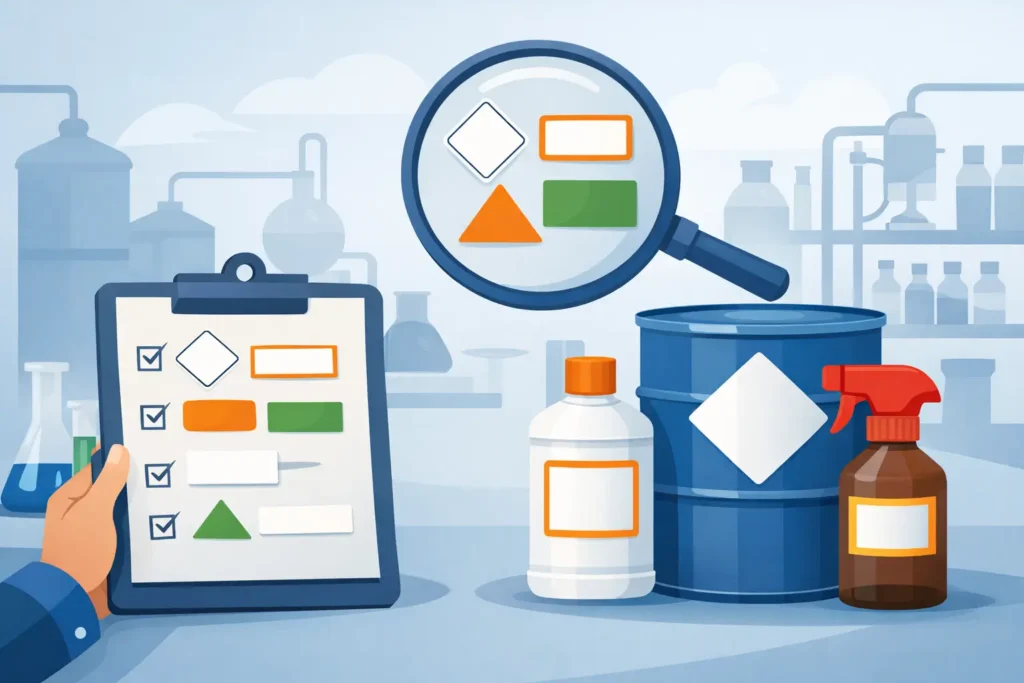
A chemical label that looks fine when it leaves the printer can become unreadable after one shift on a production floor. Solvent splash, condensation, abrasion, outdoor storage, freezer temperatures, and routine handling all test the label, adhesive, print, and container surface at once. When operations teams ask what labels work for chemicals, the useful answer is not a single material. It is the label construction that remains legible, attached, and compliant throughout the chemical’s real lifecycle.
For industrial facilities, chemical labeling is a safety control and an operational control. The label must communicate hazards clearly, but it may also carry a barcode, lot number, expiration date, batch information, handling instructions, or inventory location. A failure can slow receiving, compromise traceability, create a safety concern, or lead to a compliance issue.
What Labels Work for Chemicals? Start With the Exposure
The first selection question is not, “What is the toughest label?” It is, “What will this label encounter?” A label for a sealed bottle of laboratory reagent stored indoors has different requirements than one applied to a drum of corrosive material in an outdoor chemical yard.
Chemical exposure matters, but so does the source of exposure. A label may need to resist the product inside the container, leaks around a cap, cleaning agents used in the area, or chemicals transferred onto the surface by workers wearing gloves. Temperature cycles can be equally damaging. A label applied in a warm receiving area may later be stored in a refrigerator, freezer, or hot process environment. Expansion, contraction, moisture, and rough handling can weaken an otherwise suitable adhesive.
Container material also changes the equation. High-density polyethylene, polypropylene, glass, steel, painted metal, and low-surface-energy plastics do not accept adhesives in the same way. A label that adheres well to clean glass may lift from a textured plastic drum or a container with mold-release residue. The container’s shape matters too. Tight curves, molded ridges, seams, and recessed panels can create areas where a rigid label bridges rather than bonds.
Match the Facestock to the Job
Paper labels can be appropriate for controlled indoor applications, short-term identification, or chemical containers that will not be exposed to moisture, abrasion, or aggressive cleaning. They are economical and often print well, but they are rarely the right choice when label life extends into wet, cold, or chemically demanding conditions.
For most chemical environments, film label materials provide better durability. Polypropylene is a common choice for containers exposed to moderate moisture and handling. Polyester offers stronger resistance to abrasion, heat, and many chemicals, making it a frequent choice for durable asset identification, laboratory containers, and industrial chemical applications. Vinyl can be useful when flexibility and conformability are priorities, particularly on curved or uneven surfaces.
There is no universal hierarchy where one film always outperforms another. A polyester label may be highly durable but less conformable on a tight-radius container than a thinner polypropylene or vinyl construction. The right selection depends on the container, the exposure, the expected service life, and the information that must remain readable.
Consider Laminates and Protective Overlays
When printed data must survive repeated contact, a clear laminate or protective overlaminate can add another layer of protection. This is especially useful for barcodes, variable data, and small text that may be rubbed by gloves, cartons, or handling equipment.
Protection has trade-offs. A laminate adds cost and can complicate application, particularly if labels are printed and applied in-house. It may be justified when replacing failed labels costs more in labor, downtime, or lost traceability than the added material cost. For high-value materials, regulated products, or long-term chemical inventory, that calculation often favors a more durable construction.
Adhesive Selection Is as Important as Label Material
A durable facestock with the wrong adhesive will still fail. Adhesive must be matched to the surface condition and temperature at the time of application, not just the operating environment after application.
Permanent acrylic adhesives are widely used for industrial labels because they can provide good chemical and temperature resistance. However, application temperature can be a deciding factor. Containers labeled in a cold warehouse may require an adhesive designed to bond at lower temperatures. Likewise, labels applied to drums or bottles with textured, curved, or low-surface-energy plastic surfaces may need a more aggressive adhesive.
Removable adhesives have a place in chemical operations when containers are reused, contents change frequently, or temporary quarantine and inspection labels are needed. The key is confirming that removal will not leave residue or obscure required information. A removable inventory label should never compromise the underlying supplier or hazard communication label.
Before standardizing a label, test it on actual containers. Apply labels to production-grade surfaces, allow the adhesive to cure as recommended, and expose samples to the temperatures, moisture, cleaners, and handling conditions they will face. Testing only on a clean sample bottle at room temperature is not a meaningful substitute for a real-world trial.
Use the Right Print Method and Ribbon
Label durability is also determined by how the image is printed. Direct thermal printing can be efficient for short-life labels, but its heat-sensitive image can darken, fade, or become difficult to scan when exposed to heat, sunlight, friction, or certain chemicals. It is generally a poor fit for long-term chemical identification.
Thermal transfer printing is often the better choice for chemical labels because it uses a ribbon to create a more durable image. The ribbon formulation should match the label material and exposure. Wax ribbons are suitable for many paper applications, while wax-resin ribbons improve scratch resistance. Resin ribbons provide the highest level of resistance for many film materials and demanding environments.
A resin ribbon alone does not guarantee performance. The printhead settings, label surface, ribbon compatibility, and barcode design all affect print quality. Excessive heat can distort fine barcode elements or cause ribbon smear; insufficient heat can produce weak print that scratches away. A properly configured industrial printer and a verified ribbon-label combination are part of the system, not an afterthought.
Separate Hazard Communication From Transport and Operations Labels
Chemical labeling can involve several overlapping requirements. A supplier container in the workplace may require Hazard Communication Standard elements such as product identification, signal word, hazard statements, pictograms, precautionary statements, and supplier information. Secondary containers may require workplace labeling that identifies the chemical and communicates the applicable hazards, subject to the facility’s process and regulatory requirements.
Shipping and transport labels are different. Packages moving by ground, air, or other modes may require Department of Transportation markings, labels, placards, and documentation based on the material and transport classification. Those requirements should be evaluated separately from workplace container labels.
Operations teams also frequently need internal identification: barcodes for receiving and dispensing, lot and expiration data, warehouse location information, or status labels for quality hold and disposal. These are valuable additions, but they must be designed so they do not cover required hazard information or create confusion between internal and regulatory identifiers.
For marine or outdoor transportation applications, durability standards such as BS 5609 may be relevant. For workplace chemical labels, organizations should confirm the applicable OSHA, DOT, EPA, state, customer, and industry requirements for their specific materials and use cases. Label construction supports compliance, but it does not replace a sound hazard communication program.
Validate Barcode Readability After Exposure
A barcode that scans at the printer is not automatically a barcode that will scan in the warehouse three months later. Chemical residue, surface scratching, fading, and label lift can all degrade scan performance. This matters when a barcode supports inventory accuracy, chain-of-custody records, batch control, or emergency response information.
Design barcodes with sufficient size, contrast, and quiet zones for the scanning distance and equipment used in the facility. Then test them after exposure. Scan samples using the same handheld, vehicle-mounted, or fixed scanners used by employees. If labels will be read through stretch wrap, from a distance, or in poor lighting, test those conditions as well.
Build a Chemical Labeling System, Not a One-Time Purchase
The strongest chemical labeling programs standardize approved label constructions by application. A facility might use one durable film and resin ribbon combination for chemical drums, another for small laboratory bottles, and a temporary thermal label for short-duration staging. This reduces guesswork for purchasing, receiving, production, and EHS teams.
It also helps to document the approved printer settings, ribbon part numbers, label sizes, barcode formats, and label templates. When hardware, software, supplies, and workflow are aligned, teams can produce accurate labels on demand without relying on improvised materials or inconsistent manual processes.
PaladinID helps organizations evaluate those interconnected requirements, from container and exposure conditions to printer compatibility and variable-data workflows. The goal is not simply to select a label that sticks. It is to establish an identification process that continues to perform when the chemical, container, and operating environment put it to work.
A practical next step is to collect a few representative containers and test candidate labels under the conditions that cause the most failures in your operation. The result will be more useful than a generic material recommendation and far less expensive than discovering a label problem after products are already in the field.
At PaladinID, we understand that every labeling application is different.
That’s why companies across the country trust us to help them identify the right solution for their business. With over 40 years of experience and one of the industry’s largest selections of labeling products, we make it easy to find the right fit for your operation. Whether you need stock products or a custom-built solution, our team is ready to help. Visit our online catalog, Email us, or call us today at 888.972.5234.
PaladinID delivers label solutions that stick!

Got Labeling Questions? Our AI Assistant Has Answers - Chat Now!
For more information on PaladinID
Get Help With Your Next Label Project
We have over 35 years of providing exceptional service and labeling products to the world. Take the first step to an easy, stress-free solution for your label needs by contacting us.
Schedule a call below or email [email protected]
Make Your Mark
“Making companies more competitive by offering the correct label printing solution, on time, within budget, while creating unmatched value”.
About PaladinID, LLC
PaladinID develops and supports high-performance barcode labeling applications. We work with our clients to “Make Your Mark” by providing the expertise and tools necessary to create an entire product label printing solution. Located in central New Hampshire, PaladinID has been serving Massachusetts, Vermont, Maine, Connecticut, Rhode Island, New England, and beyond for over 30 years, and in 2017, became an RFID-certified company. We look forward to working with you.
You may be interested in our other services:
Product Labels
Product Labels
Labels for every type of application: Blank, Pre-printed, Variable data
Label Printers
Label Printers
We sell and support: Direct/thermal transfer, Inkjet, Laser
Printer Ribbons
Printer Ribbons
We sell ribbons for ALL barcode printers including: Zebra, Datamax, Sato, Intermec
Flexible Packaging
Flexible Packaging
We offer a wide variety of packaging containers for your products.
Label Software
Label Software
Software for all barcode printing and product labeling.
Label applicators
Label Applicators
Wide selection of applicators: Desktop/Mobile, Applicator only, Print & apply
