
Warehouse Rack Labels That Improve Accuracy




What Can We Help You With?
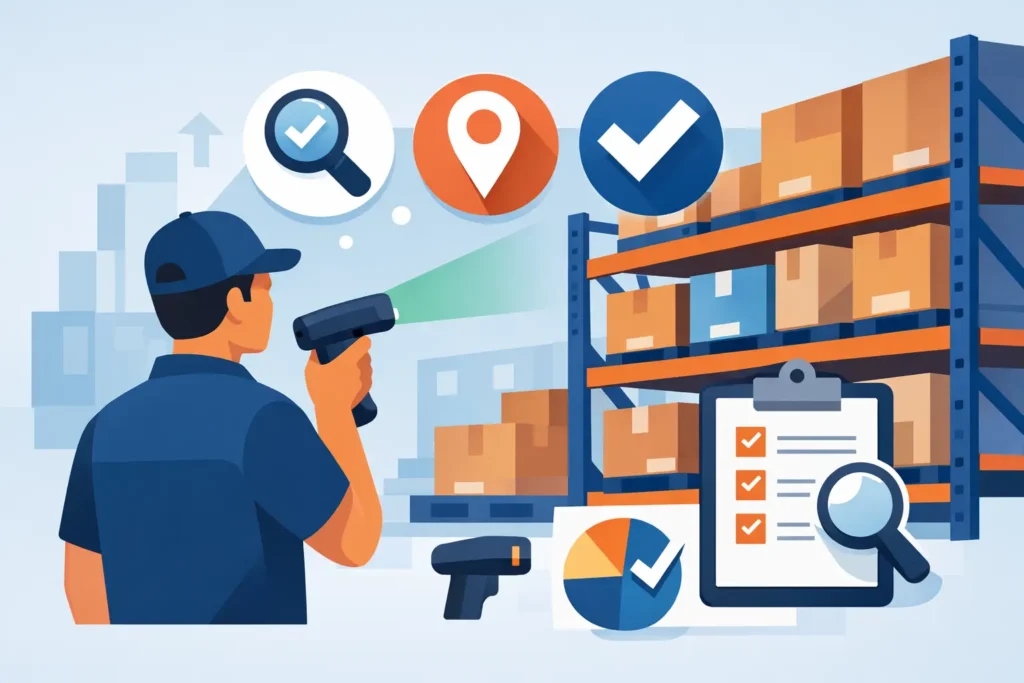
A picker scans Bay A, Level 3, Position 12 and the system rejects it. The label is still there, but the barcode is scratched, the text is too small from forklift height, and the rack beam has taken enough hits to curl the edge. That is how a simple location marker turns into a delay, a mis-pick, or a manual workaround. Warehouse rack labels matter because they sit at the point where inventory accuracy meets real warehouse traffic.
For many operations, rack labels look like a small detail until receiving slows down, cycle counts drift, or operators start relying on memory instead of scans. A well-designed rack labeling system supports slotting, replenishment, picking, putaway, and auditability. A poor one creates friction at every step. The difference is usually not just the label itself. It is the combination of material, print method, barcode design, placement, and the realities of the environment.
What warehouse rack labels are expected to do
A rack label has one job on paper – identify a location. In practice, it often has to do much more. It may need to support 1D or 2D barcode scanning from a forklift, remain readable in low light, survive abrasion from cartons and pallets, and stay adhered to painted steel, powder-coated uprights, or wire decking accessories. In some facilities, it also needs color cues for zones, cross-aisles, temperature-controlled areas, or customer-specific segregation.
That is why warehouse labeling decisions are rarely one-size-fits-all. A small parts facility with hand scanners has different requirements than a high-bay warehouse with long-range scanning. A dry distribution center has different durability needs than a freezer, yard, or dusty manufacturing warehouse. The label format that works well for a static rack position may not be the best fit for dynamic slotting or relabeling during reconfiguration.
Why warehouse rack labels fail in the field
Most rack label failures come from mismatch rather than outright product defects. The label may be printed correctly, but not for the way it will actually be used.
One common issue is size. A barcode that scans perfectly at arm’s length may fail when an operator tries to read it from equipment several feet away. Another is surface selection. Adhesives that hold on smooth indoor surfaces can struggle on textured coatings, cold racks, or areas exposed to dust and impact. Placement also matters. Labels mounted where stretch wrap, pallet overhang, or beam contact can hit them will wear faster even if the material itself is durable.
Print quality is another frequent weak point. Location labels are often expected to stay in place for years, which makes print technology important. If the image fades, smears, or loses edge definition, scan performance drops well before the label fully fails. This is one reason industrial printing methods and compatible ribbons matter in warehouse applications.
Choosing the right label format for the rack
The rack structure usually tells you a lot about what label style will perform best. Beam labels are common because they are easy to place at eye level and work well for many pick faces. Upright labels can be better protected in some layouts and may make more sense where beam space is limited. For lower rack positions exposed to repeated pallet contact, some facilities move labels to angled signs, placards, or retroreflective formats designed for long-range scanning.
There is also a practical trade-off between label accessibility and label protection. A label in the most convenient scan position may also be in the highest damage zone. In those cases, it can make sense to adjust placement, use protective overlays or frames, or move to a hanging or suspended location marker if the aisle layout supports it.
Color can help, but only when it is used consistently. Zone colors, aisle markers, and sequence logic can improve wayfinding and reduce operator hesitation. If color is added without a clear standard, it becomes visual noise. The same applies to human-readable text. Bigger is not always better, but the text should be large enough to confirm the location when a barcode cannot be scanned immediately.
Barcode design affects more than scan success
Barcode design for rack labels should match scanner capability, distance, and workflow speed. Narrow bars and dense data fields may conserve space, but they can create problems in motion or at longer distances. In many facilities, location labels do not need heavy data content. They need fast, repeatable reads.
Quiet zones, contrast, bar height, and orientation all influence performance. So does symbology selection. A facility standard may already exist through the WMS or ERP, but if scan rates are poor, the root cause can be label design rather than scanner hardware. This is where testing under actual operating conditions matters more than lab assumptions.
Material and adhesive choices matter more than most teams expect
If a warehouse rack label is intended to stay in place for the long term, face stock and adhesive are not minor details. Paper labels may work in light-duty, short-term applications, but many warehouse environments need synthetic materials that resist tearing, moisture, scuffing, and chemical exposure.
Adhesive selection should reflect both the surface and the conditions at application. Clean indoor steel at room temperature is one scenario. Cold storage installation on racks with condensation risk is another. If labels are being applied during a rushed rollout without careful surface prep, that also affects results. Even the best material can fail if dust, oil, or low application temperature are ignored.
For operations with heavy forklift traffic or repetitive pallet movement, it may be worth stepping up from a standard pressure-sensitive label to a more protected approach. That could mean laminated labels, label holders, rigid signs, or specialty materials designed for impact-prone areas. The upfront cost is higher, but so is the cost of relabeling locations repeatedly and dealing with scan failures during production hours.
Printing warehouse rack labels for long-term performance
Rack labels are not typical office labels. They are operational assets. That changes the print requirements.
Industrial thermal transfer printing is often a better fit for long-life warehouse identification because it produces durable images when paired with the right ribbon and material. Consistency matters across the entire print run. If some labels scan better than others from day one, the problem may be calibration, media compatibility, or printhead condition rather than the barcode file itself.
It also helps to think beyond the first install. Warehouses evolve. Aisles are re-slotted, sections are renumbered, and temporary overflow locations become permanent. The best rack labeling systems are set up so replacements and additions can be produced with the same formatting, media, and barcode quality standard as the original rollout. That usually requires coordination between label supply, printer setup, software templates, and internal naming conventions.
Implementation is where good plans hold or break
A rack labeling project can look straightforward until rollout begins. Then teams run into inconsistent location logic, missing sequence standards, equipment limitations, or racks that do not match the original map. Those issues are not unusual. They are exactly why implementation planning matters.
A strong rollout starts with validating the location structure before labels are printed in volume. It also helps to define scan distance, mounting height, damage risks, and any special zones in advance. If multiple facilities are involved, standardization becomes even more important. Label formats should be consistent enough to support training and system integration, while still allowing for site-specific conditions.
This is also where an experienced labeling partner can make a measurable difference. PaladinID works with organizations that need warehouse identification systems to function as part of a larger operational process, not as disconnected label purchases. That means looking at the printer, ribbon, media, barcode format, and application environment together.
When to rethink your current warehouse rack labels
If operators are keying in locations instead of scanning them, that is a warning sign. If labels need frequent replacement, if barcode verification issues keep surfacing, or if new hires struggle to navigate aisles cleanly, the problem may not be labor discipline. It may be label design that no longer fits the workflow.
Growth often exposes these weaknesses. A labeling approach that worked in one zone or one building can start to break when SKU counts rise, slotting changes accelerate, or equipment types expand. The right time to review rack labels is not only after a failure. It is when the operation changes enough that the old assumptions no longer hold.
Warehouse rack labels perform best when they are treated as part of the infrastructure. They support accuracy quietly when they are designed well, and they create daily friction when they are not. If your location labels are expected to carry the load of fast scanning, long service life, and clear identification, they need to be built for the warehouse you actually run, not the one shown on a layout drawing.
Need Help Choosing the Right Labeling Solution?
At PaladinID, we understand that every labeling application is different.
That’s why companies across the country trust us to help identify the right labeling, barcode, and identification solutions for their operations. With more than 40 years of experience and one of the industry’s largest selections of labels, thermal transfer ribbons, barcode printers, barcode scanners, and identification products, we make it easy to find the right solution for your business.
Whether you need stock products, custom labels, or a fully engineered identification solution, our experienced team is ready to help. Browse our online catalog, email us, or call 888.972.5234 to discuss your application with one of our labeling specialists.
PaladinID delivers label solutions that stick!


Got Labeling Questions? Our AI Assistant Has Answers - Chat Now!
For more information on PaladinID
Get Help With Your Next Label Project
We have over 35 years of providing exceptional service and labeling products to the world. Take the first step to an easy, stress-free solution for your label needs by contacting us.
Schedule a call below or email [email protected]
Make Your Mark
“Making companies more competitive by offering the correct label printing solution, on time, within budget, while creating unmatched value”.
About PaladinID, LLC
PaladinID develops and supports high-performance barcode labeling applications. We work with our clients to “Make Your Mark” by providing the expertise and tools necessary to create an entire product label printing solution. Located in central New Hampshire, PaladinID has been serving Massachusetts, Vermont, Maine, Connecticut, Rhode Island, New England, and beyond for over 30 years, and in 2017, became an RFID-certified company. We look forward to working with you.
You may be interested in our other services:
Product Labels
Product Labels
Labels for every type of application: Blank, Pre-printed, Variable data
Label Printers
Label Printers
We sell and support: Direct/thermal transfer, Inkjet, Laser
Printer Ribbons
Printer Ribbons
We sell ribbons for ALL barcode printers including: Zebra, Datamax, Sato, Intermec
Flexible Packaging
Flexible Packaging
We offer a wide variety of packaging containers for your products.
Label Software
Label Software
Software for all barcode printing and product labeling.
Label applicators
Label Applicators
Wide selection of applicators: Desktop/Mobile, Applicator only, Print & apply
