
Zebra PolyPro 4000T Labels: When Polypropylene Is the Right Choice for Barcode Durability


What Can We Help You With?
A barcode label that scans perfectly at receiving can become a source of costly errors weeks later if it smears, curls, tears, or loses adhesion. That’s why choosing the right label material is just as important as selecting the right printer or barcode symbology.
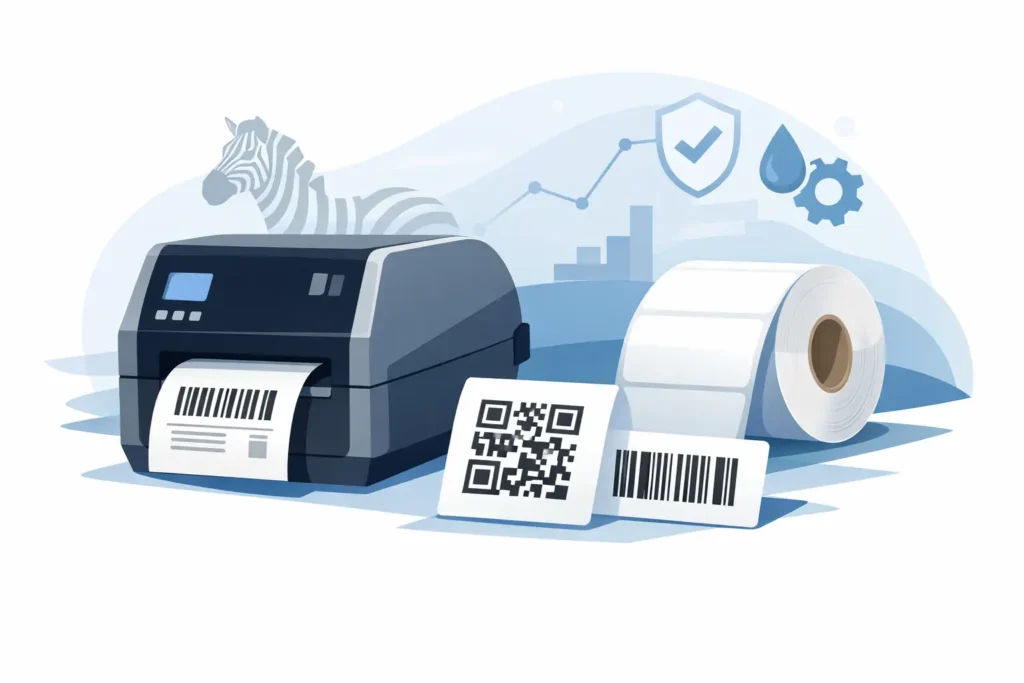
Zebra PolyPro 4000T is a thermal-transfer polypropylene label material designed for applications where standard paper labels may not offer sufficient durability. For operations that rely on accurate barcode scanning, asset identification, or inventory tracking, it offers a synthetic labeling solution built to withstand more demanding environments.
The label itself is part of the overall identification system—not simply the finishing touch. When a warehouse operator cannot scan a pallet label, a technician cannot read an asset tag, or a product label fails before its job is complete, the disruption extends well beyond the cost of replacing a label. Selecting the proper face stock, adhesive, ribbon, printer settings, and label design from the beginning helps prevent those avoidable failures.
Where Zebra PolyPro4000T Performs Best
Zebra PolyPro4000T is a thermal-transfer polypropylene material engineered for applications that require greater durability than paper labels typically provide. Polypropylene offers improved resistance to moisture, tearing, and routine handling, making it well suited for indoor and short- to medium-term applications exposed to humidity, abrasion, and everyday industrial conditions.
Typical applications include:
- Warehouse bins, racks, totes, and returnable containers
- Manufacturing work-in-process labels
- Asset identification
- Equipment and tool tracking
- Inventory labels requiring long-lasting barcode readability
Organizations implementing durable labeling across multiple facilities often find that consistent materials work best when paired with standardized labeling practices. Developing clear warehouse labeling standards helps ensure labels perform consistently regardless of location or shift.
Of course, no label material works in isolation. Even a durable polypropylene face stock cannot compensate for an adhesive that doesn’t match the application, an incompatible ribbon, or a barcode that’s too small to scan reliably. Every component of the labeling system should be evaluated together.
Why Choose Polypropylene Instead of Paper?
Paper labels remain an excellent choice for shipping labels, temporary inventory identification, and other short-life applications where cost is the primary consideration.
Polypropylene becomes more attractive as handling and environmental exposure increase.
Compared to paper, polypropylene labels generally offer:
- Better resistance to tearing
- Improved moisture resistance
- Greater durability during repeated handling
- More consistent barcode readability over time
- A smooth print surface for high-quality thermal transfer printing
For operations where damaged labels create rescanning, relabeling, or inventory errors, the added durability often reduces overall operating costs—even if the material itself costs more.
The question isn’t whether film labels are stronger than paper. It’s whether the operational cost of label failure exceeds the additional investment in a more durable material. We do carry several PolyPro 400T sizes in stock, but we can produce any size or shape you need for your application.
Match the Label to the Surface
Surface compatibility is one of the first considerations when selecting any label construction.
A label applied to smooth plastic may perform very differently when used on corrugated cartons, powder-coated equipment, painted metal, textured surfaces, or curved containers.
Surface condition is equally important. Dust, oil, condensation, release agents, and application temperature all influence adhesive performance. Labels applied in refrigerated receiving areas and later moved into warm production environments may behave differently than labels applied under stable indoor conditions.
Expected service life also matters. Labels intended for temporary production tracking have very different requirements than asset tags expected to remain readable for years.
If the application involves prolonged UV exposure, aggressive chemicals, sterilization, high heat, or extreme abrasion, another engineered material or adhesive system may be a better fit. Real-world application testing remains the best way to validate material performance.
Thermal Transfer Printing Is Part of the System
PolyPro4000T is designed for thermal transfer printing, where a ribbon transfers the image onto the label surface. Unlike direct thermal labels, thermal transfer printing is typically chosen when barcode longevity and print durability are priorities.
Ribbon selection directly affects label performance.
Wax ribbons may be sufficient for many paper applications, while wax-resin and resin ribbons generally provide greater resistance to abrasion, chemicals, and environmental exposure on polypropylene materials. The correct ribbon depends on the label material and the operating environment.
Printer configuration is equally important. Darkness settings, print speed, media calibration, and printhead condition all influence barcode quality. Excessive heat can blur fine detail, while insufficient heat can produce images that scratch or fade prematurely.
This is why improving print quality is one of the keys to improving barcode accuracy throughout the labeling process.
For critical applications, always test printed labels under actual operating conditions using the same scanners deployed in the field. Where customer specifications or regulatory requirements apply, barcode verification may also be appropriate.
Questions to Answer Before Ordering
Before standardizing on a PolyPro4000T construction, document the factors that affect label performance.
Ask questions such as:
- What surface will receive the label?
- How long must it remain attached and readable?
- Will it encounter moisture, chemicals, oils, abrasion, or outdoor exposure?
- Which printer model, printhead resolution, and ribbon will be used?
- What barcode symbology and variable information must be printed?
- What label size, roll orientation, and core dimensions fit existing equipment?
Answering these questions early helps determine whether a stock label meets the application’s needs or whether a custom construction will provide better long-term performance.
Prevent Common Labeling Failures
Many labeling problems originate in the process rather than the material itself.
Labels may lift because they’re applied to contaminated surfaces or outside the adhesive’s recommended temperature range. The print may scratch because the ribbon was selected for cost rather than durability. Barcode failures often result from worn printheads, poor calibration, or label designs that leave insufficient space for the barcode.
Conducting a small production trial before full deployment helps uncover these issues early. Print labels using production equipment, apply them to actual products or assets, and evaluate their performance under normal handling and storage conditions.
Once an application is qualified, standardize approved materials, ribbons, printer settings, and operating procedures. Reducing variation across facilities helps maintain consistent labeling performance over time.
Build a Complete Labeling System
A durable label delivers the best results when it’s supported by compatible printers, ribbons, software, and operating procedures.
The printer must consistently produce high-quality images. The ribbon must match both the label material and the environment. Label software should generate accurate, standardized information, while operators need clear procedures for media loading, calibration, and routine maintenance.
Organizations looking to strengthen inventory control often benefit from evaluating their overall inventory labeling strategy rather than focusing solely on label material.
At PaladinID, we help organizations evaluate the entire labeling system—not just the label itself. Whether you’re replacing paper labels that fail in the field, adding variable-data barcode printing, or standardizing labeling across multiple facilities, we can help identify the right combination of labels, ribbons, printers, and software for your operation.
The best way to determine whether Zebra PolyPro4000T is the right solution is to test it under your actual operating conditions. A label that continues scanning accurately after weeks or months of real-world handling delivers lasting value by reducing errors, minimizing relabeling, and keeping operations moving efficiently.
At PaladinID, we understand that every labeling application is different.
That’s why companies across the country trust us to help them identify the right solution for their business. With over 40 years of experience and one of the industry’s largest selections of labeling products, we make it easy to find the right fit for your operation. Whether you need stock products or a custom-built solution, our team is ready to help. Visit our online catalog, Email us, or call us today at 888.972.5234.
PaladinID delivers label solutions that stick!

Got Labeling Questions? Our AI Assistant Has Answers - Chat Now!
For more information on PaladinID
Get Help With Your Next Label Project
We have over 35 years of providing exceptional service and labeling products to the world. Take the first step to an easy, stress-free solution for your label needs by contacting us.
Schedule a call below or email [email protected]
Make Your Mark
“Making companies more competitive by offering the correct label printing solution, on time, within budget, while creating unmatched value”.
About PaladinID, LLC
PaladinID develops and supports high-performance barcode labeling applications. We work with our clients to “Make Your Mark” by providing the expertise and tools necessary to create an entire product label printing solution. Located in central New Hampshire, PaladinID has been serving Massachusetts, Vermont, Maine, Connecticut, Rhode Island, New England, and beyond for over 30 years, and in 2017, became an RFID-certified company. We look forward to working with you.
You may be interested in our other services:
Product Labels
Product Labels
Labels for every type of application: Blank, Pre-printed, Variable data
Label Printers
Label Printers
We sell and support: Direct/thermal transfer, Inkjet, Laser
Printer Ribbons
Printer Ribbons
We sell ribbons for ALL barcode printers including: Zebra, Datamax, Sato, Intermec
Flexible Packaging
Flexible Packaging
We offer a wide variety of packaging containers for your products.
Label Software
Label Software
Software for all barcode printing and product labeling.
Label applicators
Label Applicators
Wide selection of applicators: Desktop/Mobile, Applicator only, Print & apply
