
Zebra CryoCool Labels for Lab Sample Tracking




What Can We Help You With?
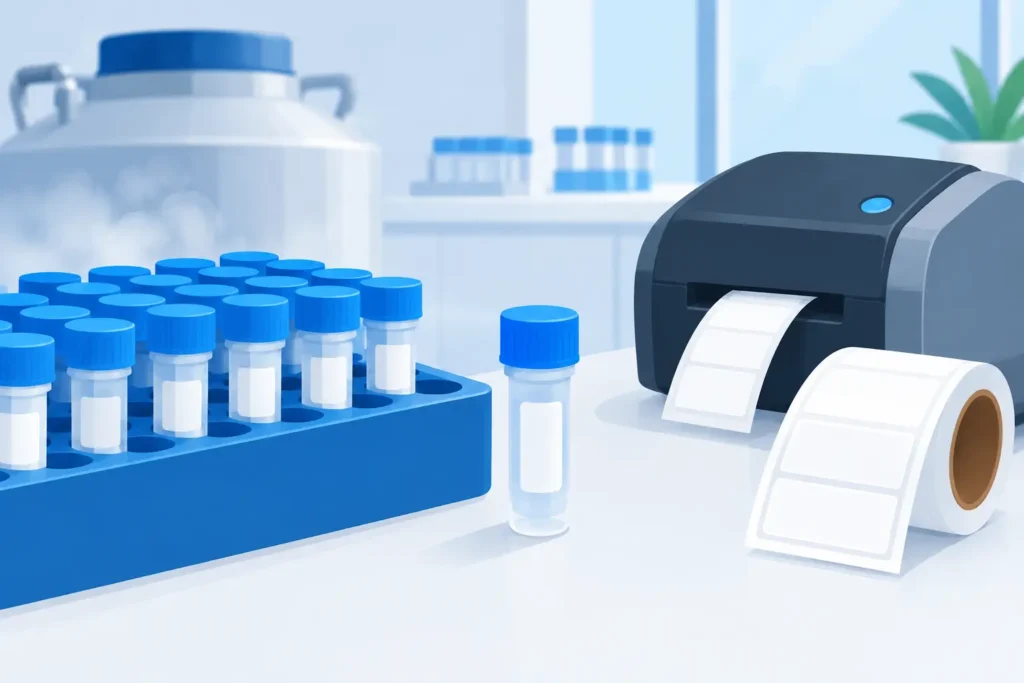
A sample label that fails after storage can turn a routine retrieval into an unexpected investigation. When tubes, vials, and plates move through freezing, thawing, transportation, and repeated handling, labels must stay securely attached and barcodes must remain scannable. Zebra CryoCool labels are designed for applications where conventional labels may not withstand demanding cold-storage workflows.
For laboratories, biobanks, pharmaceutical companies, and life sciences operations, successful labeling involves more than simply printing a label. The real challenge is ensuring the entire identification system produces readable, durable, correctly placed labels at the speed and consistency the workflow requires.
That means evaluating every part of the process: label material, adhesive, printer, ribbon, barcode design, scanner performance, and handling procedures. When these elements work together, organizations can build a more dependable sample identification process.
Where Zebra CryoCool Labels Fit
Cryogenic sample identification comes with unique challenges that ordinary inventory and shipping labels may not be designed to handle. Labels may need to adhere to small-diameter tubes, glass vials, microplates, freezer boxes, and larger containers. Along the way, they may encounter ultra-low temperatures, condensation, abrasion from racks and gloves, and repeated movement between storage and work areas.
Zebra CryoCool labels are intended for these specialized cold-chain and laboratory environments. Depending on the specific material and application, they can support identification on containers stored in low-temperature conditions while maintaining clear human-readable text and machine-readable barcode data.
However, the exact label construction matters. Container materials, application temperatures, storage temperatures, and exposure conditions can vary significantly from one workflow to another.
For example, a label applied to a vial at room temperature before freezer storage faces different conditions than one applied to a container that is already cold. Similarly, a label that performs well on a smooth polypropylene tube may not deliver the same results on a curved glass vial, frosted surface, or container exposed to frequent condensation.
The best product selection starts with your actual workflow—not just a general temperature rating.
Start With the Sample’s Full Journey
A reliable cryogenic labeling program considers every stage of a sample’s journey: creation, movement, storage, retrieval, and relabeling.
One common mistake is testing a label on a workbench, confirming that it prints correctly, and assuming the project is complete. The real challenges often appear later, when labels begin lifting at the edges, text smears during handling, or barcodes become difficult to scan through frost or condensation.
Before selecting materials, document the sample’s complete path. Consider:
- Container type and diameter: What types of tubes, vials, plates, or boxes need to be labeled?
- Available labeling area: How much space is available without covering important viewing areas?
- Application method: Are labels applied manually or through a semi-automated process?
- Temperature conditions: What are the temperatures during label application and storage?
- Handling requirements: Will containers be centrifuged, immersed, transported on dry ice, placed in racks, or handled while wearing gloves?
The information printed on the label deserves just as much attention.
A simple accession number may fit comfortably on a small tube label. However, a label containing a sample ID, date, lot number, study code, 2D barcode, and human-readable backup text requires more planning.
As data density increases, print quality and barcode sizing become more sensitive to printer resolution, ribbon selection, and scanner capabilities.
Tube, vial, and plate labeling are different jobs
Not every laboratory container presents the same labeling challenges. The container’s shape, surface, and available space all influence which label format will work best.
Small tubes create some of the tightest print-area restrictions. Labels must conform closely to the container without wrinkling, overlapping improperly, or covering critical viewing areas. For wrapped tube labels, the leading and trailing edges need sufficient adhesion because repeated insertion and removal from racks can catch exposed edges.
Vials introduce different challenges, including curved glass surfaces, potential condensation, and variations in surface texture.
Plates and freezer boxes generally provide more surface area, but their labels must still remain legible after cold exposure and repeated handling.
As a result, a single facility may need several label formats, even when all samples are managed through the same tracking system.
The Printer and Ribbon Matter as Much as the Label
Cryogenic labels are only one part of the finished product. The printer and ribbon also play important roles in producing durable, readable identification.
Thermal transfer printing is commonly used when long-term durability and resistance to handling are required because the ribbon transfers the image onto the label surface. However, using an incompatible ribbon can result in light text, poor edge definition, incomplete barcode modules, or insufficient durability for the intended environment.
Zebra industrial and desktop thermal transfer printers can be configured for laboratory labeling workflows. The right model depends on several factors, including label dimensions, expected print volume, print resolution requirements, and connectivity needs.
For example, small vial labels containing dense 2D codes may require higher print resolution than a larger freezer box label. Choosing a printer based solely on speed may not provide the fine detail needed for small Data Matrix symbols.
Ribbon compatibility is equally important. The ribbon must work with the label’s topcoat and meet the performance requirements of the application.
Wax, wax-resin, and resin ribbon formulations each behave differently. For cold-storage sample labels, resin-based solutions are often evaluated when greater print durability is needed. However, the appropriate choice depends on the approved label-ribbon combination and the types of exposure the printed image will experience.
This is where real-world testing is more valuable than assumptions.
Print representative label data, apply the labels using the actual procedure, and expose them to the same conditions the samples will encounter. Then evaluate:
- Adhesion and whether the label remains securely attached
- Print readability after exposure and handling
- Barcode scanning performance
- Resistance to abrasion
Testing should also include the scanners used at the point of sample retrieval—not just a scanner at the printing station.
Design Barcodes for Real Retrieval Conditions
A barcode that scans perfectly under bright laboratory lighting may not perform as consistently in a cold room or at a freezer rack.
Frost, glare, tight label placement, scanner angle, and small symbol size can all affect first-pass scanning success. These conditions should be considered during label design, not after problems begin.
For smaller label formats, 2D barcodes can store more data in less space than linear barcodes. However, smaller symbols require careful attention to print settings and verification.
Make sure to:
- Leave adequate quiet zones where required by the barcode symbology.
- Avoid placing critical barcode elements over label seams or extreme curves.
- Choose a font size that operators can comfortably read when a scanner is unavailable.
A consistent data structure can also make sample identification more reliable. When every label follows the same format for sample ID, specimen type, date, and storage location, staff can recognize information and identify exceptions more quickly.
Labeling software can help support standardized templates and variable data fields. This reduces the need for operators to manually rebuild labels or enter inconsistent information at individual workstations.
Validate before standardizing
A practical validation process does not need to be unnecessarily complicated, but it should be thorough and intentional.
Test labels across a representative range of container sizes, storage durations, and handling conditions. Include labels printed from multiple positions across the print width, and evaluate output as ribbons and printheads age.
Before deploying a labeling system across an entire operation, teams should verify:
- Adhesion: Does the label remain attached after the expected cold-storage exposure?
- Barcode readability: Can the production scanner consistently read the barcode?
- Print durability: Does the printed information remain clear after routine handling and rack movement?
- Data accuracy: Are the template data, numbering, and barcode encoding correct?
- Application consistency: Can the people applying the labels position them consistently?
Document the selected label, ribbon, printer settings, and application procedure. This information becomes especially valuable when training new staff, replacing a printer, or troubleshooting changes in scanning performance.
Common Problems and What They Usually Indicate
Even a carefully planned labeling system can encounter problems. The key is understanding what those problems may indicate so teams can address the underlying cause rather than repeatedly correcting the same issue.
When labels lift: The cause may be surface contamination, insufficient pressure during application, an adhesive that is unsuitable for the container or application temperature, or a label format that is too large for the container’s curve.
Cleaning and drying containers before labeling can help, but these steps cannot compensate for selecting the wrong material.
When barcodes scan inconsistently: Start by inspecting print contrast and edge clarity. Low darkness settings, incorrect ribbon selection, a worn printhead, or label movement during printing can all reduce barcode quality.
If the print quality looks good but scanning remains unreliable, review the barcode size, orientation, label placement, and whether the scanner is suitable for the code type.
When operators apply labels inconsistently: The solution may be a better label format rather than additional reminders. A well-designed label with clear alignment cues and an appropriate width can help reduce variation.
For higher-volume workflows, a dispenser or applicator or a standardized workstation setup may be justified.
Build a Supportable Cryogenic Labeling System
Laboratory identification systems need to remain dependable over time. Labels and ribbons are recurring consumables, printers require maintenance, and templates evolve as studies, sample types, and compliance requirements change.
That means procurement teams should look beyond the price of a roll. They should also evaluate material availability, printer support, replacement printheads, template management, and troubleshooting assistance.
PaladinID helps organizations evaluate the complete labeling environment—from specialized label materials and compatible ribbons to printer selection and workflow implementation.
This approach can be especially valuable when a laboratory is replacing an unreliable label, introducing new sample containers, or standardizing identification across multiple locations.
The best next step is to gather a few representative containers, define the storage and handling conditions, and conduct an application-specific test.
A label that remains attached and readable when a sample is needed is more than a small detail. It’s an essential part of the chain of custody your operation depends on.
PaladinID: Make Your Mark.
At PaladinID, we don’t just sell labels—we solve labeling problems. From specialized label materials and printing solutions to complete labeling workflows, our team can help you find the right solution for your application.
Visit more on our website, PaladinID.com, to learn more about our labeling solutions or contact our team to discuss your labeling needs.


Got Labeling Questions? Our AI Assistant Has Answers - Chat Now!
For more information on PaladinID
Get Help With Your Next Label Project
We have over 35 years of providing exceptional service and labeling products to the world. Take the first step to an easy, stress-free solution for your label needs by contacting us.
Schedule a call below or email [email protected]
Make Your Mark
“Making companies more competitive by offering the correct label printing solution, on time, within budget, while creating unmatched value”.
About PaladinID, LLC
PaladinID develops and supports high-performance barcode labeling applications. We work with our clients to “Make Your Mark” by providing the expertise and tools necessary to create an entire product label printing solution. Located in central New Hampshire, PaladinID has been serving Massachusetts, Vermont, Maine, Connecticut, Rhode Island, New England, and beyond for over 30 years, and in 2017, became an RFID-certified company. We look forward to working with you.
You may be interested in our other services:
Product Labels
Product Labels
Labels for every type of application: Blank, Pre-printed, Variable data
Label Printers
Label Printers
We sell and support: Direct/thermal transfer, Inkjet, Laser
Printer Ribbons
Printer Ribbons
We sell ribbons for ALL barcode printers including: Zebra, Datamax, Sato, Intermec
Flexible Packaging
Flexible Packaging
We offer a wide variety of packaging containers for your products.
Label Software
Label Software
Software for all barcode printing and product labeling.
Label applicators
Label Applicators
Wide selection of applicators: Desktop/Mobile, Applicator only, Print & apply
