
Choosing Material Options for Inkjet Labels


What Can We Help You With?
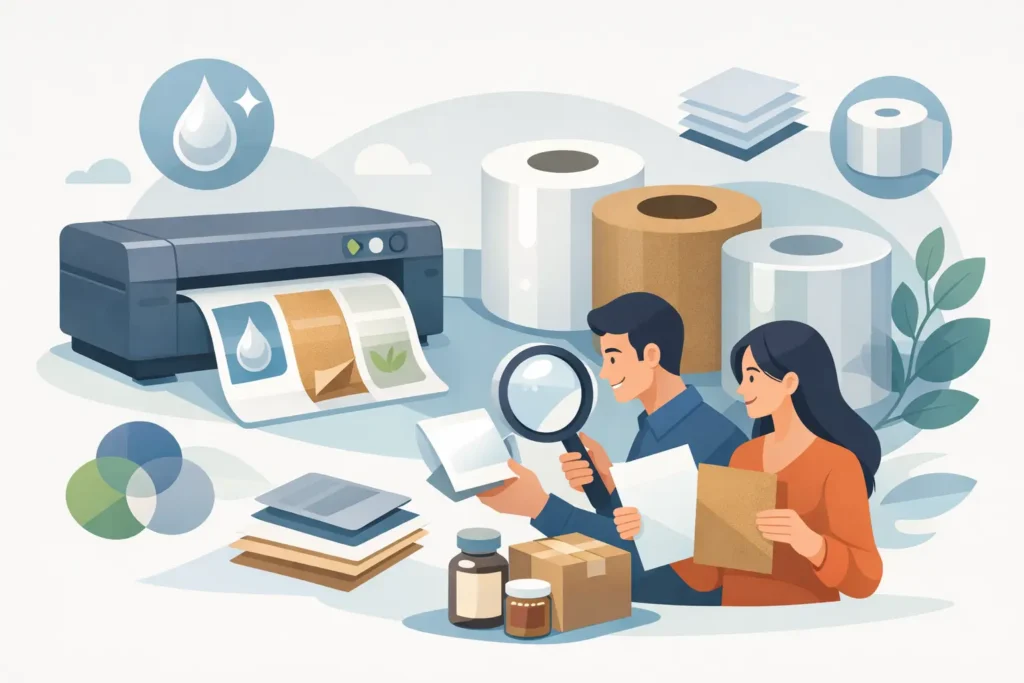
A label can look perfect when it comes off the printer and still fail before it reaches the customer, retail shelf, job site, or warehouse aisle.
Moisture can blur ink, freezer temperatures can weaken adhesive, and rough handling can damage an otherwise readable barcode. That’s why choosing the right material options for inkjet labels involves more than matching a label size to a printer. The face stock, adhesive, coating, and application environment all need to work together.
For operations teams, material selection directly affects scan accuracy, traceability, compliance, and replacement costs. The right label construction supports your workflow. The wrong one can lead to relabeling, inventory confusion, shipping errors, and unnecessary downtime.
Start With the Actual Labeling Environment
Inkjet labels are often chosen for their ability to produce high-resolution color graphics, sharp text, product information, and variable data. They’re an effective option for product labeling, retail packaging, promotional applications, and internal identification, especially when the printer, ink, and label material are designed to work together.
Before comparing material types, consider what the label will encounter after printing.
A label applied to a dry corrugated box in a climate-controlled facility has very different requirements from one placed on a chemical container, refrigerated food package, outdoor asset, or reusable tote.
Start by evaluating the surface being labeled. Is it cardboard, glass, painted metal, plastic, polyethylene, polypropylene, or a textured container?
Then consider the application temperature, operating temperature, exposure to water or oil, abrasion, sunlight, cleaning products, and expected label lifespan.
Barcode performance matters, too. A barcode that prints successfully but cannot be scanned consistently won’t support a reliable tracking or identification process.
Material Options for Inkjet Labels
The best face stock depends on the application, not just the appearance you’re trying to achieve.
When it comes to inkjet labels, paper remains a practical and economical choice for many indoor applications, while film materials offer greater resistance when moisture, frequent handling, and environmental exposure are part of everyday operations.
Paper Labels
Paper labels remain popular because they’re cost-effective, easy to convert, and available in a variety of finishes.
Matte paper provides a readable surface for text and barcodes, while gloss paper creates a brighter, more polished appearance for consumer-facing products.
For dry, indoor applications, paper may be the ideal solution. Common uses include shipping labels, carton identification, shelf labels, document labels, product labels with shorter service lives, and warehouse labels applied to clean, dry packaging.
Inkjet-compatible paper stocks feature specially designed coatings that control ink absorption, helping reduce feathering and improve color density.
The trade-off is durability.
Standard paper can tear, absorb moisture, and lose its appearance when exposed to condensation, oils, or repeated handling. If a label needs to remain readable through refrigeration, wash downs, outdoor storage, or long-term use, paper may not be the best choice without additional protection.
Polypropylene Labels
Polypropylene, often referred to as BOPP, is a film material well suited to applications where moisture resistance and product appearance are both important.
It’s commonly available in white, clear, and metallic formats, giving brands and operations teams flexibility when selecting a look that fits the container and intended use.
White polypropylene provides an opaque printable surface and is frequently used for bottles, jars, containers, and consumer packaged goods.
Clear polypropylene can create a no-label appearance on transparent packaging. However, the container’s color and the readability requirements for variable data need to be considered carefully.
Metallic films can support a premium product presentation, but they aren’t always the best background for high-contrast barcode printing.
Polypropylene offers better resistance to water and tearing than paper, but that doesn’t make it suitable for every demanding environment.
Performance still depends on the inkjet coating, adhesive, container surface, and exposure conditions. For example, a polypropylene label may handle occasional splashes well but require a more specialized construction for continuous immersion or aggressive chemical exposure.
Polyester Labels
Polyester, commonly known as PET, is a strong option when durability is a top priority.
It provides excellent tear resistance, dimensional stability, and resistance to many types of handling and environmental stress.
Polyester labels are commonly used for asset identification, equipment labels, durable goods, electronics, industrial containers, and other applications where labels need to remain securely attached and readable over an extended period.
For inkjet printing, polyester must have a compatible coating designed to accept the intended ink technology.
A film that looks suitable on a sample roll may not deliver acceptable print quality or ink adhesion in the field if its coating and the printer’s ink aren’t properly matched.
Polyester can also cost more than paper or some polypropylene constructions. That’s why it should be selected when its durability addresses a genuine operational requirement.
For a temporary shipping label, the additional expense may not be justified. For an asset tag expected to withstand years of use, polyester may be the more economical choice over the life of the application.
Vinyl and Other Specialty Films
Vinyl is often considered when flexibility and outdoor exposure are important.
It can conform to curved or irregular surfaces and may be used for equipment markings, outdoor containers, signage, and applications that require a more flexible film.
However, vinyl isn’t a universal solution. Environmental requirements, regulatory expectations, and the intended duration of use should all be reviewed before making a selection.
Other specialty materials can address more specific labeling challenges, including removable labels, tamper-evident constructions, high-tack adhesives, freezer-grade labeling, and labels designed for textured or low-surface-energy plastics.
These applications often benefit from testing because the interaction between the adhesive and the substrate is just as important as the face stock itself.
The Inkjet Coating Is Part of the Material Decision
The printable surface coating plays a major role in how ink behaves on a label.
It affects drying time, image sharpness, color quality, water resistance, and resistance to smudging. These factors are especially important for operations using pigment- or dye-based inks, since each ink type interacts differently with coated paper and film materials.
Dye-based inks often produce vivid colors but can be more vulnerable to moisture and fading unless paired with an appropriate coated material and protective finish.
Pigment inks generally provide better water and fade resistance, although results still depend on the printer, ink set, and overall label construction.
One common mistake is assuming that any material labeled “inkjet compatible” will perform equally well.
Compatibility is a starting point, not a guarantee of performance. Always evaluate print samples for barcode readability, drying time, rub resistance, label adhesion, and the actual conditions the finished product will encounter.
Adhesive Selection Can Decide Whether the Label Works
Even the highest-quality face stock can fail if the adhesive doesn’t bond properly to the application surface.
General-purpose permanent adhesives work well on many clean, dry surfaces. However, they may struggle with cold containers, rough corrugate, dusty warehouse assets, recycled plastics, or oily equipment.
Removable adhesives are useful when labels need to come off cleanly. Common applications include temporary inventory markings, promotional labels, and reusable containers.
The trade-off is lower long-term holding strength.
High-tack adhesives can improve bonding on difficult surfaces, but they may be harder to remove. They may also require additional attention during application to prevent wrinkles or trapped air pockets.
Temperature is another factor that’s frequently overlooked.
A label may perform well at room temperature after the adhesive has bonded but fail when applied in a cold environment.
Freezer-grade and cold-temperature adhesives are designed for applications where labels are applied to chilled packaging or used in refrigerated and frozen storage.
Both the application temperature and the service temperature should be specified when selecting an adhesive.
Match the Finish to Readability and Handling
Matte, gloss, and clear finishes each have their own operational advantages and considerations.
Matte finishes reduce glare and often make labels easier to scan under bright warehouse lighting. They’re a good option for barcode labels, variable information, and applications where employees need to read labels from different angles.
Gloss finishes can enhance color presentation and create a cleaner, more polished appearance for consumer-facing products. However, glare may become an issue, particularly on curved containers or under direct lighting.
Clear materials can create a refined package appearance, but they require strong contrast for barcodes and variable data. If a code is printed over a dark product, colored liquid, or busy package graphic, scanning performance may suffer.
For labels exposed to frequent handling, a protective overlaminate or varnish may also be worth considering.
These finishes can improve resistance to scuffing, moisture, and cleaning. However, they add cost and should be tested to confirm compatibility with the printed ink and label material.
Build a Reliable Inkjet Label System
Material selection shouldn’t happen independently of printer capabilities, ink type, label format, and workflow requirements.
The right label stock for a desktop color inkjet printer may differ from the construction needed for a higher-volume production inkjet system.
Even details such as roll diameter, core size, label gap, liner type, and unwind direction can affect printing performance and operator efficiency.
Testing becomes especially important when labels support regulated information, traceability, inventory control, or customer-facing product identification.
Evaluate samples using the actual container or substrate, printer, and ink. Then expose them to the conditions that could create problems, including cold storage, moisture, handling, abrasion, shipping, and cleaning.
A short testing process can help prevent a much larger material failure during full-scale production.
At PaladinID, we help organizations evaluate the complete labeling system, including material construction, print technology, barcode requirements, and the operational environment.
Our goal is to help teams move beyond choosing a label that simply prints well and find a solution that performs reliably where the work happens.
The best next step is to bring an actual sample of your container, package, asset, or substrate into the selection process. When materials are tested against the conditions they need to withstand, choosing the right label becomes much easier.
PaladinID — Make Your Mark.

Got Labeling Questions? Our AI Assistant Has Answers - Chat Now!
For more information on PaladinID
Get Help With Your Next Label Project
We have over 35 years of providing exceptional service and labeling products to the world. Take the first step to an easy, stress-free solution for your label needs by contacting us.
Schedule a call below or email [email protected]
Make Your Mark
“Making companies more competitive by offering the correct label printing solution, on time, within budget, while creating unmatched value”.
About PaladinID, LLC
PaladinID develops and supports high-performance barcode labeling applications. We work with our clients to “Make Your Mark” by providing the expertise and tools necessary to create an entire product label printing solution. Located in central New Hampshire, PaladinID has been serving Massachusetts, Vermont, Maine, Connecticut, Rhode Island, New England, and beyond for over 30 years, and in 2017, became an RFID-certified company. We look forward to working with you.
You may be interested in our other services:
Product Labels
Product Labels
Labels for every type of application: Blank, Pre-printed, Variable data
Label Printers
Label Printers
We sell and support: Direct/thermal transfer, Inkjet, Laser
Printer Ribbons
Printer Ribbons
We sell ribbons for ALL barcode printers including: Zebra, Datamax, Sato, Intermec
Flexible Packaging
Flexible Packaging
We offer a wide variety of packaging containers for your products.
Label Software
Label Software
Software for all barcode printing and product labeling.
Label applicators
Label Applicators
Wide selection of applicators: Desktop/Mobile, Applicator only, Print & apply
