
Label Printer Ribbon Guide for Industrial Teams




What Can We Help You With?
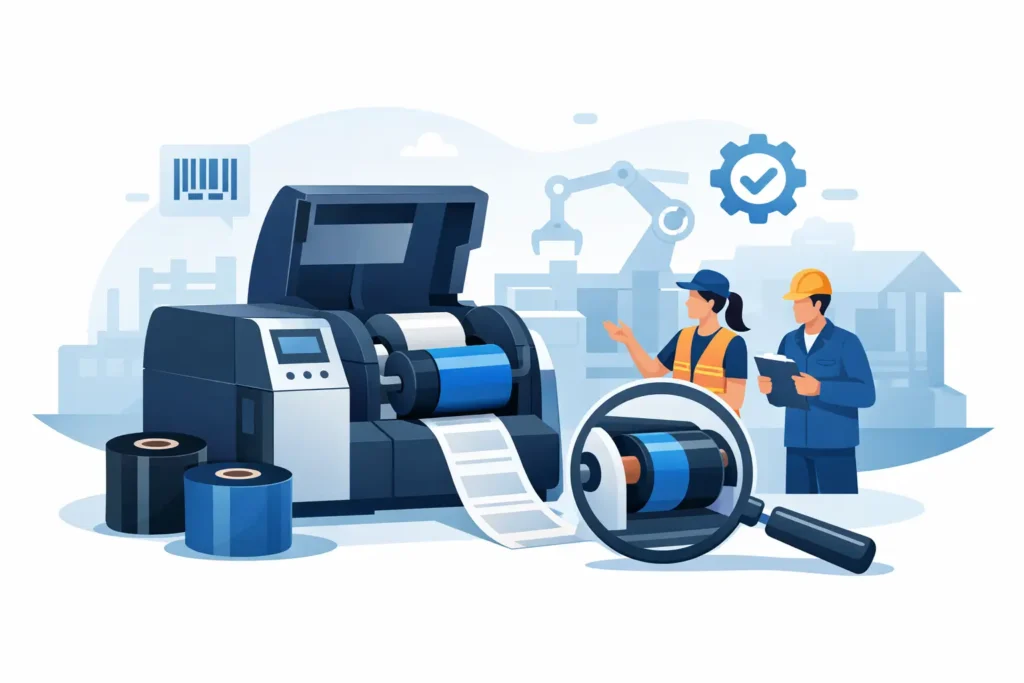
A barcode can look perfectly fine coming out of the printer and still fail at the loading dock, on the production floor, or after months in storage. In many cases, the issue isn’t the printer or the label design. It’s the ribbon.
Choosing the right ribbon is essential to producing labels that stay readable, durable, and dependable. This label printer ribbon guide explains how to match thermal transfer ribbons to your label material, printer, and the real-world conditions your identification system needs to withstand.
For industrial operations, ribbon selection is about more than printing. The right ribbon helps maintain readable barcodes, durable text, consistent print quality, and predictable supply costs. The wrong ribbon can cause smudged labels, scanning problems, premature printhead wear, relabeling, and interruptions that affect shipping, traceability, and compliance.
Start With the Printing Method
Ribbons are used in thermal transfer printing, not direct thermal printing. A thermal transfer printer uses heat to transfer ink from a ribbon onto the label surface. This generally creates a more durable printed image than direct thermal printing, which uses heat to activate a chemically treated label.
If your operation needs labels that can withstand handling, abrasion, moisture, cleaning chemicals, sunlight, or extended storage, thermal transfer printing is usually the better starting point. It also offers greater flexibility in label materials, including paper, polypropylene, polyester, vinyl, and specialty constructions.
Before ordering ribbons, confirm that your printer is configured for thermal transfer printing and that the ribbon is compatible with its printhead type. Most industrial thermal transfer printers use either flat-head or near-edge technology. These ribbon types are not interchangeable. Even a ribbon with the correct width and material can produce poor image quality or fail to transfer properly if it isn’t designed for the printer’s printhead.
The Three Main Ribbon Types
A ribbon’s ink formulation determines how well it prints on a particular label surface and how well the printed image holds up after application. The three main options—wax, wax-resin, and resin—each serve a different purpose.
Wax Ribbons for Standard Paper Labels
Wax ribbons are commonly used with uncoated and coated paper labels. They produce dark, readable images at relatively low print energy and are often the most economical choice for indoor applications.
Common uses include:
- Carton labeling
- Warehouse bin identification
- Work-in-process labels
- Retail ticketing
- General inventory control
The main trade-off is durability. Wax images can smear or scratch when exposed to heavy abrasion, chemicals, oils, or repeated handling. They’re a good fit when labels stay in controlled indoor environments and don’t need to withstand demanding conditions.
Wax-Resin Ribbons for Greater Durability
Wax-resin ribbons combine the print sensitivity of wax with the added resistance of resin. They’re a practical option for many operations because they work well on coated paper and certain synthetic labels while offering better smudge, scratch, and handling resistance than standard wax ribbons.
For shipping labels, product labels, distribution applications, cold storage staging, and inventory labels that experience routine handling, wax-resin often provides the right balance between durability and cost.
However, results still depend on the label face stock. A wax-resin ribbon may perform extremely well on a smooth, coated paper label but be less effective on a rough, highly textured, or chemically challenging surface.
Resin Ribbons for Demanding Applications
Resin ribbons are designed for applications where durability is a priority. They require more heat to transfer, but they produce images with stronger resistance to abrasion, moisture, chemicals, sterilization processes, and temperature exposure.
Resin ribbons are typically paired with synthetic label materials such as polyester, polypropylene, and vinyl.
Common applications include:
- Asset tags
- Laboratory samples
- Healthcare identification
- Chemical labeling
- Outdoor equipment
- Electronics
- Automotive components
- Utility markings
- Durable product identification
Resin ribbons cost more than wax or wax-resin options, but they can help prevent the much larger expense of label failure. This is especially important when identification needs to remain legible throughout the life of an asset or product.
Match the Ribbon to the Label, Not Just the Printer
Your printer model is only one part of a successful thermal transfer system. The ribbon must also work with the label’s surface coating and withstand the conditions the finished label will encounter. Two labels that look similar can produce very different results if one has a smoother topcoat, a rougher paper surface, or a low-energy synthetic film.
Paper labels are often well suited to wax or wax-resin ribbons. For glossy paper, a wax-resin formula may provide sharper barcode edges and better smudge resistance. Synthetic materials often require resin ribbons, particularly when labels need to withstand chemicals, high heat, outdoor exposure, or repeated contact.
Adhesive and liner choices matter, too, even though the ribbon doesn’t directly contact them. A label that needs to stay attached in freezer storage, on oily metal, or on corrugated surfaces must be designed as a complete construction.
The best ribbon can’t compensate for a label material or adhesive that isn’t suited to the application. Every part of the labeling system needs to work together.
Consider What Happens After the Label Leaves the Printer
One of the most important questions to ask when choosing a ribbon is simple: What will this label encounter after it’s applied?
Think about the label’s entire lifecycle, from printing to shipping, storage, handling, and everyday use.
For example:
- A warehouse location label may face forklift traffic, pallet contact, dust, and occasional cleaning.
- A chemical drum label may come into contact with solvents, moisture, and regulatory inspections.
- A medical sample label may be refrigerated, handled with gloves, or exposed to laboratory chemicals.
- A manufactured component label may encounter heat, oil, abrasion, or outdoor conditions.
When you’re unsure how durable a ribbon and label combination will be, testing is more reliable than making assumptions. Print representative labels using the proposed ribbon and expose them to the same handling and conditions they’ll experience in actual use.
Check barcode scan quality, text legibility, scratch resistance, and adhesion. This simple validation step can help prevent widespread labeling problems after materials have already been deployed.
Select the Right Ribbon Size and Orientation
Ribbon sizing is another important part of getting consistent printing results.
The ribbon should be slightly wider than the label and printhead area being used. This helps protect the printhead from direct contact with the label material, reducing wear and supporting consistent print quality. A ribbon that’s too narrow can leave part of the printhead exposed, while an excessively wide ribbon adds unnecessary material costs.
Ribbon length also matters. Longer rolls reduce how often operators need to stop and change ribbons, which can be helpful in high-volume environments. However, the roll must still fit the printer’s ribbon capacity. Core diameter and outside roll diameter must also match the printer’s specifications.
Don’t overlook ribbon orientation. Ribbons are manufactured with the ink coating on either the inside or outside of the roll. Your printer requires a specific orientation. Installing the wrong configuration can result in no image transfer, inconsistent printing, or wasted material.
Always confirm your printer’s requirements before placing a recurring order. This is especially important when standardizing ribbon supplies across multiple locations.
Set Print Energy for the Ribbon and Label Combination
Even a compatible ribbon can produce poor results if the printer’s heat setting isn’t correct.
Too little print energy can result in light text, incomplete barcode bars, and weak scanning performance. Too much energy can cause excessive ink transfer, blurred edges, ribbon wrinkling, and unnecessary stress on the printhead.
Print speed also affects results. Higher speeds may require adjustments to darkness or energy settings, particularly when using resin ribbons or printing dense barcode content.
Start with the ribbon manufacturer’s recommended settings, then test the combination at the speed and label format used in your actual production environment.
Don’t judge print performance by visual darkness alone. Scan the barcode using the same scanners your operation relies on. A label may look dark but still have blurred bar edges that prevent dependable scanning.
For compliance-related, regulated, or customer-mandated labels, include the required barcode quality grades in your approval process.
Avoid Treating Ribbons as a Commodity
Low-cost ribbons may appear interchangeable, but the consistency of their formulation matters. Differences in coating, backcoat quality, roll winding, and material compatibility can affect printhead life, barcode quality, and operator productivity.
A lower purchase price doesn’t necessarily mean lower overall costs. If an inexpensive ribbon causes more recalibration, wasted labels, or unreadable barcodes, it may end up costing your operation more.
Standardizing approved ribbon and label combinations gives your team better control over printing performance. For each application, document:
- Printer model
- Label part number
- Ribbon part number
- Print settings
- Intended use
This creates a repeatable baseline for purchasing, maintenance, and troubleshooting across your operation.
For organizations managing multiple printers, label materials, and printing environments, PaladinID can help evaluate the complete labeling system rather than selecting a ribbon in isolation. The goal isn’t simply to produce an image. It’s to keep the right information readable, scannable, and properly attached wherever your operation needs it.
A well-matched ribbon often goes unnoticed because everything keeps running as it should. That’s the standard worth building toward: labels that print cleanly, withstand their intended environment, and support accurate work without creating another point of failure.
Need Help Finding the Right Ribbon for Your Application?
Choosing the right thermal transfer ribbon can make a major difference in print quality, label durability, and overall operating efficiency. PaladinID works with businesses to find labeling solutions that match their materials, printers, and real-world application requirements.
WE DON’T JUST SELL LABELS. WE SOLVE LABELING PROBLEMS.
Visit PaladinID to explore labeling solutions or get help finding the right supplies for your operation.

Got Labeling Questions? Our AI Assistant Has Answers - Chat Now!
For more information on PaladinID
Get Help With Your Next Label Project
We have over 35 years of providing exceptional service and labeling products to the world. Take the first step to an easy, stress-free solution for your label needs by contacting us.
Schedule a call below or email [email protected]
Make Your Mark
“Making companies more competitive by offering the correct label printing solution, on time, within budget, while creating unmatched value”.
About PaladinID, LLC
PaladinID develops and supports high-performance barcode labeling applications. We work with our clients to “Make Your Mark” by providing the expertise and tools necessary to create an entire product label printing solution. Located in central New Hampshire, PaladinID has been serving Massachusetts, Vermont, Maine, Connecticut, Rhode Island, New England, and beyond for over 30 years, and in 2017, became an RFID-certified company. We look forward to working with you.
You may be interested in our other services:
Product Labels
Product Labels
Labels for every type of application: Blank, Pre-printed, Variable data
Label Printers
Label Printers
We sell and support: Direct/thermal transfer, Inkjet, Laser
Printer Ribbons
Printer Ribbons
We sell ribbons for ALL barcode printers including: Zebra, Datamax, Sato, Intermec
Flexible Packaging
Flexible Packaging
We offer a wide variety of packaging containers for your products.
Label Software
Label Software
Software for all barcode printing and product labeling.
Label applicators
Label Applicators
Wide selection of applicators: Desktop/Mobile, Applicator only, Print & apply
