
Zebra Certified Label Supplies for Reliable Printing



What Can We Help You With?
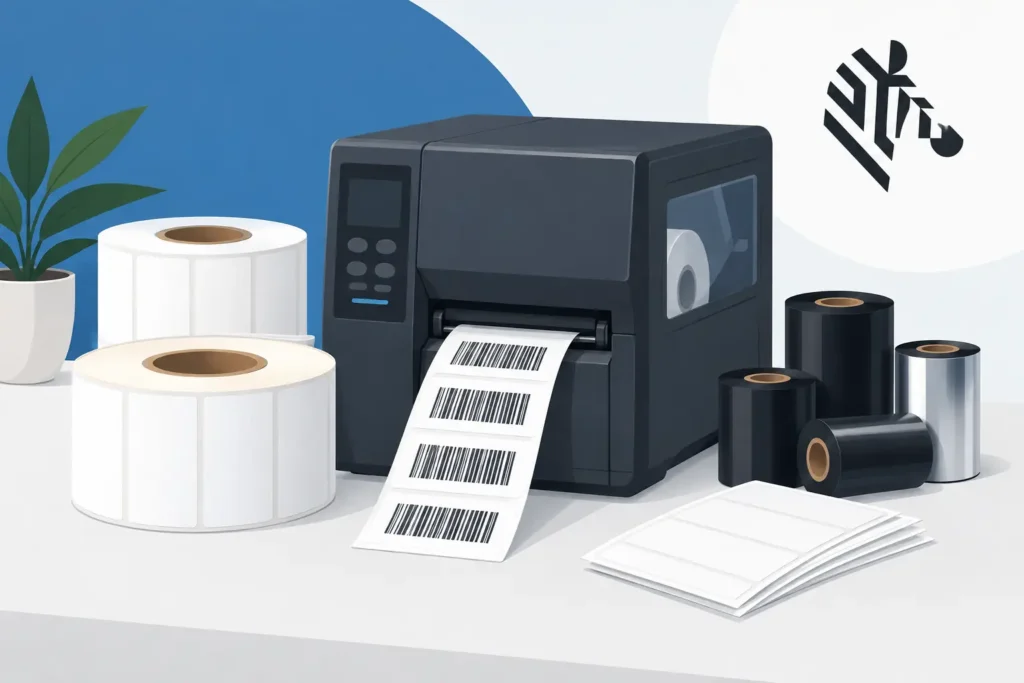
A barcode that scans perfectly at the print station but fails at receiving, on the production floor, or during a customer audit is more than a minor printing issue. It’s an operational problem that can affect inventory accuracy, shipping speed, product traceability, and labor costs.
That’s where Zebra certified label supplies make a difference. Designed to work with Zebra printing systems, these supplies help businesses achieve consistent print quality by matching labels, tags, ribbons, and media construction to the printer and the real-world conditions of each application.
For operations teams, the goal isn’t simply to purchase media that fits a printer. It’s to establish a dependable labeling process that produces readable, durable identification from the first label to the last roll.
What Zebra Certified Label Supplies Are Designed to Do
Zebra certified supplies are developed and tested for use with Zebra printing systems. This matters because barcode print quality depends on much more than the printer itself.
The label facestock, adhesive, ribbon chemistry, liner, printing method, printhead settings, and application environment all influence the final result.
When these components are properly matched, businesses can reduce common labeling problems, including:
- Poor barcode edge definition
- Ribbon wrinkling
- Labels peeling too early
- Adhesive residue
- Unreadable barcodes
- Premature printhead wear
Certified supplies are especially valuable when labels carry information that must remain accurate throughout receiving, storage, transportation, production, or field use.
However, that doesn’t mean every operation needs the same media construction.
A clean, climate-controlled warehouse may perform perfectly well with a standard paper label. A manufacturer identifying work-in-process parts exposed to oil, abrasion, or heat may require synthetic materials and a more durable ribbon.
The real value of certified supplies is consistency that meets the specific demands of the application.
Why Compatible Is Not Always Enough
Many labels and ribbons are marketed as compatible with Zebra printers. While some may be perfectly suitable for basic, low-risk applications, compatibility alone doesn’t always account for the factors that influence long-term printing performance.
Consider a few common examples:
A thermal-transfer ribbon that isn’t properly matched to the label material may produce a barcode that looks acceptable but lacks sufficient contrast or durability.
An adhesive that holds securely in a dry office environment may begin lifting from corrugated cartons in cold storage.
Even tag stock can create problems if its thickness, coating, or perforation isn’t suited to the printer configuration.
These seemingly small differences can create expensive disruptions.
The savings from purchasing a lower-priced roll can quickly disappear when employees have to reprint labels, manually verify shipments, replace a printhead, or investigate missing inventory.
For critical workflows, supply selection should be based on the total cost of potential failure, not simply the price per roll.
Barcode Quality Is an Operational Requirement
A barcode must scan reliably across every stage of the workflow. That includes handheld scanners, fixed scanners, mobile computers, and customer or carrier systems.
Several factors influence scanning performance, including print darkness, printing speed, ribbon selection, label surface, and barcode size.
This becomes particularly important for labels containing small linear barcodes, dense 2D codes, serialized data, or regulatory information.
A high-resolution printer may be necessary for fine-detail printing, but even the best printer cannot compensate for an unsuitable media combination.
The most practical way to verify performance is to test actual label data under normal production conditions.
Printhead Protection Has Real Value
Your printer’s printhead is a consumable component, but its lifespan can be shortened by rough media surfaces, adhesive buildup, debris, improper ribbon selection, and excessive heat settings.
Replacing a printhead creates more than a hardware expense. It can also interrupt production and slow down daily operations.
Using supplies designed for the printer helps support cleaner media movement and more consistent heat transfer.
Regular cleaning is still necessary, particularly in dusty warehouses and industrial environments. However, selecting the right combination of labels and ribbons gives maintenance teams a much stronger starting point.
Selecting Zebra Certified Label Supplies by Application
The best supply decision starts with understanding what a label needs to withstand after it leaves the printer.
Procurement teams often begin by looking at label dimensions and order quantities. While both are important, the actual application conditions should come first.
Shipping, Receiving, and Warehouse Identification
For shipping cartons, pallet labels, rack locations, and bin identification, scan reliability and adhesive performance are usually the biggest priorities.
Labels may be exposed to frequent handling, friction, temperature changes, and dusty surfaces.
Direct thermal labels can be an effective option for short-life shipping labels, while thermal-transfer labels may be better suited to applications where identification needs to remain readable for longer periods.
Warehouse teams should also consider label dimensions from the scanner’s perspective.
For example, a small barcode placed on a large pallet may technically meet printing requirements but still be difficult to scan from the expected distance.
Label layout, placement, and symbol size should support how employees actually perform their jobs.
Manufacturing and Work-in-Process Tracking
Manufacturing environments often expose labels to much harsher conditions than typical shipping applications.
Heat, moisture, chemical contact, abrasion, outdoor exposure, and oily surfaces can quickly damage a standard paper label.
Depending on the application, synthetic label materials, durable adhesives, and resin or wax-resin ribbons may be necessary.
The surface receiving the label matters just as much.
A label that adheres well to smooth plastic may fail when applied to textured powder-coated metal or curved components.
When labels support part traceability, quality records, or safety identification, testing samples on the actual surface is well worth the effort.
Healthcare, Laboratory, and Regulated Workflows
Healthcare and laboratory applications require particular attention to legibility, adhesive performance, and the ability to withstand demanding handling conditions.
Specimen labels, medication labels, patient identification, and laboratory tracking may need to remain readable through refrigeration, freezing, moisture exposure, or contact with cleaning agents.
These applications should be approached as a validation process.
Before finalizing a supply specification, confirm:
- Printer model
- Label size
- Container type
- Storage temperature
- Scanning equipment
- Applicable regulatory or internal documentation requirements
Taking these factors into account helps ensure the selected supplies meet the actual demands of the workflow.
Asset Labels and Long-Term Identification
Asset labels used on equipment, tools, IT hardware, utility infrastructure, and rental fleets typically need to last much longer than standard carton labels.
They may be exposed to UV light, cleaning products, abrasion, and outdoor weather conditions.
For these applications, label material and adhesive selection are just as important as barcode print quality.
A properly designed, durable asset label can reduce the time and expense associated with replacing identifiers and reconciling assets that can no longer be scanned.
However, durability requirements should always be specific to the application.
A label designed for indoor office equipment doesn’t need the same construction as one applied to outdoor machinery or exposed piping.
Match the Printer, Print Method, and Ribbon
Zebra printers support different printing technologies, and the supplies selected must match the equipment being used.
Understanding the difference between direct thermal and thermal-transfer printing is an important part of getting the best performance from your labeling system.
Direct thermal printing uses heat-sensitive media and does not require a ribbon.
It’s an efficient option for short-term labels such as shipping labels, receipts, and temporary identification. However, exposure to heat, sunlight, friction, or simply the passage of time can reduce image quality.
Thermal-transfer printing uses a ribbon to transfer an image onto the label or tag.
This method is generally preferred when greater print durability is required. Different ribbon types offer different levels of performance:
- Wax ribbons: Often suited to paper label applications.
- Wax-resin ribbons: Provide additional resistance.
- Resin ribbons: Support demanding synthetic-material applications.
The right choice depends on the label material and the conditions the printed image needs to withstand.
Printer settings are equally important.
Print speed and darkness should be calibrated for the selected media rather than automatically pushed to maximum output.
Excessive darkness can create blurred barcode edges, while insufficient energy can produce weak or incomplete images.
A properly controlled setup process helps protect print quality while supporting longer equipment life.
Build Supply Consistency Into Procurement
Labeling problems often begin when a proven supply specification is replaced with something that seems almost identical.
A different adhesive, roll winding direction, label gap, ribbon width, or material thickness can affect both printing and application performance.
Standardizing approved supplies by printer model and application makes reordering easier and helps prevent unexpected problems at the point of use.
A practical supply specification should document:
- Printer model
- Printing method
- Label dimensions
- Core size
- Media material
- Adhesive type
- Ribbon type, when applicable
- Required durability
- Expected application environment
It should also identify whether the application requires variable data, preprinted graphics, color coding, RFID encoding, or compliance information.
For organizations operating across multiple facilities, this level of standardization is especially important.
It helps prevent one location from introducing a substitute that creates inconsistent barcode quality across the network. It also gives purchasing, operations, and IT teams a shared reference when evaluating alternatives or planning equipment upgrades.
When Custom Supplies Are the Better Answer
Stock Zebra certified label supplies address many everyday labeling requirements. However, some workflows need more than a standard, off-the-shelf solution.
Custom labels may be the better choice when an application requires:
- Nonstandard label dimensions
- Specialized adhesives
- Preprinted branding
- Color-coded zones
- Sequential numbering
- Integrated forms
- RFID inlays
- Materials engineered for difficult surfaces or environments
Custom doesn’t have to mean complicated.
It simply means designing the supply around the application instead of forcing the application to work with a generic label.
For high-volume operations or labels tied to compliance and traceability, this approach can reduce waste, simplify employee workflows, and improve consistency.
PaladinID helps organizations evaluate the complete printing system, including printer capabilities, media construction, ribbon selection, label design, and the conditions the finished label must withstand.
This consultative approach is particularly valuable when a labeling issue may actually be caused by printer configuration, workflow design, or application requirements rather than the label itself.
The most reliable labeling programs treat supplies as an essential part of the operating system, not an interchangeable afterthought.
Start by understanding where the label will go, what information it needs to communicate, and what conditions it must survive.
The right certified media selection can help keep critical information readable and reliable long after the print job is finished.
Need Help Finding the Right Label Supplies for Your Zebra Printer?
PaladinID brings more than 35 years of labeling experience to businesses looking for dependable, application-specific labeling solutions.
Whether you need Zebra-compatible labels and ribbons, specialized materials, or a customized labeling solution, our team can help you evaluate your requirements and find the right fit.
PaladinID — Make Your Mark.


Got Labeling Questions? Our AI Assistant Has Answers - Chat Now!
For more information on PaladinID
Get Help With Your Next Label Project
We have over 35 years of providing exceptional service and labeling products to the world. Take the first step to an easy, stress-free solution for your label needs by contacting us.
Schedule a call below or email [email protected]
Make Your Mark
“Making companies more competitive by offering the correct label printing solution, on time, within budget, while creating unmatched value”.
About PaladinID, LLC
PaladinID develops and supports high-performance barcode labeling applications. We work with our clients to “Make Your Mark” by providing the expertise and tools necessary to create an entire product label printing solution. Located in central New Hampshire, PaladinID has been serving Massachusetts, Vermont, Maine, Connecticut, Rhode Island, New England, and beyond for over 30 years, and in 2017, became an RFID-certified company. We look forward to working with you.
You may be interested in our other services:
Product Labels
Product Labels
Labels for every type of application: Blank, Pre-printed, Variable data
Label Printers
Label Printers
We sell and support: Direct/thermal transfer, Inkjet, Laser
Printer Ribbons
Printer Ribbons
We sell ribbons for ALL barcode printers including: Zebra, Datamax, Sato, Intermec
Flexible Packaging
Flexible Packaging
We offer a wide variety of packaging containers for your products.
Label Software
Label Software
Software for all barcode printing and product labeling.
Label applicators
Label Applicators
Wide selection of applicators: Desktop/Mobile, Applicator only, Print & apply
