
Guide to GHS Chemical Labels for Safer Worksites


What Can We Help You With?
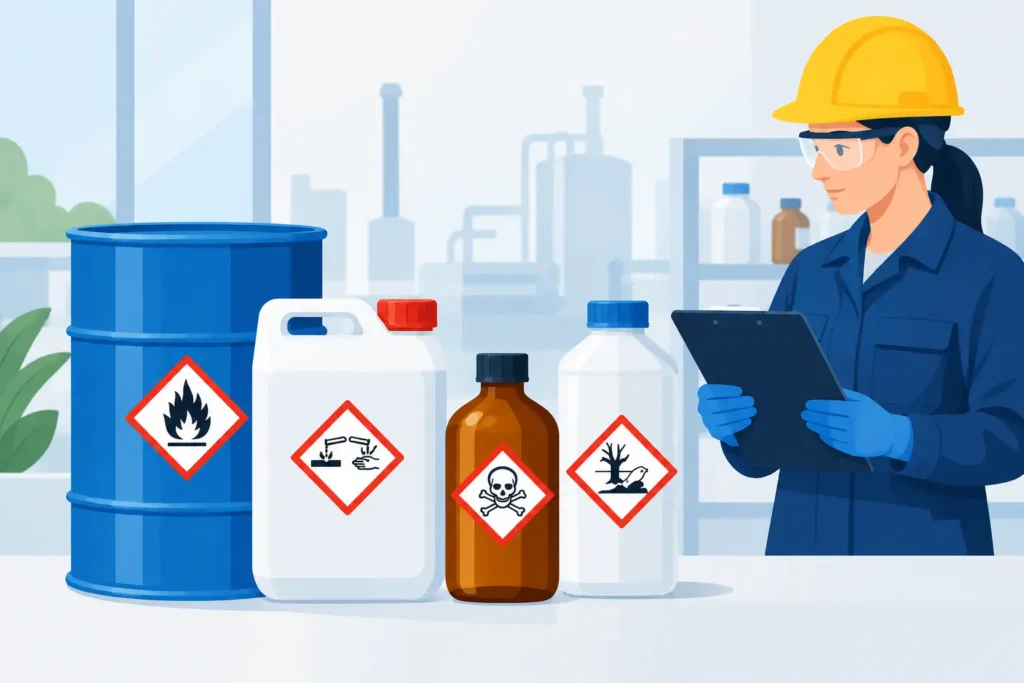
A chemical container that arrives without a legible hazard label creates an immediate operational problem. Employees cannot make informed handling decisions, safety teams cannot verify communication requirements, and production or warehouse work can slow down while someone identifies the contents. This guide to GHS chemical labels explains what must appear on a label, where workplace practices can differ, and how to build a labeling process that holds up in real operating conditions.
What GHS Chemical Labels Are Designed to Do
The Globally Harmonized System of Classification and Labelling of Chemicals, commonly called GHS, creates a consistent way to communicate chemical hazards. In the United States, OSHA incorporates GHS-aligned requirements into its Hazard Communication Standard. The goal is practical: a worker should be able to identify a chemical’s hazards and basic precautions quickly, whether the container is received from a supplier, stored in a chemical area, or used at a workstation.
A GHS label is not just a compliance document printed on adhesive stock. It is part of the daily safety system. It connects the product identifier on a container to the safety data sheet, communicates immediate risks through standardized elements, and gives employees information when they need it most – at the point of use.
For operations teams, label reliability matters as much as label content. A fully compliant design is still a failure if moisture, abrasion, heat, cleaning agents, or UV exposure make it unreadable before the container is empty.
The Six Required GHS Label Elements
For shipped hazardous chemical containers, OSHA requires six core label elements. The label must be in English, although other languages may be included as needed for the workforce.
- Product identifier: The name or number used to identify the chemical. It must match the identifier shown in Section 1 of the safety data sheet.
- Signal word: Either “Danger” or “Warning.” “Danger” indicates the more severe hazard category. A label uses only one signal word, even when a chemical presents multiple hazards.
- Hazard statement(s): Standardized language describing the nature and degree of the hazard, such as “Causes severe skin burns and eye damage.”
- Pictogram(s): A black symbol on a white background within a red diamond border. The applicable pictograms depend on the chemical’s classification.
- Precautionary statement(s): Recommended measures for prevention, response, storage, and disposal. These tell employees what to do, not merely what can go wrong.
- Supplier identification: The chemical manufacturer, importer, or other responsible party’s name, U.S. address, and telephone number.
Labels may also include supplemental information that does not conflict with or undermine the required GHS elements. Examples can include directions for use, lot codes, expiration dates, personal protective equipment guidance, or internal tracking information. Supplemental content is often valuable, but it should never crowd out required safety information or make the label difficult to scan.
Pictograms Need Clear, Consistent Reproduction
There are nine GHS pictograms overall, although OSHA does not enforce the environmental pictogram because environmental hazards fall under other agencies. Common workplace pictograms include flame, corrosion, skull and crossbones, health hazard, exclamation mark, gas cylinder, exploding bomb, flame over circle, and environment.
The red diamond border is not decorative. Poor color reproduction, undersized symbols, or a label layout that obscures the pictogram can compromise readability and create compliance risk. When printing labels on demand, verify that the printer, ribbon, and label material can produce sharp text, durable barcodes, and clear pictogram boundaries at the required size.
Shipped Containers and Workplace Containers Are Not the Same
One of the most common sources of confusion is treating every container as though it has identical labeling requirements. The right approach depends on whether the container is being shipped, received, transferred, or used within the workplace.
A chemical received from a supplier should retain the supplier’s original label. Do not remove, deface, or cover required information. If an incoming label becomes damaged or unreadable, the employer must replace it with a label containing the necessary information.
For a secondary container, such as a spray bottle filled from a larger drum, OSHA allows a workplace labeling system as long as employees have immediate access to the hazard information. Many operations use a simplified label with the product identifier and general hazard information, sometimes supported by color coding or internal symbols. That flexibility is useful, but it does not mean a handwritten chemical name alone is always sufficient.
The exception is a portable container intended only for the immediate use of the employee who performs the transfer. Once that container is left unattended, shared, stored, or used across shifts, it should be labeled under the employer’s workplace labeling system.
A practical rule is to design for the way containers are actually used, not the narrowest interpretation of an exception. If a bottle may move between workstations or sit on a bench overnight, label it clearly.
A Guide to GHS Chemical Labels in Real Operations
The label format should fit the container, environment, and workflow. A four-inch drum label, a small vial label, and a tag for a chemical tote do not have the same available space or exposure profile. The core hazard information must remain legible, but the material and printing method should be selected around the application.
In a dry indoor stockroom, a quality thermal transfer label may provide dependable performance with the right ribbon. In a washdown area, laboratory, outdoor yard, or industrial setting exposed to solvents, oil, or temperature swings, the label construction may need a more durable synthetic facestock, aggressive adhesive, and chemical-resistant ribbon. The container itself also matters. Curved surfaces, textured plastic, low-energy plastics, and reused drums can create adhesion challenges that are not obvious during a desk test.
Barcode content can be added to a GHS label when it supports receiving, inventory control, batch traceability, or chemical management software. However, barcodes should support the safety label, not compete with it. Make sure barcode placement does not reduce the prominence of the product identifier, pictograms, or required statements.
Build Label Templates Instead of Recreating Labels
Chemical labeling becomes unreliable when employees build a new layout every time a container is filled. A controlled template reduces variation and gives safety, operations, and purchasing teams a clear approval point.
A useful template establishes the approved product identifier, required hazard elements, pictogram placement, font sizes, label dimensions, and any internal data fields. If variable information such as lot number, fill date, expiration date, or operator ID is needed, define where it belongs and how it will be populated. Labeling software can help control this process by limiting editable fields, drawing data from approved sources, and preventing unapproved changes to the core layout.
This is especially valuable for facilities managing many chemicals, multiple sites, or frequent secondary-container labeling. Standardizing templates reduces the risk that one shift uses an outdated precautionary statement while another uses the current safety information.
Verify the Information Before You Print
The safety data sheet is the operational source for label data. Before creating or revising a label, confirm that the product identifier matches Section 1 and that the hazard classifications, signal word, hazard statements, precautionary statements, and pictograms align with the current safety data sheet.
Do not assume two products with similar names have the same hazards. Product reformulations, different concentrations, and different suppliers can change the required classification. Establish a review process when a new chemical is introduced or an updated safety data sheet is received.
It also helps to assign ownership. Environmental health and safety may approve hazard content, while operations owns point-of-use practices and procurement confirms supplier information. IT or systems teams may manage label software and data connections. Clear roles prevent a label change from being treated as a simple printing task when it is actually a safety and process-control decision.
Test for the Conditions Your Labels Will Face
Label samples should be tested where they will work, not only where they are printed. Apply samples to representative containers and evaluate adhesion, scan quality, readability, and resistance after normal handling. Include the conditions that cause failures in your facility: refrigeration, forklift traffic, chemical splashes, glove handling, outdoor exposure, abrasion, or routine cleaning.
Printer maintenance is part of the same system. A worn printhead, incorrect darkness setting, unsuitable ribbon, or contaminated platen roller can create faded text and inconsistent barcode quality. For GHS labels, print quality affects more than appearance. It determines whether hazard communication remains usable through the life of the container.
The best chemical labeling programs make the safe action the easy action. When approved templates, dependable label materials, compatible printers, and clear ownership are in place, employees spend less time improvising and more time working with information they can trust.
At PaladinID, we understand that every labeling application is different.
That’s why companies across the country trust us to help them identify the right solution for their business. With over 40 years of experience and one of the industry’s largest selections of labeling products, we make it easy to find the right fit for your operation. Whether you need stock products or a custom-built solution, our team is ready to help. Visit our online catalog, Email us, or call us today at 888.972.5234.
PaladinID delivers label solutions that stick!

Got Labeling Questions? Our AI Assistant Has Answers - Chat Now!
For more information on PaladinID
Get Help With Your Next Label Project
We have over 35 years of providing exceptional service and labeling products to the world. Take the first step to an easy, stress-free solution for your label needs by contacting us.
Schedule a call below or email [email protected]
Make Your Mark
“Making companies more competitive by offering the correct label printing solution, on time, within budget, while creating unmatched value”.
About PaladinID, LLC
PaladinID develops and supports high-performance barcode labeling applications. We work with our clients to “Make Your Mark” by providing the expertise and tools necessary to create an entire product label printing solution. Located in central New Hampshire, PaladinID has been serving Massachusetts, Vermont, Maine, Connecticut, Rhode Island, New England, and beyond for over 30 years, and in 2017, became an RFID-certified company. We look forward to working with you.
You may be interested in our other services:
Product Labels
Product Labels
Labels for every type of application: Blank, Pre-printed, Variable data
Label Printers
Label Printers
We sell and support: Direct/thermal transfer, Inkjet, Laser
Printer Ribbons
Printer Ribbons
We sell ribbons for ALL barcode printers including: Zebra, Datamax, Sato, Intermec
Flexible Packaging
Flexible Packaging
We offer a wide variety of packaging containers for your products.
Label Software
Label Software
Software for all barcode printing and product labeling.
Label applicators
Label Applicators
Wide selection of applicators: Desktop/Mobile, Applicator only, Print & apply
