
A Manufacturing Traceability Labeling Example




What Can We Help You With?
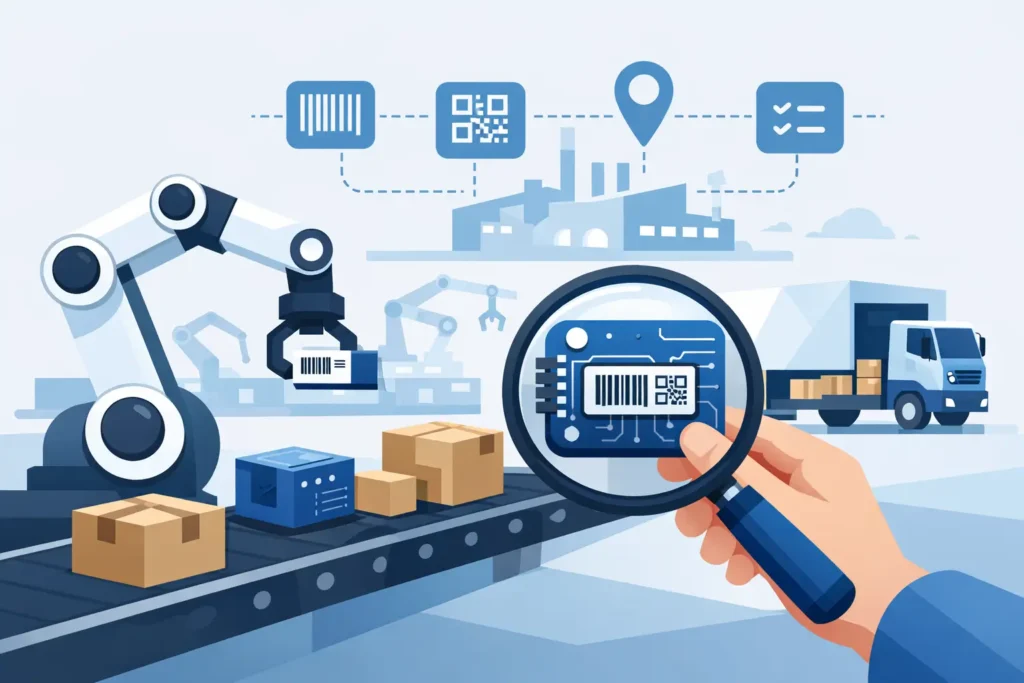
A manufacturing traceability labeling example is most valuable when it follows a real product through every stage where identification matters: receiving, staging, production, inspection, packaging, and shipping.
A label is much more than a barcode attached to a container. It’s the physical connection between the material on your production floor and the information stored in your ERP, MES, WMS, quality system, or customer portal.
Consider a manufacturer assembling fluid-control components for industrial equipment. The plant receives cast housings, seals, springs, and machined parts from multiple suppliers. Finished assemblies may require customer-specific documentation, lot controls, and field-service traceability.
Now imagine a defect is discovered six months after a shipment has gone out. The manufacturer needs to quickly determine which component lot was affected, which finished assemblies used those components, which customers received them, and whether any related inventory is still on hand.
That level of visibility doesn’t happen by accident. It requires a labeling process designed around the operation—not a collection of disconnected printers and label formats.
Manufacturing Traceability Labeling Example From Receiving to Shipping
The process starts at receiving.
A pallet of machined housings arrives with a supplier packing slip and supplier lot number. Before the material is moved into storage, the receiving team verifies the purchase order, quantity, supplier part number, and lot information.
The facility then prints an internal receiving label for each pallet or container.
That label may contain:
- Internal part number.
- Supplier part number.
- Supplier lot number.
- Received date.
- Purchase order.
- Quantity.
- Storage location.
- Unique internal lot ID.
A 2D barcode, such as Data Matrix or QR Code, can store the internal lot ID or a structured set of important data fields. The right barcode depends on available label space, scanning distance, customer requirements, and the data formats supported by the company’s systems.
The internal lot ID becomes the foundation for the rest of the workflow. Even if a supplier changes its label layout or provides incomplete barcode information, the manufacturer can maintain a consistent internal identification standard.
As material moves into quarantine, inspection, or stock, receiving personnel scan the new label. Each scan updates the material’s status and location without requiring employees to manually reenter a lengthy lot number.
What the receiving label must accomplish
A receiving label needs to withstand the environment where it will be used.
A paper label may work perfectly well on clean, dry cartons that move quickly into production. However, it may fail when applied to returnable totes, oily metal containers, products in cold storage, outdoor staging areas, or pallets exposed to rough handling.
In these situations, material selection, adhesive chemistry, ribbon type, and printing method are just as important as the barcode information itself.
For example, a thermal transfer label paired with a durable resin ribbon may be the right choice for containers exposed to abrasion, moisture, or solvents.
Direct thermal labels can be an efficient option for short-term shipping applications. However, they’re generally a poor choice for traceability records that must remain readable for months in environments involving heat, sunlight, or demanding warehouse conditions.
The best specification depends on actual environmental exposure, expected label life, and the surface of the container.
Linking Component Lots to Work Orders
Once production begins, operators scan the internal lot labels for every controlled component issued to a work order.
For example, the system records that work order 74219 used:
- Housing lot H-240816.
- Seal lot S-55102.
- Spring lot SP-88731.
This is where traceability becomes much more than basic inventory labeling.
Inventory labeling answers one important question: Where is this material?
Traceability labeling answers another: Where did this material go?
A reliable system needs to answer both questions. Teams should be able to trace forward from a raw-material lot to the finished goods that used it. They should also be able to work backward from a finished serial number to every associated component lot, operator record, inspection result, and production event.
At the assembly station, the manufacturer prints a work-in-process (WIP) label for the production batch or individual unit.
This label might include:
- Work order number.
- Finished-good part number.
- Production date.
- Quantity.
- Routing step.
- WIP ID.
If the product is serialized, each completed unit receives a unique serial number connected to its component consumption record.
This is also where consistent processes become especially important. Scanning component labels before use is more reliable than asking operators to select lots from a screen or manually write information on a traveler.
Manual methods can still serve as a backup, particularly in lower-volume operations. However, they create more opportunities for missing, illegible, or delayed records.
The process should make the easiest action for the operator the correct action.
Using Quality Labels to Control Product Status
Traceability doesn’t automatically mean every item is approved for production or shipment. Quality status must be easy to recognize and properly recorded in the system.
A manufacturing facility may use different label formats or colors to identify:
- Quarantine material.
- Released material.
- Rejected material.
- Rework material.
- Hold material.
These visual indicators should support the barcode and system transaction, not replace them.
In our example, finished valve assemblies move from production to final inspection. The inspector scans the WIP or serial label, records the test results, and applies a final product identification label only after the unit passes inspection.
The final label may display the finished part number, serial number, manufacturing date, revision level, inspection status, and a scannable code that retrieves the complete production record.
If a unit fails inspection, it receives a hold or nonconforming-material label that clearly prevents it from being accidentally shipped or returned to stock.
The label should identify the specific unit or lot—not simply display the word “HOLD.” Generic status tags can be useful on a rack or cart, but they aren’t enough when an individual item must remain traceable through rework, disposition, or scrap.
There is also an important decision to make when designing this process: Should you use lot-level or item-level traceability?
Item-level serialization provides the most detailed history, but it also requires more labels, scans, and data management. Lot-level traceability may be sufficient for products manufactured and shipped in controlled batches.
The right approach depends on regulatory expectations, recall exposure, warranty risk, product value, and the practical demands of the production line.
Packaging and Shipping Preserve the Chain of Custody
Once a product is packaged, the system needs to connect individual units or finished lots to their shipping containers.
A carton label may include:
- Carton ID.
- Customer part number.
- Internal part number.
- Quantity.
- Lot or serial number range.
- Purchase order.
- Shipment information.
A pallet label then connects all the cartons placed on that pallet.
This relationship between parent and child containers is critical.
For example, carton C-10984 contains serial numbers 001201 through 001220, while pallet P-4407 contains cartons C-10980 through C-10990.
With this information properly recorded, a single pallet scan can confirm which products were staged, loaded, and shipped.
It also makes recall containment much faster. Instead of manually reviewing every shipment record, the manufacturer can identify the exact cartons and customers associated with an affected lot.
Customer compliance requirements may also influence the final label format. Some customers require specific barcodes, human-readable fields, label dimensions, or placement instructions. Others require shipping labels to be generated through EDI transactions or warehouse systems.
The labeling solution must meet these requirements without disrupting the company’s internal traceability process.
This often means using shared data fields to generate different label templates for receiving, WIP, product, carton, and pallet applications.
The Technology Must Work as One System
Even when every individual component seems appropriate, a traceability program can still fail if the pieces don’t work together.
A durable label is useless if the printer cannot consistently produce readable barcodes.
A properly printed barcode won’t help if scanners cannot capture it at the needed distance or if the software sends the scan data to the wrong template.
Even a perfectly printed label creates risk if operators don’t have a practical way to apply it where the work is actually happening.
That’s why implementation should always start with the workflow.
First, map out where identification is created, scanned, changed, combined, inspected, and shipped. Then determine the information needed at each stage and select the labels, printers, ribbons, scanners, software, and integration methods that support the process.
Equipment should match the application. A desktop printer may be appropriate for a controlled office or inspection station, while high-volume receiving docks and production lines may require industrial printers, network management, and planned consumable replenishment.
PaladinID helps organizations evaluate their complete labeling environment, including label materials, printing technology, barcode quality, variable-data workflows, and the operational support needed to maintain consistent identification.
The goal isn’t to add labels just for the sake of having them. It’s to create records your team can trust when a shipment is questioned, a component is recalled, or production needs to keep moving.
Build a Traceability Process Your Team Can Trust
The most effective traceability label is one that stays attached, scans correctly, provides the right information to the person handling the item, and creates a usable record without slowing down the operation.
When your labeling process supports every stage—from receiving and production to inspection and shipping—traceability becomes an everyday operational control rather than a report that has to be pieced together after something goes wrong.
Build your process around that standard, and your organization will be better prepared to manage inventory, investigate quality issues, and maintain product accountability.
WE DON’T JUST SELL LABELS. WE SOLVE LABELING PROBLEMS.
Visit PaladinID to explore labeling solutions designed to support your manufacturing and traceability needs.


Got Labeling Questions? Our AI Assistant Has Answers - Chat Now!
For more information on PaladinID
Get Help With Your Next Label Project
We have over 35 years of providing exceptional service and labeling products to the world. Take the first step to an easy, stress-free solution for your label needs by contacting us.
Schedule a call below or email [email protected]
Make Your Mark
“Making companies more competitive by offering the correct label printing solution, on time, within budget, while creating unmatched value”.
About PaladinID, LLC
PaladinID develops and supports high-performance barcode labeling applications. We work with our clients to “Make Your Mark” by providing the expertise and tools necessary to create an entire product label printing solution. Located in central New Hampshire, PaladinID has been serving Massachusetts, Vermont, Maine, Connecticut, Rhode Island, New England, and beyond for over 30 years, and in 2017, became an RFID-certified company. We look forward to working with you.
You may be interested in our other services:
Product Labels
Product Labels
Labels for every type of application: Blank, Pre-printed, Variable data
Label Printers
Label Printers
We sell and support: Direct/thermal transfer, Inkjet, Laser
Printer Ribbons
Printer Ribbons
We sell ribbons for ALL barcode printers including: Zebra, Datamax, Sato, Intermec
Flexible Packaging
Flexible Packaging
We offer a wide variety of packaging containers for your products.
Label Software
Label Software
Software for all barcode printing and product labeling.
Label applicators
Label Applicators
Wide selection of applicators: Desktop/Mobile, Applicator only, Print & apply
