
8000T Vinyl Clear Self-Laminating Wire Labels




What Can We Help You With?
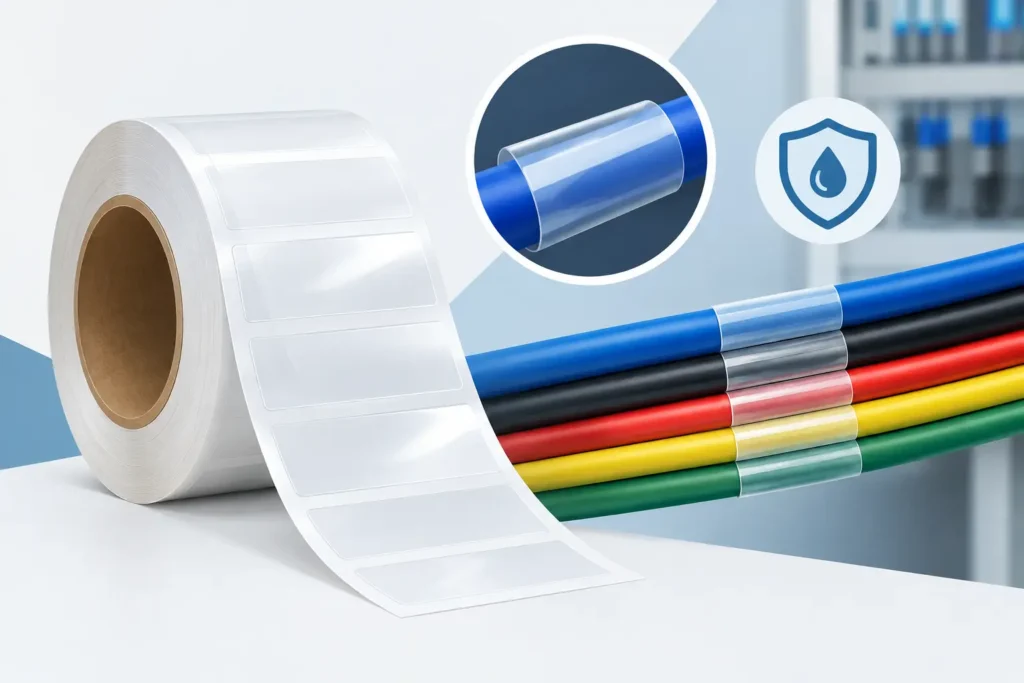
A wire marker that lifts, smears, or covers the identifier it was meant to protect creates more than a maintenance nuisance. It slows troubleshooting, introduces risk during service work, and weakens the traceability built into a panel, harness, or equipment installation. The 8000t vinyl clear self-laminating wire wrap label format addresses that problem by placing printed data beneath a clear protective laminate as the label wraps around the wire.
For operations teams, the value is straightforward: readable wire identification must remain readable after installation. Whether labels support electrical panels, control cabinets, network cabling, machinery, field equipment, or assembled wire harnesses, the correct material and format can reduce rework and make future maintenance more efficient.
How 8000T Vinyl Clear Self-Laminating Wire Labels Work
A self-laminating wire wrap label is designed with two functional sections. The printable area carries the variable data, such as a wire number, terminal reference, circuit designation, barcode, or safety information. A clear vinyl tail wraps over that printed area, creating a protective layer without requiring a separate laminate step.
This construction matters because wire and cable identification faces conditions that ordinary paper labels are not designed to handle. Wires bend, move through tight panel spaces, and may be exposed to handling, abrasion, oils, moisture, or cleaning procedures. The clear overlaminate helps protect the printed image while preserving visibility of the identifier.
The label is generally wrapped around the conductor so the printable portion remains visible and the clear tail overlaps it. A clean, tight application is essential. If the label is applied loosely, placed over contamination, or selected for the wrong wire diameter, its long-term performance can suffer regardless of the quality of the material.
Where This Wire Identification Format Fits Best
Clear self-laminating vinyl labels are commonly used where technicians need durable, legible identification on individual wires and smaller cables. Electrical control panels are a frequent application because dense wiring makes circuit tracing difficult when markers are inconsistent or hard to read. Manufacturing equipment, HVAC controls, telecommunications closets, data installations, and utility systems also benefit from clearly identified conductors.
They are particularly useful when variable information must be printed on demand. A team may need different identifiers for every wire in a cabinet, or it may need to revise a panel build after an engineering change. Thermal transfer printing allows operations to produce precise, sequential, and job-specific labels without relying on handwritten markers.
That said, self-laminating wire wrap labels are not the answer for every cable-marking requirement. Large-diameter cables may require a wider wrap or an alternative identification method. Outdoor installations, high-heat environments, chemical exposure, or frequent washdown may call for a material with application-specific resistance properties. The right choice depends on the actual service environment, not simply the fact that a label wraps around wire.
The Details That Determine Label Performance
Material selection should begin with the wire, the environment, and the printer. The phrase “clear vinyl” describes an important part of the construction, but it does not replace a full application review. Operations teams should evaluate several practical factors before standardizing a label.
Wire and Cable Diameter
A label must be sized for the outside diameter of the wire or cable, including insulation. The printable area needs enough room for required text, while the clear laminate tail must provide sufficient overlap to protect the print and hold securely. A label that is too small may not wrap correctly. One that is too large can create excess material, interfere with bundle organization, or make the identifier harder to locate.
Measure real production samples rather than relying solely on a nominal wire gauge. Jacket thickness varies, and cable assemblies may differ from standard conductor dimensions. For tight applications, testing the label on an actual wire bundle is more useful than making a decision from a catalog dimension alone.
Print Technology and Ribbon Compatibility
Most durable wire identification programs rely on thermal transfer printing because it supports sharp text, barcodes, and serialized data. Print quality, however, is a system result. The label stock, thermal transfer ribbon, printhead condition, printer settings, and artwork all affect readability.
A ribbon that is poorly matched to the label surface may produce weak print, poor scratch resistance, or inconsistent barcode contrast. Excessive heat can distort fine text or create overly dark barcodes, while insufficient heat can leave incomplete characters. Printer calibration and routine printhead maintenance are equally important, especially for labels carrying small fonts or high-density barcodes.
Surface Preparation and Application Method
The adhesive needs a clean surface to perform as intended. Dust, oil, moisture, mold-release residue, and hand oils can reduce initial adhesion. Before applying labels, wipe down the wire jacket according to the material and site requirements, then allow it to dry fully.
Apply the label at a consistent point in the wiring process. Many teams label conductors before final termination because there is more working room and a better opportunity to wrap the label evenly. Others apply labels after termination to match a verified panel layout. Either approach can work if the process is standardized and operators have clear placement rules.
Required Information and Readability
A wire label can only help if a technician can read it in the field. Determine the minimum text size that remains legible at normal working distance, then confirm that the selected label provides enough printable area. Long descriptions may need an abbreviated naming convention, supported by a wiring schedule or digital record.
If barcodes are required, validate them after printing and after application. A barcode that scans on a flat label may be more difficult to scan once wrapped around a small wire. Code symbology, X-dimension, scanner capability, and label curvature should all be considered during testing.
Building a Repeatable Wire Labeling Process
The best labeling program treats wire markers as part of the work process, not as a last-minute consumable purchase. Begin with a defined identifier standard. It should specify naming rules, data order, font size, label placement, and barcode requirements where applicable. This prevents one operator from printing “MTR-01” while another uses “MOTOR1” for the same type of circuit.
Next, connect the data source to the printing workflow. For low-volume work, operators may enter identifiers directly into labeling software. For larger builds, importing data from engineering files, spreadsheets, maintenance systems, or production databases can reduce manual entry errors. The goal is to print accurate labels at the point they are needed without creating a separate rekeying task.
A controlled print process also helps procurement and operations manage inventory. Instead of keeping a wide assortment of ad hoc labels and ribbons, teams can standardize on approved materials by wire range and application. That improves consistency across sites, simplifies replenishment, and makes it easier to qualify replacement printers or ribbons when equipment changes.
When Testing Is Worth the Extra Time
For routine indoor panel work, a straightforward sample application may be enough to confirm fit and print quality. For mission-critical equipment or demanding environments, more deliberate testing is justified. Apply labels to representative wires, allow the adhesive to set, then evaluate them after the handling, temperature, abrasion, or chemical exposure expected in service.
Testing should also include the human factors that are easy to overlook. Can installers apply the label consistently while wearing required gloves? Can maintenance personnel locate and read the identifier in a crowded enclosure? Does the barcode scan after the label is wrapped? These questions often reveal process issues before they become field failures.
PaladinID can help organizations evaluate the full wire identification system, including label material, printer and ribbon compatibility, variable-data workflow, and on-site application requirements. That consultative approach is especially valuable when a facility is standardizing multiple panel types, introducing serialized tracking, or replacing unreliable handwritten identification.
A Clear Label Is a Maintenance Advantage
The purpose of a self-laminating wire label is not simply to put text on a conductor. It is to preserve useful identification through installation, inspection, troubleshooting, and repair. When the material fits the wire, the print system is properly matched, and the application process is controlled, clear vinyl wire wrap labels become a dependable part of operational discipline.
Before committing to a large order, run representative samples through the actual printer, apply them to the wires your team uses, and inspect them under real working conditions. That small validation step can prevent a large-scale labeling problem and give technicians the information they need when time matters most.
Frequently Asked Questions About 8000T Vinyl Clear Self-Laminating Wire Wrap Labels
1. What are 8000T vinyl clear self-laminating wire wrap labels used for?
8000T vinyl clear self-laminating wire wrap labels are designed to identify and protect printed information on electrical wires and cables. They are commonly used in electrical panels, industrial machinery, wire harnesses, telecommunications systems, and control cabinets. The clear protective section wraps over the printed information to help prevent smudging, abrasion, and everyday wear.
2. How do self-laminating wire wrap labels work?
Self-laminating wire wrap labels have a printable section and a clear protective section. After printing the wire identification information, the label is wrapped around the wire so the transparent portion covers the printed text. This creates a protective layer without requiring additional laminating equipment, helping keep wire identification readable during installation, maintenance, and troubleshooting.
3. Are 8000T vinyl self-laminating labels compatible with Zebra printers?
8000T vinyl clear self-laminating labels are intended for thermal transfer printing, but compatibility depends on the specific Zebra printer model, label dimensions, roll configuration, and ribbon selection. Before ordering, verify that the label stock is compatible with your printer and that the printer can accommodate the required media size. PaladinID can help identify suitable label and ribbon combinations for your equipment.
4. What type of ribbon should be used with 8000T vinyl wire wrap labels?
A compatible thermal transfer ribbon is required to print on 8000T vinyl wire wrap labels. Depending on the label’s specifications and operating environment, a resin or other manufacturer-approved ribbon may be appropriate. Using the correct ribbon helps produce clear text and barcodes with the durability needed for wire identification. Always confirm ribbon compatibility with the label material and printer before purchasing.
5. How do I choose the correct size self-laminating label for my wire?
To select the correct label size, measure the outside diameter of the insulated wire or cable. The label must provide enough printable space for your identification information and sufficient clear material to wrap around the wire and overlap the printed area. Wire gauge alone may not determine the correct label size because insulation thickness varies. Testing a sample on your actual wire is recommended.
6. Are 8000T vinyl clear self-laminating labels waterproof and chemical resistant?
The clear protective laminate helps shield printed information from moisture, handling, and certain environmental contaminants. However, water and chemical resistance depend on the complete label construction, adhesive, ribbon, and exposure conditions. For applications involving oils, solvents, cleaning chemicals, or frequent moisture exposure, verify the manufacturer’s resistance specifications and test the labels under actual operating conditions.
7. Can self-laminating vinyl wire labels withstand high temperatures?
Vinyl self-laminating wire labels may be suitable for a range of industrial operating temperatures, but their exact temperature limits depend on the specific product construction. Applications near motors, electrical equipment, or other heat sources should be evaluated carefully. Check the manufacturer’s minimum and maximum service-temperature specifications before using these labels in high-temperature environments.
8. Can I print barcodes, serial numbers, and custom text on 8000T wire wrap labels?
Yes. When used with a compatible thermal transfer printer and labeling software, printable wire wrap labels can carry wire numbers, circuit identifiers, serial numbers, barcodes, and other variable information. Available printable space depends on the label size. For barcode applications, choose a format that remains readable and scannable after the label is wrapped around the wire.
9. How do I apply self-laminating wire wrap labels correctly?
Start with a clean, dry wire surface free of oil, dust, and other contaminants. Position the printed section where the identification will be visible, then wrap the clear portion smoothly and tightly around the wire so it covers the printed information. Avoid wrinkles, trapped air, and loose edges. Proper sizing and application help maintain adhesion and readability over time.
10. What is the difference between self-laminating wire wrap labels and heat-shrink wire markers?
Self-laminating wire wrap labels use an adhesive-backed material that wraps around a wire, with a clear section protecting the printed identification. Heat-shrink wire markers are sleeves that shrink around the wire when heat is applied. Self-laminating labels are useful when heat application is undesirable or when labeling wires that are already installed. Heat-shrink markers may be preferred for certain demanding applications or installations where a sleeve-style identification system is specified.
At PaladinID, we understand that every labeling application is different.
That’s why companies across the country trust us to help them identify the right solution for their business. With over 40 years of experience and one of the industry’s largest selections of labeling products, we make it easy to find the right fit for your operation. Whether you need stock products or a custom-built solution, our team is ready to help. Visit our online catalog, Email us, or call us today at 888.972.5234.
PaladinID delivers label solutions that stick!


Got Labeling Questions? Our AI Assistant Has Answers - Chat Now!
For more information on PaladinID
Get Help With Your Next Label Project
We have over 35 years of providing exceptional service and labeling products to the world. Take the first step to an easy, stress-free solution for your label needs by contacting us.
Schedule a call below or email [email protected]
Make Your Mark
“Making companies more competitive by offering the correct label printing solution, on time, within budget, while creating unmatched value”.
About PaladinID, LLC
PaladinID develops and supports high-performance barcode labeling applications. We work with our clients to “Make Your Mark” by providing the expertise and tools necessary to create an entire product label printing solution. Located in central New Hampshire, PaladinID has been serving Massachusetts, Vermont, Maine, Connecticut, Rhode Island, New England, and beyond for over 30 years, and in 2017, became an RFID-certified company. We look forward to working with you.
You may be interested in our other services:
Product Labels
Product Labels
Labels for every type of application: Blank, Pre-printed, Variable data
Label Printers
Label Printers
We sell and support: Direct/thermal transfer, Inkjet, Laser
Printer Ribbons
Printer Ribbons
We sell ribbons for ALL barcode printers including: Zebra, Datamax, Sato, Intermec
Flexible Packaging
Flexible Packaging
We offer a wide variety of packaging containers for your products.
Label Software
Label Software
Software for all barcode printing and product labeling.
Label applicators
Label Applicators
Wide selection of applicators: Desktop/Mobile, Applicator only, Print & apply
