
Industrial Barcode Labeling Guide: How to Build a Reliable Labeling System




What Can We Help You With?
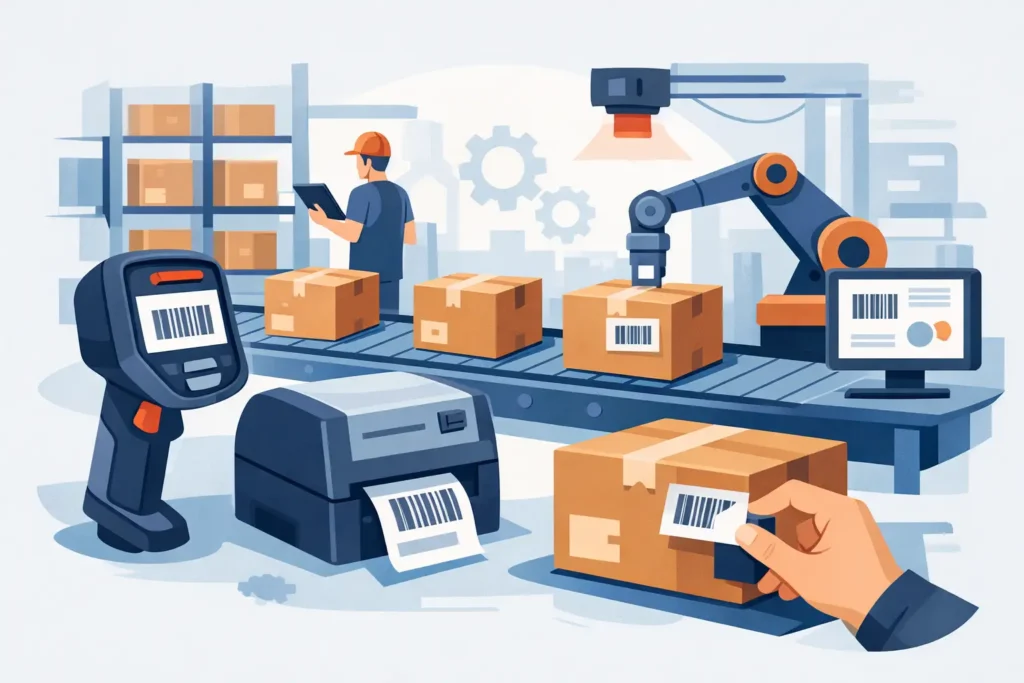
A barcode that scans perfectly at a desk can fail quickly on a production floor. Heat, abrasion, moisture, chemicals, UV exposure, and constant handling expose weak points in both the label and the labeling system behind it. That’s why an industrial barcode labeling guide needs to cover much more than label size or printer speed. It should address the complete workflow—from data creation and label printing to barcode scanning and long-term durability.
For manufacturers, warehouses, and distribution centers, labeling is mission-critical. It affects inventory accuracy, shipping efficiency, compliance, traceability, and labor productivity. When labels smear, peel, fade, or scan inconsistently, the result is rework, delays, and manual intervention. The most reliable labeling programs are built around the application—not around a generic product specification.
Build the Labeling System Around the Application
An industrial barcode label is only one part of a much larger system. Long-term success depends on how the label material, adhesive, ribbon, printer, software, and barcode data work together. If any component is mismatched, overall performance suffers.
For example, pairing a durable synthetic label with an incompatible ribbon can produce barcodes that scratch off during normal handling. Likewise, a high-performance industrial printer cannot compensate for inconsistent data or poorly designed label templates.
Rather than evaluating individual products, begin by understanding the operating environment, barcode requirements, workflow, and maintenance expectations. The right solution is the one that performs consistently under real production conditions—not just during a sample print.
Start with the Environment
Every labeling project begins with a simple question: What will this label experience?
A warehouse rack label has very different requirements than a chemical drum label, pipe marker, reusable tote label, or serialized product label moving through an automated production line.
Consider factors such as:
- Surface material
- Expected service life
- Indoor or outdoor exposure
- Moisture and chemical contact
- Heat or freezer temperatures
- Abrasion and repeated handling
- Scanner type and scan distance
Matching the label to its environment from the beginning prevents many of the failures that lead to rescanning and relabeling later. Organizations looking to improve consistency across facilities should also establish clear warehouse labeling standards so materials, templates, and placement remain uniform.
Selecting the Right Label Material and Adhesive
Material selection should reflect both the label’s expected lifespan and the environment it will encounter.
Paper labels remain an economical solution for shipping labels, carton identification, and many temporary warehouse applications. However, they are not designed for prolonged exposure to moisture, chemicals, abrasion, or repeated handling.
Synthetic materials—including polyester and polypropylene—provide significantly greater durability for demanding applications. Their resistance to tearing, moisture, and wear makes them well suited for asset tracking, manufacturing, and industrial identification.
For example, industrial polypropylene labels provide excellent resistance to smudging, water, and oils, making them a strong choice for many barcode and inventory labeling applications where paper labels may not last.
Adhesive selection is equally important. Permanent adhesives are available in formulations designed for smooth surfaces, rough materials, cold-temperature application, removable use, and low-surface-energy plastics. The best adhesive is determined by the application—not by the label material alone.
Printers and Ribbons Matter Just as Much
Industrial labeling demands equipment designed for reliability and continuous operation. While desktop printers may be suitable for occasional labeling, high-volume environments generally benefit from industrial printers built for heavier media, faster production, and easier maintenance.
Print technology should also match the application.
Direct thermal printing works well for short-life shipping and logistics labels where long-term durability isn’t required.
Thermal transfer printing is typically the better choice when labels must withstand handling, chemicals, moisture, or extended storage. The ribbon becomes part of the finished label, making ribbon selection just as important as choosing the label itself.
Wax ribbons remain common for paper labels. Wax-resin ribbons provide improved durability, while resin ribbons are generally preferred for synthetic materials exposed to harsher conditions.
Print resolution deserves careful consideration as well. Standard 203 dpi is sufficient for many warehouse applications, while compact text, serialized labels, and dense 2D barcodes often benefit from 300 dpi or higher.
Software and Data Consistency
Many barcode problems begin long before the printer.
Manual data entry, inconsistent spreadsheets, and locally modified templates often create labeling errors that no printer can correct.
Modern labeling software should support controlled templates, variable data, user permissions, and, when appropriate, integration with ERP, WMS, MES, or inventory systems. Standardized templates ensure barcode size, quiet zones, human-readable text, and formatting remain consistent regardless of who prints the label.
That consistency improves both scan reliability and inventory accuracy, particularly for organizations managing multiple facilities.
Barcode Design for Real-World Scanning
A barcode doesn’t need to look perfect—it needs to scan reliably in the environment where it’s used.
Scanner type, lighting, scan distance, label placement, and operator workflow all influence performance.
Warehouse shelf labels scanned from forklifts often require larger symbols than product identification labels scanned by hand. Likewise, placing a barcode too close to a label edge or wrapping it around a curved surface can reduce readability even when print quality is excellent.
Testing should include multiple scanners, operators, and environmental conditions before deployment.
If you’re troubleshooting inconsistent scan performance, our guide on improving barcode accuracy explains how printer settings, materials, placement, and scanners work together to improve reliability.
Maintenance Is Part of the Labeling System
Even well-designed labeling systems require regular maintenance.
Printheads wear over time. Platen rollers accumulate debris. Printer calibration changes. Media lots vary.
Routine preventive maintenance keeps barcode quality consistent while reducing unexpected downtime.
Organizations that purchase labels, ribbons, printers, and software independently often spend more time troubleshooting because responsibility is divided among multiple suppliers. Working with a knowledgeable labeling partner helps ensure every component performs as an integrated system rather than as separate purchases.
Put This Industrial Barcode Labeling Guide Into Practice
Use this industrial barcode labeling guide as a framework for evaluating your entire labeling operation—not simply selecting supplies.
Start with the application.
Match the label material and adhesive to the environment.
Choose printers and ribbons that support the required durability.
Standardize label templates and data sources.
Then validate the complete system under actual operating conditions before rolling it out across the organization.
Testing labels after they’ve been exposed to real handling, storage, and transportation conditions provides a much more accurate picture than evaluating freshly printed samples alone.
Industrial barcode labeling works best when it’s treated as operational infrastructure rather than a consumable purchase. When labels, printers, ribbons, software, and procedures are aligned, barcode scanning becomes routine, inventory becomes more accurate, and operations spend less time correcting preventable errors.
At PaladinID, we help organizations design complete labeling systems that perform reliably in real-world industrial environments. Whether you’re standardizing labels across multiple facilities, upgrading barcode printing, or selecting materials for a demanding application, our specialists can help you identify the right combination of labels, printers, ribbons, and software for your operation.
Browse our online catalog, contact our team, or call 888-972-5234 to discuss your labeling requirements.


Got Labeling Questions? Our AI Assistant Has Answers - Chat Now!
For more information on PaladinID
Get Help With Your Next Label Project
We have over 35 years of providing exceptional service and labeling products to the world. Take the first step to an easy, stress-free solution for your label needs by contacting us.
Schedule a call below or email [email protected]
Make Your Mark
“Making companies more competitive by offering the correct label printing solution, on time, within budget, while creating unmatched value”.
About PaladinID, LLC
PaladinID develops and supports high-performance barcode labeling applications. We work with our clients to “Make Your Mark” by providing the expertise and tools necessary to create an entire product label printing solution. Located in central New Hampshire, PaladinID has been serving Massachusetts, Vermont, Maine, Connecticut, Rhode Island, New England, and beyond for over 30 years, and in 2017, became an RFID-certified company. We look forward to working with you.
You may be interested in our other services:
Product Labels
Product Labels
Labels for every type of application: Blank, Pre-printed, Variable data
Label Printers
Label Printers
We sell and support: Direct/thermal transfer, Inkjet, Laser
Printer Ribbons
Printer Ribbons
We sell ribbons for ALL barcode printers including: Zebra, Datamax, Sato, Intermec
Flexible Packaging
Flexible Packaging
We offer a wide variety of packaging containers for your products.
Label Software
Label Software
Software for all barcode printing and product labeling.
Label applicators
Label Applicators
Wide selection of applicators: Desktop/Mobile, Applicator only, Print & apply
