
RFID Labels vs Barcode Labels




What Can We Help You With?
A missed scan at a dock door can slow a shipment. A mislabeled pallet can ripple through inventory, picking, and billing. That is why the conversation around RFID labels vs barcode labels is not really about technology for its own sake. It is about choosing the identification system that keeps your operation accurate, visible, and workable at scale.
For many organizations, the right answer is not as simple as newer versus older. Barcode labels remain the standard in countless warehouses, production lines, labs, and shipping workflows because they are cost-effective, easy to deploy, and widely supported. RFID labels bring a different set of strengths, especially where speed, automation, and non-line-of-sight tracking matter. The better choice depends on your environment, your process, and the level of visibility you actually need.
RFID labels vs barcode labels: the core difference
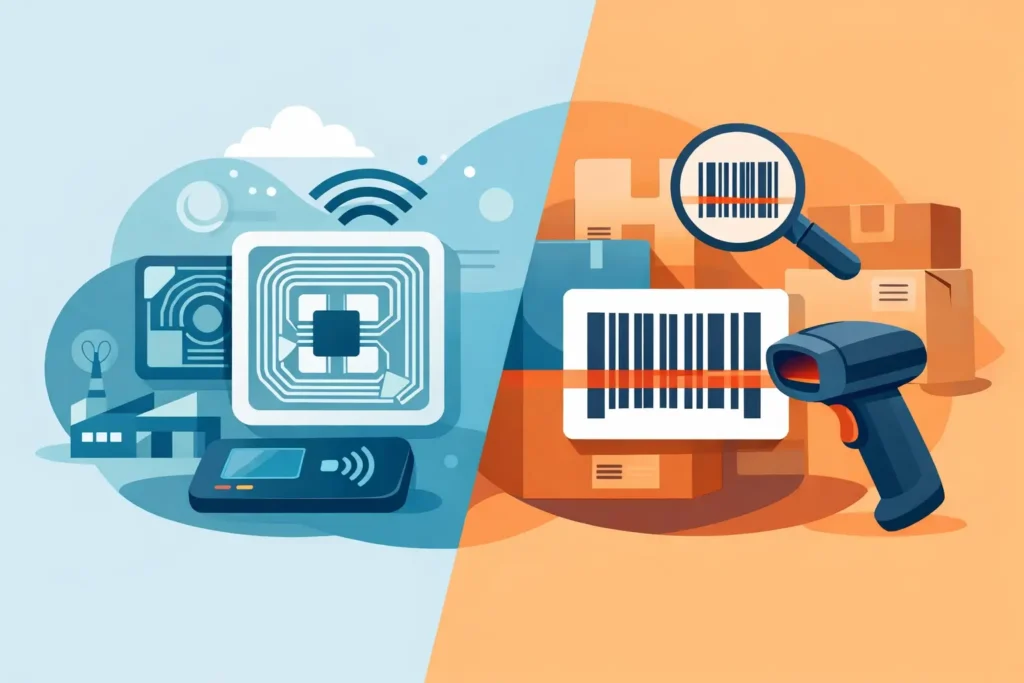
A barcode label stores visual data that must be read by a scanner or camera. In most cases, that means line of sight matters. The label must be printed clearly, positioned correctly, and presented properly for the scanner to capture it.
An RFID label contains an embedded chip and antenna. Instead of being read visually, it communicates by radio frequency. That allows it to be detected without a direct line of sight, and in some cases, multiple items can be read at once. That single difference changes what is possible in receiving, inventory counts, asset tracking, and process automation.
This does not mean RFID replaces barcodes in every setting. It means the two technologies solve different operational problems.
Where barcode labels still make the most sense
Barcode labels remain the practical choice for many businesses because they deliver reliable performance without requiring major system changes. If your team scans one item at a time, your process is already disciplined, and your cost sensitivity is high, barcodes are often the right fit.
They also work well in environments where a human checkpoint is useful. In manufacturing, healthcare, distribution, and compliance labeling, that scan event can serve as a deliberate confirmation step. Someone scans the item, validates the data, and moves it to the next stage. That kind of control is not a weakness. In some workflows, it is exactly what prevents errors.
Barcode labels also benefit from broad compatibility. Printers, handheld scanners, mobile computers, warehouse systems, and ERP platforms are already built around the use of barcodes. Training is usually straightforward, label costs are low, and implementation risk is limited compared to more advanced tracking systems.
For organizations labeling cartons, shelves, locations, work-in-process items, shipping labels, or basic assets, barcode systems continue to offer strong value.
Where RFID labels create a measurable advantage
RFID becomes attractive when manual scanning starts to limit throughput or visibility. If workers have to stop, aim, and scan every item, the process can become a bottleneck. If inventory accuracy depends on perfect scan discipline, gaps are likely to show up over time.
RFID labels can help remove those friction points. A reader at a portal can capture tagged items as they pass through a doorway or dock lane. Cycle counts can be faster because staff can read many tagged assets or inventory items in a single pass. In the right application, that means less labor, faster verification, and better real-time visibility.
This is especially useful in environments with high item volume, fast movement, or repeated handling. Warehouses, returnable asset programs, healthcare equipment tracking, rental operations, and industrial yard management are common examples. In those cases, the value of RFID is not just the label itself. It is the reduction in manual effort and the improvement in data capture.
Still, RFID is not automatic magic. Performance depends on tag selection, reader placement, material type, software integration, and testing in real-world environments.
Cost is not just about the label price
One of the most common mistakes in evaluating RFID labels vs barcode labels is comparing only the unit cost of the label. Barcode labels are less expensive up front. That part is straightforward. RFID labels cost more because of the embedded inlay and the supporting infrastructure required to read and manage them.
But the total cost picture is broader than that. If barcode scanning requires more labor, more rescans, more exception handling, or more inventory reconciliation, the lower label price may not tell the whole story. On the other hand, if your workflow is stable and manual scans are already efficient, RFID may add cost without enough return.
A useful way to evaluate the decision is to look at labor time, error rates, shrink, inventory accuracy, compliance requirements, and the cost of missed visibility. In some operations, RFID pays for itself through process improvement. In others, barcode labels remain the more disciplined investment.
Accuracy, speed, and control
Barcode systems can be extremely accurate when print quality is strong and users follow the process. They are also highly controlled. Every scan is intentional, which helps when you need a clear transaction history tied to specific process steps.
RFID can increase speed dramatically because it reduces the dependence on one-at-a-time scanning. It also supports automated data capture, which can improve consistency where manual compliance is difficult to maintain. But more data is not always better if your system is not set up to filter, interpret, and act on it correctly.
That is why process design matters. If you want event-based visibility at choke points like dock doors, staging areas, or storage rooms, RFID may better support that. If you need a confirmed operator action before a shipment is packed, a barcode scan may still be the cleaner tool.
Environmental and application factors matter
Not every label performs the same way in the field. Barcode labels can fail if the print quality degrades, the surface is damaged, or the label is exposed to chemicals, abrasion, moisture, or heat beyond its construction limits. Those issues are manageable with the right facestock, adhesive, ribbon, and printer settings.
RFID labels introduce another layer of application detail. Materials such as metal and liquid can affect reading performance. Tag orientation, mounting surface, and reader configuration matter. A tag that works well on corrugated may not perform the same way on a metal asset or a chemical container.
That is why label selection should never happen in isolation. The media, printer, ribbon, software, and read environment all have to work together. In demanding applications, testing under actual operating conditions is usually the difference between a working system and an expensive pilot that stalls.
Integration is often the real decision point
The label is only one part of the identification system. Barcode labels are usually easier to integrate because most businesses already have scanners, print workflows, and software fields designed around them. Expanding a barcode system often means improving label durability, standardizing formats, or upgrading printers and scanners.
RFID usually requires a more intentional rollout. You may need readers, antennas, middleware, software changes, encoding workflows, and new process logic. That does not make RFID a poor choice. It means the business case should include implementation planning, not just tag procurement.
This is where many industrial buyers benefit from working with a partner that understands the full labeling environment, from media and printers to software and workflow design. A good deployment is not built by swapping labels alone.
How to choose between RFID labels and barcode labels
If your operation depends on low-cost labeling, universal compatibility, and controlled point-by-point scanning, barcode labels are often the right answer. They are proven, practical, and effective in a wide range of compliance, warehouse, shipping, and production applications.
If your operation struggles with manual-scan bottlenecks, limited visibility between process steps, or labor-intensive inventory counts, RFID may be worth serious consideration. The strongest candidates are usually high-volume environments where automation creates measurable value.
There is also a middle ground. Some organizations use both. A label can carry a barcode for broad compatibility and human-readable fallback, while RFID supports automated tracking in specific zones or workflows. For many businesses, that hybrid model is more realistic than a full replacement strategy.
The best decision usually comes from asking a few direct questions. What data do you need, when do you need it, and how much manual effort are you willing to accept to get it? What surfaces are you labeling? What systems must the labels work with? And what does a scanning failure actually cost your operation?
PaladinID works with organizations that need those answers grounded in real applications, not generic product claims. That includes matching label construction, printer capability, software, and workflow requirements so the system performs where it counts.
The right label technology is the one that supports your process without adding unnecessary complexity. If barcode labels already give you dependable control, that is a strong position. If your operation has outgrown manual scanning, RFID may be the next logical step. The key is to choose based on how your business runs today and where it needs more visibility tomorrow.
At PaladinID, we understand that every labeling application is different.
That’s why companies across the country trust us to help them identify the right solution for their business. With over 40 years of experience and one of the industry’s largest selections of labeling products, we make it easy to find the right fit for your operation. Whether you need stock products or a custom-built solution, our team is ready to help. Visit our online catalog, Email us, or call us today at 888.972.5234.
PaladinID delivers label solutions that stick!


Got Labeling Questions? Our AI Assistant Has Answers - Chat Now!
For more information on PaladinID
Get Help With Your Next Label Project
We have over 35 years of providing exceptional service and labeling products to the world. Take the first step to an easy, stress-free solution for your label needs by contacting us.
Schedule a call below or email [email protected]
Make Your Mark
“Making companies more competitive by offering the correct label printing solution, on time, within budget, while creating unmatched value”.
About PaladinID, LLC
PaladinID develops and supports high-performance barcode labeling applications. We work with our clients to “Make Your Mark” by providing the expertise and tools necessary to create an entire product label printing solution. Located in central New Hampshire, PaladinID has been serving Massachusetts, Vermont, Maine, Connecticut, Rhode Island, New England, and beyond for over 30 years, and in 2017, became an RFID-certified company. We look forward to working with you.
You may be interested in our other services:
Product Labels
Product Labels
Labels for every type of application: Blank, Pre-printed, Variable data
Label Printers
Label Printers
We sell and support: Direct/thermal transfer, Inkjet, Laser
Printer Ribbons
Printer Ribbons
We sell ribbons for ALL barcode printers including: Zebra, Datamax, Sato, Intermec
Flexible Packaging
Flexible Packaging
We offer a wide variety of packaging containers for your products.
Label Software
Label Software
Software for all barcode printing and product labeling.
Label applicators
Label Applicators
Wide selection of applicators: Desktop/Mobile, Applicator only, Print & apply
