
Zebra 8000T Void Gloss: Where It Fits


What Can We Help You With?
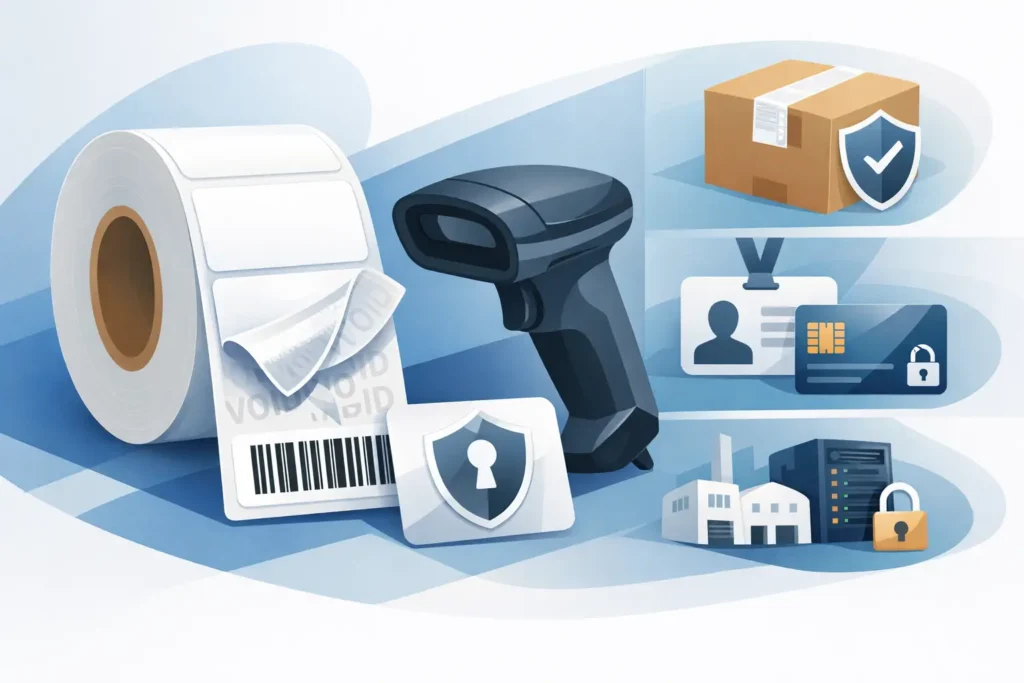
A tamper-evident label only does its job when failure is obvious. That is why buyers look at the Zebra 8000T Void Gloss in the first place. It is designed for applications where a label should leave a visible message or pattern when someone attempts to remove it, helping operations teams protect assets, detect interference, and support chain-of-custody processes.
For many organizations, the question is not whether they need a tamper-evident label. The real question is whether this particular construction fits the surface, printer, environment, and workflow they are running every day. A label that performs well in a controlled office setting can fail quickly in a warehouse, on a textured asset, or in a supply chain that sees heat, abrasion, and frequent handling.
What Zebra 8000T Void Gloss is designed to do
Zebra 8000T Void Gloss is a thermal-transfer polyester label material designed for tamper evidence. Its core function is straightforward: if the label is removed or tampered with, it indicates interference. That makes it useful for asset tags, warranty seals, product security labels, and any process where visual evidence of removal matters.
The gloss topcoat supports thermal transfer printing, which is important for operations that need durable variable data such as serial numbers, barcodes, dates, or lot information. In practical terms, that means you are not choosing only a security feature. You are choosing a printable label construction that must maintain barcode readability and legible text while also providing tamper indication.
That combination matters because many teams need a single label to handle multiple tasks at once. A warehouse might need a security label that also scans into an asset management system. A manufacturer might need a seal that carries a serialized barcode for traceability. A healthcare or life sciences operation may need a tamper-evident element without sacrificing print clarity.
When Zebra 8000T Void Gloss makes sense
The best fit for Zebra 8000T Void Gloss is an application where deterrence and visible evidence are more important than clean removability. If someone peels at the label, you want the label to reveal that action. That is typically the point.
Common use cases for Zebra 8000T Void Gloss
This material is often considered for electronics, IT assets, calibration labels, warranty seals, and product packaging where unauthorized access needs to be apparent. It can also be useful in internal control programs for tools, equipment, and high-value inventory.
If your organization manages assets across departments or facilities, tamper-evident labeling can help reduce disputes over whether an item was opened, altered, or improperly transferred. In regulated or quality-driven environments, that visual evidence can support internal accountability even when it is not a formal compliance requirement.
There is also a practical operations benefit. A label that shows interference can shorten investigation time. Instead of guessing whether an item has been accessed, your team has a visible indicator to work from.
Printer and ribbon compatibility matter more than many buyers expect
A common mistake is to evaluate a label material based solely on its spec sheet. With Zebra 8000T Void Gloss, print performance depends on the printer, ribbon, darkness settings, speed, and printhead condition.
Because this is a thermal transfer product, ribbon selection is part of the decision. The wrong ribbon can lead to reduced image durability, poor barcode edge definition, or inconsistent adhesion of the printed image to the label surface. That can turn a good tamper-evident label into a poor scanning label.
For industrial users, the goal is not just to get an image onto the label. The goal is repeatable print quality across shifts, batches, and multiple printer stations. That means testing the label with the exact printer model and ribbon family you plan to run, especially if your labels include small text, dense barcodes, or sequential data.
If your operation already uses Zebra industrial printers, this material may fit naturally into that environment. Even then, setup still matters. Print speed that is too high or heat that is not dialed in can reduce consistency. Small adjustments in media calibration and ribbon matching often make a meaningful difference.
Surface type can determine success or failure
Not every smooth-looking surface behaves the same way. One of the biggest variables in tamper-evident labeling is the substrate to which the label is applied.
Clean, high-energy surfaces generally give adhesives the best chance to bond properly. But many real-world applications are less forgiving. Powder-coated metals, lightly textured plastics, low-surface-energy materials, and items exposed to oils or cleaners can all affect adhesion. If the bond is weak from the start, the tamper feature may not perform as intended. You might get edge lift, premature failure, or inconsistent void behavior.
This is why application testing matters. If you are labeling laptops, handheld devices, molded plastic housings, or packaging films, treat each surface as its own test case. Even within the same facility, labels applied to metal racks, plastic bins, and finished goods cartons can behave differently.
Environmental conditions to evaluate
Temperature swings, moisture, abrasion, and chemical exposure should all be part of the discussion. A tamper-evident label in a climate-controlled room is one thing. A tamper-evident label in a hot warehouse, a service vehicle, or a production floor is another.
Gloss polyester constructions can offer good durability, but no label material should be assumed to be universal. If items are cleaned regularly, handled aggressively, or exposed to outdoor conditions for any period, it is worth confirming both the print durability and adhesive behavior under those exact conditions.
Trade-offs to understand before you standardize
The strongest label choices are usually made by teams that understand the trade-offs, not just the features. Zebra 8000T Void Gloss offers a clear value when tamper evidence is required, but that value comes with considerations.
First, this is not the right choice if you need a label to remove cleanly without residue or visible evidence. By design, tamper-evident constructions are meant to show disturbance. If your workflow includes frequent relabeling or temporary identification, another material may be a better fit.
Second, gloss materials can deliver sharp print quality, but they may also make scuffs, scratches, or handling wear more visible in certain applications. That is not necessarily a problem, but it should be part of your evaluation if appearance matters to customers or auditors.
Third, the best-performing tamper-evident label is not always the most aggressive adhesive on paper. Performance depends on the balance between face stock, adhesive, application surface, and removal behavior. A label that is too aggressive for a given surface may cause application issues, while one that is too forgiving may undermine the security goal.
How to evaluate Zebra 8000T Void Gloss in your operation
The most reliable approach is a controlled application trial. Start with the exact surfaces you need to label and the exact printers and ribbons you expect to use. Print the variable data formats your operation actually relies on, including small barcodes, serial numbers, and human-readable text.
Apply labels using normal production methods rather than ideal lab conditions. Then test them after realistic dwell times. Some adhesives develop performance over time, so immediate peel behavior may not tell the full story. Check for adhesion, print quality, scan reliability, and the consistency of the void feature after handling or attempted removal.
It also helps to test edge cases. Try labels on items that see more friction, more temperature variation, or less controlled cleaning processes. If your team works across multiple facilities, sample each environment before standardizing.
This is where a consultative supplier becomes more valuable than a simple material source. Label selection is rarely just about ordering a stock number. It is about ensuring the material works with your printers, ribbons, scanning requirements, and operating conditions, so your team is not troubleshooting failures after rollout.
A good fit when security and printability need to work together
Zebra 8000T Void Gloss draws attention for addressing a specific operational need: making unauthorized removal visible while still supporting durable thermal-transfer printing. For organizations managing assets, product integrity, warranty control, or internal accountability, that can be a strong combination.
The key is to treat it as part of a labeling system, not a standalone item. Printer settings, ribbon choice, surface compatibility, and environmental realities all influence the result. When those pieces are aligned, tamper-evident labeling becomes much more dependable and much easier to scale.
If your team is weighing options, the smartest next step is not to guess based on a catalog description. It is validating the material against your real application so the label performs the way your operation needs it to when it matters most. We do carry many stock sizes in the Zebra 8000T Void Gloss, but can manufacture any size or shape for your specific application.
At PaladinID, we understand that every labeling application is different.
That’s why companies across the country trust us to help them identify the right solution for their business. With over 40 years of experience and one of the industry’s largest selections of labeling products, we make it easy to find the right fit for your operation. Whether you need stock products or a custom-built solution, our team is ready to help. Visit our online catalog, Email us, or call us today at 888.972.5234.
PaladinID delivers label solutions that stick!

Got Labeling Questions? Our AI Assistant Has Answers - Chat Now!
For more information on PaladinID
Get Help With Your Next Label Project
We have over 35 years of providing exceptional service and labeling products to the world. Take the first step to an easy, stress-free solution for your label needs by contacting us.
Schedule a call below or email [email protected]
Make Your Mark
“Making companies more competitive by offering the correct label printing solution, on time, within budget, while creating unmatched value”.
About PaladinID, LLC
PaladinID develops and supports high-performance barcode labeling applications. We work with our clients to “Make Your Mark” by providing the expertise and tools necessary to create an entire product label printing solution. Located in central New Hampshire, PaladinID has been serving Massachusetts, Vermont, Maine, Connecticut, Rhode Island, New England, and beyond for over 30 years, and in 2017, became an RFID-certified company. We look forward to working with you.
You may be interested in our other services:
Product Labels
Product Labels
Labels for every type of application: Blank, Pre-printed, Variable data
Label Printers
Label Printers
We sell and support: Direct/thermal transfer, Inkjet, Laser
Printer Ribbons
Printer Ribbons
We sell ribbons for ALL barcode printers including: Zebra, Datamax, Sato, Intermec
Flexible Packaging
Flexible Packaging
We offer a wide variety of packaging containers for your products.
Label Software
Label Software
Software for all barcode printing and product labeling.
Label applicators
Label Applicators
Wide selection of applicators: Desktop/Mobile, Applicator only, Print & apply
