
Thermal Transfer vs Direct Thermal




What Can We Help You With?
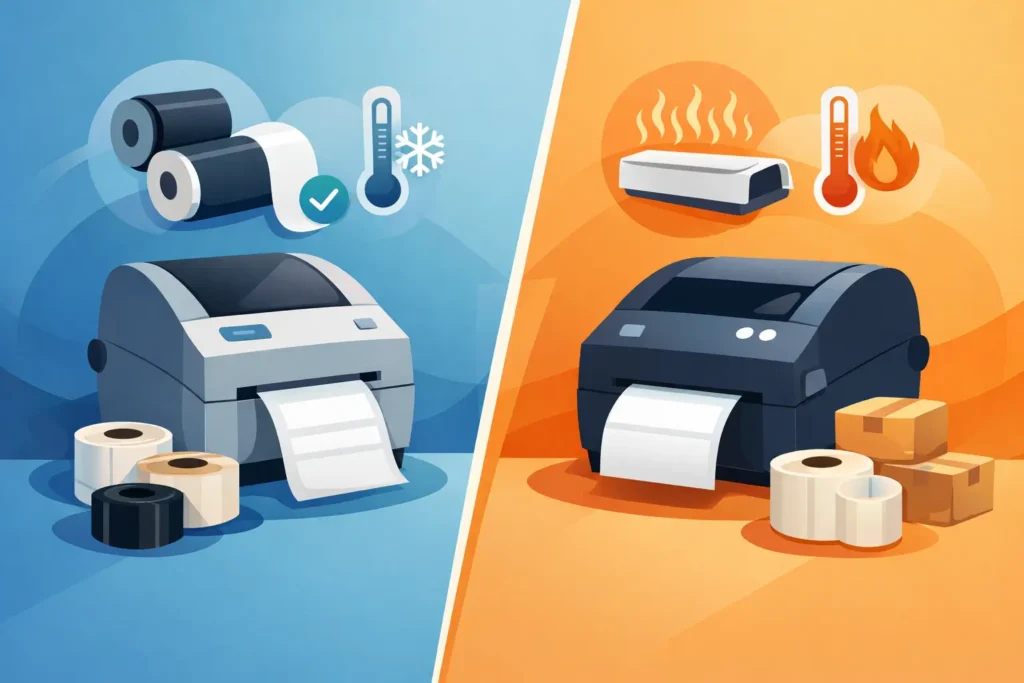
A label that scans perfectly at the printer but fades in a warehouse aisle two weeks later is not a small problem. It slows receiving, creates inventory errors, and forces teams to relabel products that should have moved the first time. That is why the choice between thermal transfer vs direct thermal matters more than many operations teams expect.
Both print methods are widely used in barcode and labeling environments, and both have a place in business operations. The right choice depends on what you are labeling, how long the label needs to last, and what conditions it will face after it leaves the printer. If you are standardizing a labeling system across production, warehousing, shipping, or asset tracking, this decision affects print quality, consumable costs, equipment compatibility, and long-term reliability.
Thermal transfer vs direct thermal: the core difference
The basic distinction is straightforward. Direct thermal printing creates an image by applying heat directly to chemically treated label material. No ribbon is required. The printhead activates the label surface itself, producing text, barcodes, and graphics.
Thermal transfer printing works differently. It uses heat to transfer ink from a ribbon onto the label surface. Instead of darkening the label stock, the printer melts or releases ribbon material in the printed pattern.
That difference changes nearly everything about performance. Direct thermal is simpler from a supply standpoint because there is no ribbon to load, track, or replace. Thermal transfer adds a ribbon and delivers greater material flexibility and better resistance to heat, abrasion, chemicals, moisture, and long-term fading.
In practical terms, direct thermal is often the better fit for short-life labels. Thermal transfer is usually the better fit for labels that need to remain readable and scanable for extended periods or in demanding environments.
Where direct thermal makes sense
Direct thermal is commonly used for shipping labels, temporary product labels, receipts, patient visitor labels, and other applications where the printed image is not expected to last for months or years. In operations with high print volume and fast label turnover, that simplicity can be a real advantage.
Because there is no ribbon, direct thermal systems reduce one consumable from the process. That can make media changes faster and day-to-day operations easier for teams that need speed and consistency at packing stations or receiving docks. If a label is created, applied, scanned, and discarded within a short window, direct thermal often does the job efficiently.
It can also be a strong choice when you want to minimize operator intervention. Fewer supplies mean fewer loading steps and fewer chances to mismatch ribbon and label materials.
The trade-off is durability. Direct thermal labels are sensitive to heat, light, friction, and some environmental exposure. Over time, the image can darken, fade, or become less readable. That does not make direct thermal inferior. It simply means it performs best in the applications for which it was designed.
Where thermal transfer earns its place
Thermal transfer is the standard for more demanding industrial labeling because it offers greater control over durability. Since the image is applied to the label material via transferred ribbon ink, it can withstand far better in storage, transit, outdoor exposure, and manufacturing environments.
This matters for asset tags, shelf labels, inventory identification, product compliance labels, laboratory labels, work-in-process tracking, nursery tags, pipe markers, and any barcode that must remain readable over time. If the label will be handled repeatedly, exposed to temperature swings, or expected to survive long after printing, thermal transfer is typically the safer choice.
It is also the most versatile option in terms of label materials. Thermal transfer can print on paper, polyester, polypropylene, and specialty stocks designed for chemical resistance, UV exposure, freezer use, or harsh industrial conditions. Ribbon selection also plays a role. Wax, wax-resin, and resin ribbons each serve different durability and substrate needs.
That flexibility is one reason many operations teams choose thermal transfer when label failure carries a real operational cost. A missed scan on a shipping label is frustrating. A missed scan on a serialized component, regulated product, or fixed asset can be much more disruptive.
Cost is not as simple as ribbon vs no ribbon
Many buyers start with the consumable cost, which is reasonable. Direct thermal avoids purchasing ribbons, so on the surface, it can appear less expensive. In some environments, it is.
But the total cost depends on more than the number of supplies loaded into the printer. Direct thermal labels usually require specially coated media. Thermal transfer labels may use a wider range of facestocks, paired with the correct ribbon. Depending on your application, material pricing can shift the equation.
Then there is the cost of failure. If a label fades before the process is complete, the savings from skipping ribbon can disappear quickly. Reprints, relabeling labor, shipping delays, chargebacks, inventory discrepancies, and compliance issues all entail costs that do not appear in a simple media quote.
Printer wear can factor in, too. In some cases, direct thermal media can contribute to printhead wear because the printhead is in direct contact with the treated label surface during imaging. Thermal transfer uses a ribbon between the printhead and the label, which can provide some protection. Actual lifespan depends on printer settings, media quality, maintenance, and operating conditions, but it is worth considering in a fleet environment.
Barcode performance and scan reliability
For most industrial buyers, the question is not just how the label looks when printed. It is whether the barcode scans every time it is needed.
Both methods can produce crisp, high-quality barcodes when properly configured. The issue is how that print quality holds up across the life of the label. A direct thermal barcode may scan perfectly on day one, then degrade after exposure to warehouse heat, sunlight through a dock door, or repeated handling. A thermal transfer barcode is generally better suited for applications where scan consistency must hold over a longer period.
This is especially relevant when labels move across multiple touchpoints. If receiving, putaway, replenishment, picking, packing, and shipping all depend on the same barcode, durability becomes part of the process design, not just printer setup.
How to choose the right method for your operation
The best choice starts with the application, not the printer brochure. Ask how long the label needs to remain readable, where it will be used, what surface it will be applied to, and what could happen if it fails.
If you are labeling corrugated boxes for same-week shipment, direct thermal is often a smart and efficient option. If you are labeling products for storage, tracking returnable assets, marking racks, identifying specimens, or printing compliance labels that must remain legible for the life of the item, thermal transfer is usually the better fit.
Environment matters just as much as lifespan. Labels used in freezers, outdoor yards, manufacturing plants, healthcare settings, chemical-exposure areas, or high-friction handling environments often require thermal transfer with the right ribbon-and-substrate combination. A poor material match can cause failure even if the print method is technically correct.
This is where a consultative approach matters. The print technology, label stock, adhesive, ribbon, printer settings, and software workflow all affect results. Treating them as separate purchases often leads to performance gaps.
Thermal transfer vs direct thermal in real business use cases
In warehousing and distribution, direct thermal is common for shipping labels because the label life is short and speed is critical. For location labels, long-term bin marking, and asset identification, thermal transfer is usually the stronger choice.
In manufacturing, work-in-process labels may go either way depending on cycle time and environmental exposure. Product ID labels, nameplates, compliance markings, and labels exposed to abrasion or solvents typically point toward thermal transfer.
In healthcare and laboratory settings, direct thermal labels may work, but specimen tracking, pharmaceutical labeling, and any application requiring longer readability or environmental resistance often require thermal transfer materials.
In nursery, lumber, utilities, pipe, recycling, and other rugged-use sectors, thermal transfer is often preferred because labels must withstand weather, handling, and extended field use.
The printer decision should support the labeling system
Some printers are designed for both methods, while others are optimized for one. That means the decision is not only about media. It also affects hardware selection, ribbon management, print speed expectations, maintenance routines, and user training.
For organizations managing multiple departments or locations, consistency matters. Standardizing on the right print method for each workflow can reduce support issues and improve supply planning. It can also make it easier to maintain barcode quality across the operation.
That is why many companies look beyond a one-time printer purchase and evaluate the full labeling system. A dependable setup includes matched printers, labels, ribbons, replacement parts, and support that aligns with the actual application. For businesses with complex requirements, working with an experienced partner such as PaladinID can help prevent expensive trial and error.
The best print method is the one that keeps labels readable for as long as your process requires. When that decision is made with the real environment in mind, your labeling system stops being a weak point and starts doing what it should – supporting accurate, efficient operations every day.
At PaladinID, we understand that every labeling application is different.
That’s why companies across the country trust us to help them identify the right solution for their business. With over 40 years of experience and one of the industry’s largest selections of labeling products, we make it easy to find the right fit for your operation. Whether you need stock products or a custom-built solution, our team is ready to help. Visit our online catalog, Email us, or call us today at 888.972.5234.
PaladinID delivers label solutions that stick!


Got Labeling Questions? Our AI Assistant Has Answers - Chat Now!
For more information on PaladinID
Get Help With Your Next Label Project
We have over 35 years of providing exceptional service and labeling products to the world. Take the first step to an easy, stress-free solution for your label needs by contacting us.
Schedule a call below or email [email protected]
Make Your Mark
“Making companies more competitive by offering the correct label printing solution, on time, within budget, while creating unmatched value”.
About PaladinID, LLC
PaladinID develops and supports high-performance barcode labeling applications. We work with our clients to “Make Your Mark” by providing the expertise and tools necessary to create an entire product label printing solution. Located in central New Hampshire, PaladinID has been serving Massachusetts, Vermont, Maine, Connecticut, Rhode Island, New England, and beyond for over 30 years, and in 2017, became an RFID-certified company. We look forward to working with you.
You may be interested in our other services:
Product Labels
Product Labels
Labels for every type of application: Blank, Pre-printed, Variable data
Label Printers
Label Printers
We sell and support: Direct/thermal transfer, Inkjet, Laser
Printer Ribbons
Printer Ribbons
We sell ribbons for ALL barcode printers including: Zebra, Datamax, Sato, Intermec
Flexible Packaging
Flexible Packaging
We offer a wide variety of packaging containers for your products.
Label Software
Label Software
Software for all barcode printing and product labeling.
Label applicators
Label Applicators
Wide selection of applicators: Desktop/Mobile, Applicator only, Print & apply
