
RFID Inventory Tracking for Better Control




What Can We Help You With?
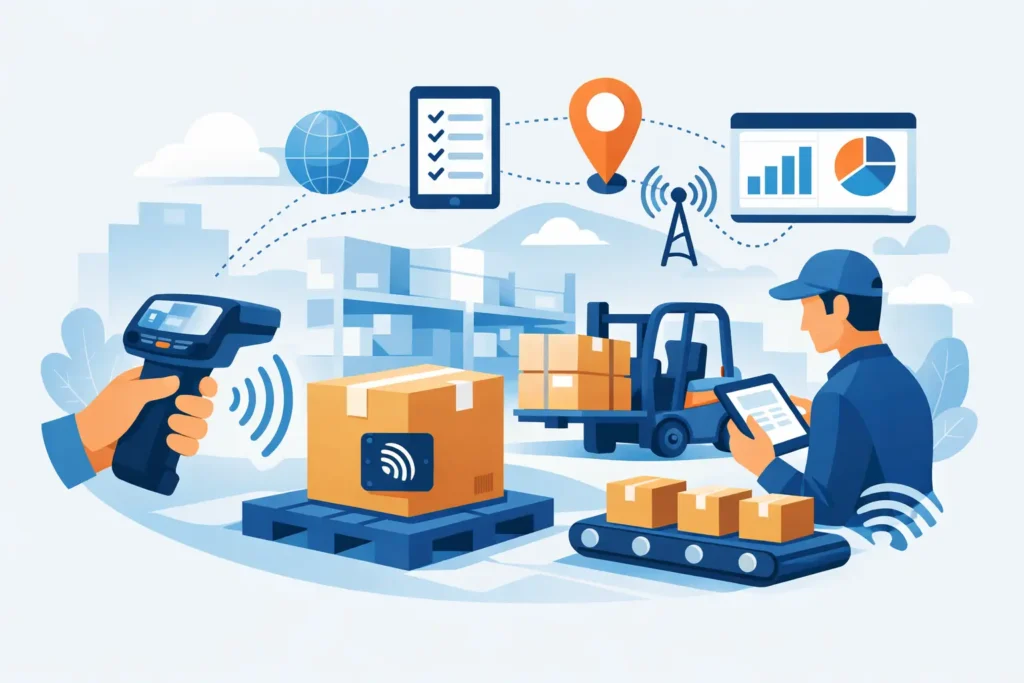
A cycle count that shuts down aisles, a receiving team that cannot confirm what actually arrived, and a picker hunting for product that the system says is in stock – these are the kinds of problems RFID inventory tracking is meant to solve.
For operations teams, RFID is not just a faster way to count. It changes how inventory is identified, captured, and verified across the workflow. When the system is designed well, you get better location visibility, fewer manual scans, and cleaner data for replenishment, shipping, and audit readiness. When it is poorly designed, you can end up with readability issues, tagging inconsistencies, and hardware that does not fit the environment. That is why the real question is not whether RFID is useful. It is whether it fits your operation, your products, and your process discipline.
What RFID inventory tracking actually changes
Barcode systems require line-of-sight and one-at-a-time scanning. That works well in many facilities and remains the right answer for plenty of applications. RFID works differently. Tags communicate via radio frequency, allowing multiple items, cases, or pallets to be identified without requiring the same level of manual handling.
That difference matters most where labor, speed, and inventory accuracy are under pressure. In a warehouse, RFID can reduce the time it takes to verify inbound shipments, perform cycle counts, and confirm product movement. In manufacturing, it can improve work-in-process visibility and reduce errors caused by manual data entry. In environments with high item volumes or frequent movement, the gains are often less about replacing a single scan and more about eliminating repeated touches throughout the day.
The practical value comes from automation at key control points. A handheld reader can capture dozens or hundreds of tagged items during a count. A fixed reader at a dock door can validate movement in or out of a zone. Middleware or inventory software can then compare those reads against expected transactions and flag exceptions.
Where RFID inventory tracking makes the most sense
Not every inventory environment benefits equally from RFID. The strongest use cases tend to share a few characteristics: high transaction volume, labor-intensive counts, recurring visibility gaps, and enough item value or process cost to justify the investment.
Warehouses often see the most immediate benefit in receiving, putaway verification, cycle counting, and shipping confirmation. Instead of scanning each label individually, teams can capture inventory in bulk. That can shorten receiving times, reduce count delays, and improve confidence in on-hand data.
Manufacturing operations may use RFID to track raw materials, components, totes, returnable assets, or finished goods as they move through production. This is especially useful when items are staged across multiple areas, and manual tracking creates lag between physical movement and system updates.
Healthcare, life sciences, rental, utilities, and other asset-heavy industries also benefit when traceability and fast location checks matter. If staff spend too much time searching for products or equipment, RFID can create measurable operational value even before labor savings are fully accounted for.
Still, there are cases where the barcode remains the better fit. If items are low value, handled infrequently, or stored in a way that makes RFID reads difficult, the return may be limited. The right answer depends on what problem you are trying to fix.
The core components of an RFID system
RFID inventory tracking is not one product. It is a system made up of tags, printers, readers, software, and the labels and materials that support performance in the field.
The tag is the starting point. It includes an inlay and antenna, and it must be matched to the item, packaging material, and read environment. Tagging corrugated, plastic containers, metal assets, and liquid-filled products are very different applications. A tag that performs well in one setting may fail in another.
The label itself matters just as much. Adhesive choice, facestock durability, and print quality affect how well tags hold up during storage, movement, and handling. If labels peel, tear, or print poorly, the RFID layer will not rescue the process.
Printers and encoding hardware also need to be matched to the job. Industrial RFID printers are built to encode tags and print readable human-readable and barcode data in one pass. That matters for operations that still rely on mixed workflows or need a visual fallback.
Readers can be handheld, vehicle-mounted, desktop, or fixed in place. The choice depends on how inventory should be captured. Handhelds are often the best way to start because they support flexible counts and process testing. Fixed infrastructure can add automation, but it requires more planning around read zones, traffic patterns, and exception handling.
Software connects the physical system to business logic. That includes encoding rules, device management, filtering duplicate reads, and passing clean data into the WMS, ERP, or inventory platform. If the software layer is weak, the data becomes noisy fast.
Why implementation matters more than the technology pitch
RFID often gets sold on speed, but successful deployments are built on control. The technology can read tags quickly, but your operation still needs clear rules for when items are tagged, how IDs are associated with records, where reads are expected, and what happens when exceptions occur.
A common mistake is treating RFID like a simple hardware purchase. It is closer to a workflow project. You need to decide whether items are tagged at receiving, during production, at packaging, or before shipment. You need to know whether the goal is item-level, case-level, pallet-level, or asset-level visibility. You also need to define how users will confirm or correct data when the system finds a mismatch.
Testing is not optional. Metal racking, liquid products, stacked cases, dock door congestion, and tag placement all affect read performance. A pilot in the actual environment will tell you more than a spec sheet ever will. It also helps teams understand where RFID should automate the process and where a barcode backup still makes sense.
This is where an experienced labeling and identification partner adds value. The best results come from aligning label materials, printers, encoding, software, and reader strategy with the operation itself, not from forcing the operation to fit a generic package.
Common trade-offs and limitations
RFID inventory tracking can dramatically improve visibility, but it is not magic. It comes with trade-offs that buyers should evaluate early.
Cost is the first consideration. Tags, RFID-capable printers, readers, software, and implementation work all add up. The return is often strong in the right environment, but it needs to be tied to specific gains such as reduced labor, fewer shipping errors, lower shrink, or better inventory accuracy.
Read reliability is another variable. Performance depends on tag design, item material, packaging orientation, and environmental factors. Metal and liquids can be challenging. Dense storage can also complicate item-level reads if products are packed tightly together.
There is also a process discipline requirement. RFID can automate data capture, but only if tagging and data association are done consistently. If products are tagged incorrectly, encoded with incorrect data, or introduced outside the standard workflow, the system will quickly expose those weaknesses.
For some operations, a hybrid approach is the most practical path. RFID may handle pallet verification and cycle counts, while barcodes remain in place for item-level picking or exception handling. That is not a compromise. It is often the smartest way to balance speed, cost, and operational control.
How to evaluate whether RFID is worth it
Start with the pain point, not the technology. Are cycle counts disrupting operations? Are receiving errors creating downstream problems? Are teams spending too much time searching for inventory or validating shipments? Those are measurable issues, and they create the business case.
Next, define where visibility breaks down. If your inventory records are inaccurate due to poor receiving discipline, RFID at the dock may matter more than fixed readers throughout the building. If the real issue is time spent counting stored product, handheld readers and properly encoded labels may deliver the fastest return.
Then look at product and packaging realities. What materials are involved? How many SKUs move through the process? What level of tracking is actually needed? An item-level strategy is more complex than a pallet-level strategy, and it is not always necessary.
Finally, evaluate the system as a whole. Tags, labels, printers, ribbons, printheads, software, and reader configuration all affect performance. Buyers who focus only on reader hardware often miss the source of later problems. A dependable RFID solution is built the same way any strong identification system is built – with compatible components, testing, and support behind it.
For companies considering the move, PaladinID can help evaluate the application, materials, hardware, and workflow fit so the system is built for the environment you actually operate in.
The best RFID projects do not start with a promise of perfect automation. They start with a clear operational problem, a tested process, and a system designed to keep working when the warehouse is busy, the products are varied, and accuracy still has to hold up.
At PaladinID, we understand that every labeling application is different.
That’s why companies across the country trust us to help them identify the right solution for their business. With over 40 years of experience and one of the industry’s largest selections of labeling products, we make it easy to find the right fit for your operation. Whether you need stock products or a custom-built solution, our team is ready to help. Visit our online catalog, Email us, or call us today at 888.972.5234.
PaladinID delivers label solutions that stick!


Got Labeling Questions? Our AI Assistant Has Answers - Chat Now!
For more information on PaladinID
Get Help With Your Next Label Project
We have over 35 years of providing exceptional service and labeling products to the world. Take the first step to an easy, stress-free solution for your label needs by contacting us.
Schedule a call below or email [email protected]
Make Your Mark
“Making companies more competitive by offering the correct label printing solution, on time, within budget, while creating unmatched value”.
About PaladinID, LLC
PaladinID develops and supports high-performance barcode labeling applications. We work with our clients to “Make Your Mark” by providing the expertise and tools necessary to create an entire product label printing solution. Located in central New Hampshire, PaladinID has been serving Massachusetts, Vermont, Maine, Connecticut, Rhode Island, New England, and beyond for over 30 years, and in 2017, became an RFID-certified company. We look forward to working with you.
You may be interested in our other services:
Product Labels
Product Labels
Labels for every type of application: Blank, Pre-printed, Variable data
Label Printers
Label Printers
We sell and support: Direct/thermal transfer, Inkjet, Laser
Printer Ribbons
Printer Ribbons
We sell ribbons for ALL barcode printers including: Zebra, Datamax, Sato, Intermec
Flexible Packaging
Flexible Packaging
We offer a wide variety of packaging containers for your products.
Label Software
Label Software
Software for all barcode printing and product labeling.
Label applicators
Label Applicators
Wide selection of applicators: Desktop/Mobile, Applicator only, Print & apply
