
Zebra 8000D Lab Labels: What to Know


What Can We Help You With?
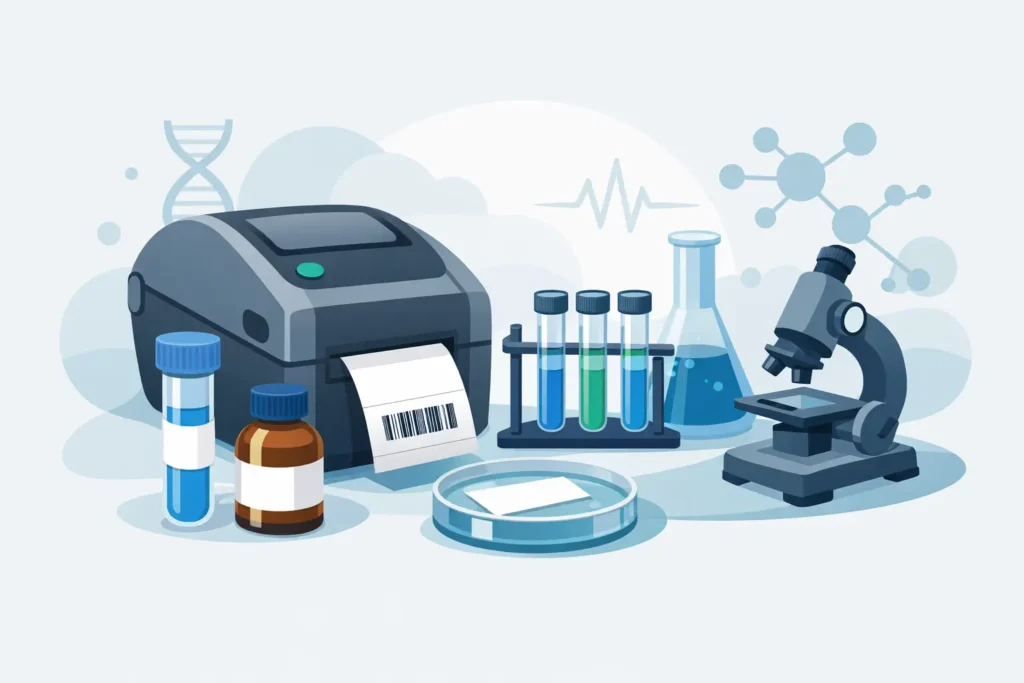
When a lab label fails, the problem rarely stays small. A barcode that will not scan, a face stock that lifts in cold storage, or a print image that fades after handling can slow sample processing and create avoidable risk. That is why many operations evaluating Zebra 8000D lab materials are not simply comparing label rolls – they are trying to protect accuracy, traceability, and throughput.
For labs, healthcare environments, and other controlled workflows, direct thermal labeling can be a practical choice when speed and simplicity matter. But material selection has to match the real conditions on the bench, in storage, and in transit. The Zebra 8000D lab line is often considered for specimen identification and related applications because it is designed for laboratory use cases where print quality, scannability, and fit with existing Zebra hardware matter.
Where Zebra 8000D lab labels make sense
The main appeal of Zebra 8000D lab labels is that they are engineered for direct thermal printing in lab-related environments. That means no ribbon is required, which can reduce supply complexity and enable faster media changes for teams printing high volumes of labels across shifts.
That convenience matters in settings where users need to print quickly at the point of use. A phlebotomy station, accessioning area, diagnostic lab, or hospital department may not want the extra step of managing thermal transfer ribbons for every printer. Direct thermal media can support a cleaner, simpler workflow when labels are used within a practical lifespan and under conditions the material is built to handle.
The key phrase there is practical lifespan. Direct thermal labels are not the right answer for every identification program. If your labels must remain readable for extended periods, face aggressive chemicals, or survive repeated outdoor exposure, you need to evaluate whether a direct thermal lab stock is enough or whether a thermal transfer construction is the better fit.
What to evaluate before choosing Zebra 8000D lab media
A lab label is only as good as its performance in your actual process. Product sheets are useful, but they do not replace application testing.
Print life and image stability
With any direct thermal construction, heat sensitivity is part of how the image is created. That can be an advantage for simplicity, but it also means image durability has limits. If labels are exposed to heat, friction, certain chemicals, or prolonged storage, the print may darken, fade, or become less reliable over time.
For short- to medium-duration identification, that trade-off may be perfectly acceptable. If a sample moves through collection, testing, and final disposition quickly, direct thermal often performs well. If records, retained samples, or archived materials must stay legible for long periods, the calculation changes.
Adhesive performance in real lab conditions
A label that prints well but will not stay attached is still a failure. Labs use a wide range of surfaces, including vials, test tubes, slides, specimen containers, bags, and trays. Some are smooth plastics, some are curved, some face moisture or refrigeration, and some move immediately from room temperature to cold environments.
The question is not just whether the label sticks initially. It is whether it remains adhered through handling, condensation, storage, and scanning. Curved surfaces can be particularly demanding because edge lift becomes more likely when the label construction is too stiff, or the adhesive is not matched to the substrate.
Barcode and text readability
Lab identification depends on accurate scanning. A direct thermal material needs to deliver sharp print contrast and consistent image quality across the printer fleet. Small barcodes, tight text, serialized information, and patient or sample identifiers all raise the stakes.
If your operation uses compact labels or high-density symbologies, printer condition becomes just as important as media choice. A worn printhead, poor calibration, or incorrect darkness and speed settings can turn a capable label stock into a scanning problem.
Zebra 8000D lab compatibility considerations
One reason buyers consider Zebra 8000D lab products is their expected compatibility with Zebra printer environments. Even then, compatibility should never be treated as automatic. See our list of the Zebra 8000D Lab labels. If you do not see the size you need, give us a call at 888.972.5234; we can make any size, shape, or form for your application.
Printer model and sensor setup
Media dimensions, core size, roll diameter, gap or mark sensing, and print mode all need to line up with the printer being used. Desktop, healthcare, and industrial Zebra printers have distinct media-handling characteristics. A label that runs well on one platform may require setup changes on another.
This is especially relevant for organizations standardizing across multiple departments. If one facility uses compact healthcare printers while another uses industrial units in a central print area, the same label program may need careful validation before rollout.
Software and formatting
The label stock is only one part of the system. Your label design software, printer language, barcode standards, and data source all affect output quality. In lab environments, tight spacing and precise placement are common, so a format that works on plain paper labels may need adjustment when moving to a specialized stock.
This is where implementation support has real value. Many labeling issues are not caused by the material itself but by how printer settings, templates, and hardware maintenance interact with that material.
Direct thermal versus thermal transfer for lab labeling
The most useful question is not whether Zebra 8000D lab is good. It is whether it is right for your application.
Direct thermal is often a strong fit when labels are printed and used promptly, supply simplicity matters, and the environment is controlled enough to support image stability. It reduces consumable complexity because there is no ribbon to load, match, or reorder.
Thermal transfer is usually the better choice when you need longer-term durability, greater resistance to environmental exposure, or a more permanent image. That added durability comes with the need to match ribbon and label material correctly, but for many regulated or high-risk workflows, that extra step is worthwhile.
Operations teams should also think about serviceability. If many operators with varying levels of training use printers, direct thermal printing may reduce user errors related to ribbon loading. On the other hand, if the cost of relabeling, rescanning, or sample investigation is high, a more durable print method may pay for itself quickly.
Common use cases and practical limits
Zebra 8000D lab materials are often evaluated for specimen labeling, patient-related sample identification, and workflow labels used within healthcare and laboratory processes. Those are reasonable use cases when the labels are expected to remain readable through collection, transport, and testing without requiring extended archival performance.
Where teams can run into trouble is assuming that all lab environments are basically the same. They are not. A pathology workflow, a hospital lab, a research environment, and a reference testing operation may all have very different storage times, handling methods, chemical exposure profiles, and compliance expectations.
A label that performs well on room-temperature sample containers may not behave the same way in refrigerated storage or during repeated gloved handling. If cryogenic storage, sterilization exposure, or highly aggressive solvents are involved, you may need a more specialized construction entirely.
How to qualify Zebra 8000D lab labels before rollout
The smartest approach is controlled testing. Start with the exact container types, data formats, and printer models used in production. Print labels with actual barcodes and text sizes, then test them through the full workflow rather than a quick bench check.
Include scan verification at each handoff point. Look at first-pass scan rates, edge lift, smearing, image darkening, and post-storage readability. If labels are applied in one temperature range and used in another, test that transition specifically.
It also helps to evaluate operator use. A label stock may pass technical testing but still create problems if it is difficult to load, hard to peel, or inconsistent across locations. Standardization works best when the media, printer configuration, and work instructions are aligned.
For organizations managing multiple labeling requirements, a partner with experience in media, hardware, and workflow can speed up the process. PaladinID works with companies that need more than a part number – they need a labeling system that performs reliably under actual operating conditions.
The bigger decision behind the label
Choosing a lab label is rarely just a purchasing task. It affects compliance, sample integrity, labor efficiency, and confidence in your identification process. Zebra 8000D lab media may be a strong fit for direct-thermal lab workflows, but only if the application aligns with the material’s strengths.
The right decision comes from asking a few grounded questions. How long must the label remain readable? What surface is it applied to? What temperatures, handling steps, and scan points will it encounter? And how much risk does your process carry if a label fails?
Those answers matter more than a catalog description. When the label, printer, software, and workflow are matched correctly, the result is not just a printed identifier. It is a more reliable operation with fewer interruptions where accuracy matters most.
At PaladinID, we understand that every labeling application is different.
That’s why companies across the country trust us to help them identify the right solution for their business. With over 40 years of experience and one of the industry’s largest selections of labeling products, we make it easy to find the right fit for your operation. Whether you need stock products or a custom-built solution, our team is ready to help. Visit our online catalog, Email us, or call us today at 888.972.5234.
PaladinID delivers label solutions that stick!

Got Labeling Questions? Our AI Assistant Has Answers - Chat Now!
For more information on PaladinID
Get Help With Your Next Label Project
We have over 35 years of providing exceptional service and labeling products to the world. Take the first step to an easy, stress-free solution for your label needs by contacting us.
Schedule a call below or email [email protected]
Make Your Mark
“Making companies more competitive by offering the correct label printing solution, on time, within budget, while creating unmatched value”.
About PaladinID, LLC
PaladinID develops and supports high-performance barcode labeling applications. We work with our clients to “Make Your Mark” by providing the expertise and tools necessary to create an entire product label printing solution. Located in central New Hampshire, PaladinID has been serving Massachusetts, Vermont, Maine, Connecticut, Rhode Island, New England, and beyond for over 30 years, and in 2017, became an RFID-certified company. We look forward to working with you.
You may be interested in our other services:
Product Labels
Product Labels
Labels for every type of application: Blank, Pre-printed, Variable data
Label Printers
Label Printers
We sell and support: Direct/thermal transfer, Inkjet, Laser
Printer Ribbons
Printer Ribbons
We sell ribbons for ALL barcode printers including: Zebra, Datamax, Sato, Intermec
Flexible Packaging
Flexible Packaging
We offer a wide variety of packaging containers for your products.
Label Software
Label Software
Software for all barcode printing and product labeling.
Label applicators
Label Applicators
Wide selection of applicators: Desktop/Mobile, Applicator only, Print & apply
