
Zebra Z-Ultimate 3000 for Industrial Labels


What Can We Help You With?
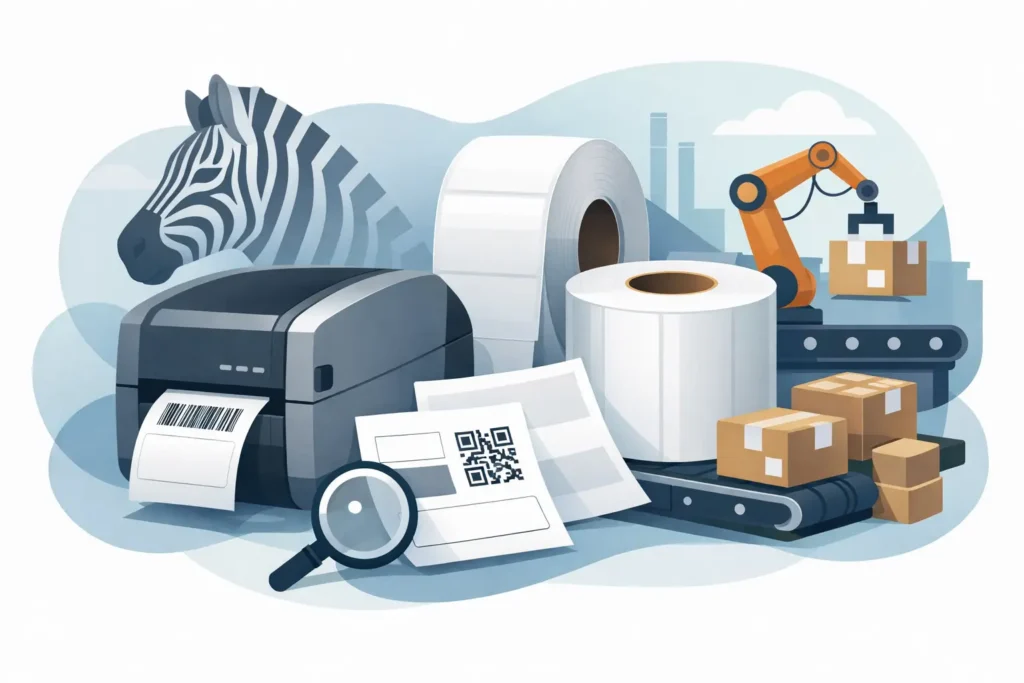
A label that looks fine at the print station can still fail in the field. That is usually where material choice becomes the real issue, and Zebra Z-Ultimate 3000 is a good example of why. It is widely used because it gives operations teams a durable polyester label option for barcodes, asset tags, rating plates, and product identification where paper simply will not hold up.
For warehouses, manufacturers, healthcare operations, and other environments that depend on scan accuracy, the question is not whether polyester labels are useful. The better question is whether this specific construction matches the surface, exposure, and print requirements of your application. That is where many labeling projects either become reliable or begin to create avoidable rework.
What the Zebra Z-Ultimate 3000 is designed to do
Zebra Z-Ultimate 3000 is a white polyester thermal-transfer label material designed for long-term identification. Compared with standard paper labels, it offers much better resistance to moisture, moderate chemical exposure, abrasion, and general handling. That makes it a strong fit for operations that need labels to stay readable after shipping, storage, cleaning, or repeated contact.
In practical terms, this material is often chosen for indoor industrial labeling where print permanence and barcode consistency matter more than low upfront label cost. You will commonly see it used for asset tracking, shelf and bin labeling, work-in-process labels, product ID, and compliance labeling. It can also be a solid choice for applications where a more professional, permanent-looking label is expected.
The face stock matters, but the adhesive does as well. One reason this material is specified so often is that it is intended to bond well to a range of common surfaces, including metals and many plastics. Still, that does not mean every surface behaves the same. Powder-coated equipment, textured plastics, oily surfaces, and low-surface-energy materials can quickly change the outcome.
Where Zebra Z-Ultimate 3000 works best
The best applications for the Zebra Z-Ultimate 3000 are those that demand durability without requiring extreme specialty requirements. If your operation needs labels that withstand routine wear, warehouse movement, and everyday industrial conditions, this material often hits the sweet spot.
Manufacturing is an obvious use case. Operations teams use polyester labels on equipment, components, finished goods, and inventory because they need a stable barcode image and a label that does not tear like paper. In a warehouse, the same logic applies to rack labels, tote identification, and asset tags that are handled frequently or exposed to dust and friction.
Healthcare and laboratory settings can also benefit when labels need a cleaner, more durable appearance and better resistance than paper offers. That said, if the application involves aggressive sterilization cycles, heavy solvent exposure, or very specialized compliance requirements, it is worth validating the exact construction rather than assuming any polyester label will do the job.
This is where selection becomes less about the catalog description and more about the real operating environment. A label that performs well on smooth indoor assets may not be the right answer for outdoor exposure, curved containers, or surfaces that are routinely wiped with strong chemicals.
Performance trade-offs to know before you specify it
Zebra Z-Ultimate 3000 is durable, but durability is not the same as being universal. Buyers sometimes treat polyester as a catch-all upgrade over paper, which can create unnecessary cost or performance gaps.
The first trade-off is price. Polyester labels generally cost more than paper labels, so they make the most sense when the label needs to last or when relabeling incurs labor costs, scan failures, or compliance risks. If you are printing high-volume short-life shipping labels, a premium polyester material is often more than the application requires.
The second trade-off is the application surface. Smooth, clean surfaces usually produce the best results. If the item being labeled is dirty, cold, rough, or treated with oils, adhesive performance may drop. In those cases, the issue is not necessarily the print media itself. It may be surface prep, adhesive selection, or the need for a different construction.
The third trade-off is environmental exposure. This material handles many common indoor industrial conditions well, but it is still important to define what the label will be exposed to over time. UV exposure, temperature fluctuations, repeated use of cleaning agents, and contact with harsh chemicals all affect label life. A good fit in one department may not be a good fit across an entire facility.
Printing Zebra Z-Ultimate 3000 the right way
A durable face stock only performs as well as the print process behind it. Zebra Z-Ultimate 3000 is a thermal transfer material, which means ribbon selection, printer settings, and printhead condition all directly affect barcode quality and image durability.
For most operations, the choice of ribbon is where performance is won or lost. Resin or wax-resin ribbons are commonly used with polyester labels because they provide stronger resistance to scratching and smearing than basic wax ribbons. The right match depends on the print speed, darkness settings, required durability, and the specific label-printer combination being used.
Printer setup matters more than many teams expect. If heat settings are too low, the image may look acceptable at first, but fail under abrasion. If settings are too high, you can damage print quality, shorten printhead life, or create inconsistent edges on barcodes and text. A worn printhead can also turn a good label material into a poor barcode result.
This is why material selection should not be treated as a standalone purchase. Labels, ribbons, printer calibration, and software formatting all work together. When one variable is off, the label is often blamed first, even when the root cause lies elsewhere in the system.
How to decide if the Zebra Z-ultimate 3000 fits your operation
Start with the expected life of the label. If the identifier needs to remain readable for months or years, polyester is usually worth considering. If the label is temporary, used once, or replaced quickly, a less expensive material may be the better business decision.
Next, look at the surface and environment. Ask what the label is being applied to, whether that surface is clean and smooth, how much handling it will get, and what exposure it will face. Moisture, rubbing, cleaning chemicals, and storage conditions all matter. So does the item’s shape. Flat metal panels behave differently from molded plastic containers or curved equipment housings.
Then look at scan risk. If a failed barcode causes shipping delays, inventory errors, compliance problems, or maintenance confusion, it is often worth paying for a more durable material and validating the full print setup. A label that stays in place and scans consistently usually costs less than repeated relabeling and downstream errors.
For companies managing multiple departments or facilities, standardization is another factor. It can be tempting to specify one label material for every use case. Sometimes that works. Sometimes it creates overspending in one area and underperformance in another. A better approach is to group applications by actual requirements and choose materials accordingly.
Common mistakes when buying this label material
One common mistake is buying based on the material name alone. Zebra Z-Ultimate 3000 has a strong reputation, but the name does not replace application testing. Surface energy, exposure conditions, and ribbon compatibility still need to be checked.
Another mistake is assuming the adhesive will compensate for poor application conditions. Even good adhesives struggle on dusty, oily, or cold surfaces. Label failure is often as much a process problem as a material one.
A third issue is ignoring the rest of the labeling system. If the printer is not calibrated, the ribbon is mismatched, or the artwork creates dense barcodes in a small space, even a high-quality polyester label may not perform as expected. Teams that get the best results usually treat label selection as part of a broader workflow decision, not a one-line reorder.
That is also where working with an experienced labeling partner can save time. PaladinID helps companies evaluate not just the label stock, but the printer, ribbon, print settings, and application conditions that determine whether the solution will actually hold up on the floor.
When to look beyond Zebra Z-Ultimate 3000
There are situations where this material may not be the best fit. If the label must conform tightly to irregular surfaces, a more flexible construction may be better. If the environment includes extreme outdoor weathering, aggressive solvents, or high-heat exposure, you may need a more specialized material and adhesive system.
On the other end of the spectrum, if your use case is basic carton labeling or short-term inventory identification, polyester may be more durable than you need. The right material is not always the toughest one. It is the one that meets the requirement without creating unnecessary cost.
That is the practical way to evaluate Zebra Z-Ultimate 3000. It is a strong industrial label option, especially for operations that need durable, clean, reliable identification on common surfaces. But the best results come when the label is matched to the environment, the printer is set up correctly, and the full system is designed around how your team actually works.
If you are reviewing materials for a new rollout or trying to fix recurring label failures, the most useful next step is not guessing which stock is best. It is defining what the label has to survive, then building the print and application process around that reality.
At PaladinID, we understand that every labeling application is different.
That’s why companies across the country trust us to help them identify the right solution for their business. With over 40 years of experience and one of the industry’s largest selections of labeling products, we make it easy to find the right fit for your operation. Whether you need stock products or a custom-built solution, our team is ready to help. Visit our online catalog, Email us, or call us today at 888.972.5234.
PaladinID delivers label solutions that stick!

Got Labeling Questions? Our AI Assistant Has Answers - Chat Now!
For more information on PaladinID
Get Help With Your Next Label Project
We have over 35 years of providing exceptional service and labeling products to the world. Take the first step to an easy, stress-free solution for your label needs by contacting us.
Schedule a call below or email [email protected]
Make Your Mark
“Making companies more competitive by offering the correct label printing solution, on time, within budget, while creating unmatched value”.
About PaladinID, LLC
PaladinID develops and supports high-performance barcode labeling applications. We work with our clients to “Make Your Mark” by providing the expertise and tools necessary to create an entire product label printing solution. Located in central New Hampshire, PaladinID has been serving Massachusetts, Vermont, Maine, Connecticut, Rhode Island, New England, and beyond for over 30 years, and in 2017, became an RFID-certified company. We look forward to working with you.
You may be interested in our other services:
Product Labels
Product Labels
Labels for every type of application: Blank, Pre-printed, Variable data
Label Printers
Label Printers
We sell and support: Direct/thermal transfer, Inkjet, Laser
Printer Ribbons
Printer Ribbons
We sell ribbons for ALL barcode printers including: Zebra, Datamax, Sato, Intermec
Flexible Packaging
Flexible Packaging
We offer a wide variety of packaging containers for your products.
Label Software
Label Software
Software for all barcode printing and product labeling.
Label applicators
Label Applicators
Wide selection of applicators: Desktop/Mobile, Applicator only, Print & apply
