
How Custom Laser Labels Improve Operations


What Can We Help You With?
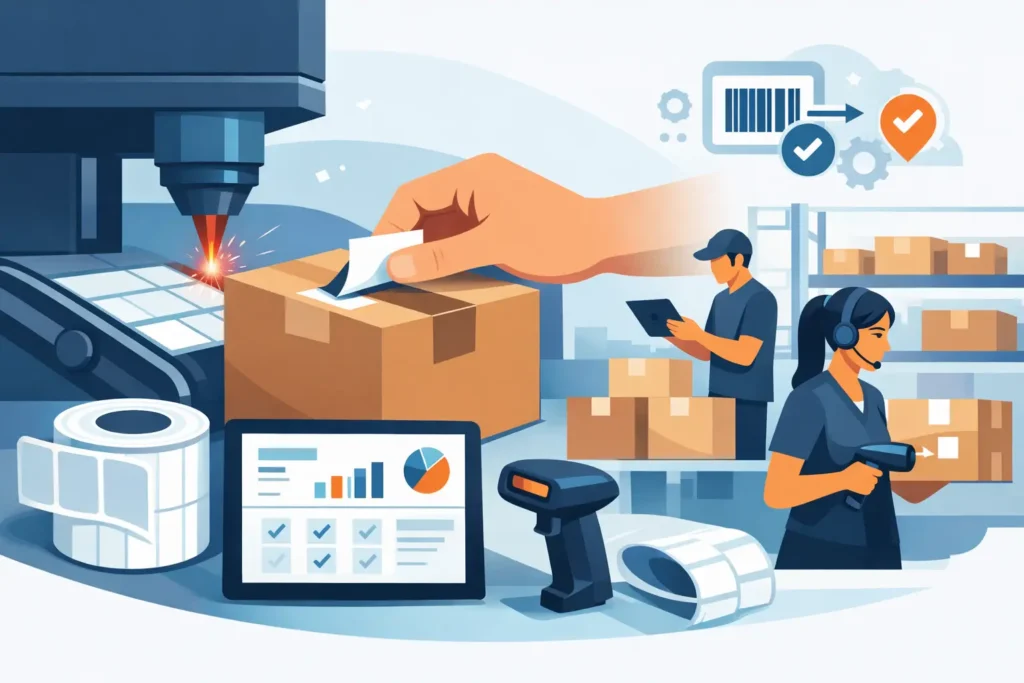
A label failure rarely starts as a label problem. It shows up as a barcode that will not scan at receiving, a shipping carton routed to the wrong dock, or an asset tag that fades before the next audit. That is where custom laser labels earn their value. They give operations teams control over print quality, sizing, adhesive performance, and workflow fit, so labeling supports the process instead of slowing it down.
For many organizations, laser printing remains a practical choice because it is already built into office and administrative workflows. Purchasing, compliance, quality, and shipping teams often need labels with variable information, but they do not always need a dedicated label printer at every workstation. In the right application, a custom laser label program can close that gap and deliver consistent results without forcing teams to work around stock formats never designed for the job.
Where custom laser labels make the most sense
Custom laser labels are a strong fit when a business needs precise sheet layouts, clean text and graphics, and compatibility with existing laser printers. Common use cases include product identification, carton labeling, file and record management, healthcare documentation, warehouse shelf markers, compliance labeling, and integrated label forms that combine paperwork with peel-off labels.
The advantage is not simply customization for its own sake. It is the ability to match the label to the task. If your operation needs two labels and a packing slip on one sheet, a standard template may create wasted space and extra handling. If you need a specific label size to fit a small product box without covering critical information, stock sheets can force compromises. A custom format reduces those compromises and helps standardize output across teams.
That said, laser labels are not the right answer for every environment. If labels will face heavy abrasion, constant moisture, chemical exposure, or long-term outdoor conditions, thermal transfer or specialty constructions may be a better fit. Choosing the right technology depends on the application, the printer fleet, and the expected life of the label.
What separates custom laser labels from stock options
Stock labels are useful when the application is simple and the format is common. They can work well for basic address labels or routine office tasks. Operational environments tend to be less forgiving. Once labels support inventory control, compliance, or tracking, the details matter more. We even have a large selection of colored laser labels.
Custom laser labels allow you to define the dimensions, sheet configuration, face stock, adhesive, perforations, and any special features required by your workflow. That control affects more than appearance. It influences print registration, feed reliability, hand-application speed, and how well barcodes and variable data hold up during handling.
A custom construction can also help reduce hidden inefficiencies. Teams often adapt their process to fit the label they have on hand, not the label they actually need. That may mean trimming sheets, using multiple documents when a single integrated form would do the job, or applying oversized labels that interfere with packaging graphics or regulatory text. Those workarounds add labor and increase the chance of error.
Designing custom laser labels around the workflow
A good label specification starts with the process, not the printer. Before finalizing a format, it helps to look at where the label is printed, who applies it, what surface it adheres to, and what happens after application. A label for an indoor file folder has a very different job than a label for a corrugated shipper moving through multiple touchpoints.
Size is usually the first decision, but it should not be the only one. The printable area needs to accommodate text, barcodes, logos, and any required warnings or instructions without crowding. Barcode symbology, quiet zones, and scanner requirements should be considered early, especially when space is limited. A label that looks acceptable on screen can still fail in production if the barcode is compressed too tightly or printed with low contrast.
Adhesive selection is equally important. Corrugated, plastic, metal, coated paper, and textured surfaces all behave differently. So do cold rooms, dusty environments, and products stored for extended periods. A label that sticks well in a climate-controlled office may fail on shrink wrap in a warehouse or curl on an uneven carton surface. Matching adhesive and facestock to the real substrate is part of building a reliable solution.
Sheet layout matters more than many buyers expect. Laser printers generate heat, and sheeted label materials must be built to feed cleanly without adhesive bleed, curling, or printer contamination. The spacing of labels on the sheet, the liner construction, and the material caliper can all affect performance. This is one reason application-specific guidance is valuable. A label that looks efficient on paper is not necessarily a label that will run well through your equipment.
Print quality, barcodes, and compliance
One of the biggest reasons companies choose custom laser labels is the consistency of output. When labels carry barcodes, lot numbers, expiration dates, or compliance information, print quality is not cosmetic. It directly affects scan rates, traceability, and record accuracy.
Laser printers can produce sharp text and graphics, but the label material must be designed for that printing method. Toner adhesion, heat resistance, and sheet stability all influence whether the final label looks clean and remains legible. If the material is not suited to laser output, teams may see flaking toner, edge lift, sheet jams, or inconsistent imaging.
Compliance adds another layer. In healthcare, life sciences, manufacturing, and regulated distribution, labels may need to carry exact data fields, durable warnings, or machine-readable identification. A custom layout helps ensure that required information appears in the correct location and remains readable throughout the intended period of use. That is especially useful when a label has to support both human readability and automated scanning.
When integrated forms are the better answer
Some of the most effective custom laser labels are not standalone sheets at all. They are integrated forms that combine a document with one or more labels on the same page. For shipping, service records, work orders, patient documentation, and inventory transactions, this format can improve accuracy by tying the label directly to the source document.
The benefit is practical. Users print once, separate the label, apply it, and retain the rest of the form for records or routing. That reduces manual matching and helps eliminate situations in which a label is generated in one system while the paperwork comes from another. For operations managing high volumes or repeatable transactions, that small change can remove a surprising amount of friction.
Evaluating whether laser is the right long-term fit
It is worth being direct here: custom laser labels are useful, but they are not universal. If your business prints high volumes of variable labels at the point of application, thermal printing often offers better speed, media flexibility, and durability. If you need highly resistant labels for industrial assets, extreme temperatures, or outdoor exposure, a laser sheet label may not deliver the lifespan you need.
The better question is not whether laser labels are good or bad. It is whether they fit the operational requirement. Many organizations benefit from using both laser and thermal systems in different parts of the business. Administrative teams may rely on laser-compatible forms and documentation labels, while warehouse or production teams use thermal printers for on-demand barcode labeling. The most reliable approach is usually the one that aligns each print method with the job it performs best.
Why support matters with custom laser labels
Custom products tend to perform best when they are specified with the full system in mind. That includes printer compatibility, software output, barcode requirements, application conditions, and replenishment planning. The label itself is only one part of the process.
This is where an experienced labeling partner can make a measurable difference. Instead of treating custom laser labels as a one-off purchase, the better approach is to validate the construction, test it in the actual environment, and make sure it supports the broader identification workflow. PaladinID works with organizations that need that level of practical support, especially when labeling requirements span departments and must be applied consistently over time.
If you are evaluating custom laser labels, start with the failures or bottlenecks you are trying to eliminate. A better label format can improve print consistency, reduce handling steps, and support cleaner data capture, but only when it is designed around the way your operation actually works. The right label should feel less like a supply item and more like a small piece of infrastructure that keeps everything moving.
At PaladinID, we understand that every labeling application is different.
That’s why companies across the country trust us to help them identify the right solution for their business. With over 40 years of experience and one of the industry’s largest selections of labeling products, we make it easy to find the right fit for your operation. Whether you need stock products or a custom-built solution, our team is ready to help. Visit our online catalog, Email us, or call us today at 888.972.5234.
PaladinID delivers label solutions that stick!

Got Labeling Questions? Our AI Assistant Has Answers - Chat Now!
For more information on PaladinID
Get Help With Your Next Label Project
We have over 35 years of providing exceptional service and labeling products to the world. Take the first step to an easy, stress-free solution for your label needs by contacting us.
Schedule a call below or email [email protected]
Make Your Mark
“Making companies more competitive by offering the correct label printing solution, on time, within budget, while creating unmatched value”.
About PaladinID, LLC
PaladinID develops and supports high-performance barcode labeling applications. We work with our clients to “Make Your Mark” by providing the expertise and tools necessary to create an entire product label printing solution. Located in central New Hampshire, PaladinID has been serving Massachusetts, Vermont, Maine, Connecticut, Rhode Island, New England, and beyond for over 30 years, and in 2017, became an RFID-certified company. We look forward to working with you.
You may be interested in our other services:
Product Labels
Product Labels
Labels for every type of application: Blank, Pre-printed, Variable data
Label Printers
Label Printers
We sell and support: Direct/thermal transfer, Inkjet, Laser
Printer Ribbons
Printer Ribbons
We sell ribbons for ALL barcode printers including: Zebra, Datamax, Sato, Intermec
Flexible Packaging
Flexible Packaging
We offer a wide variety of packaging containers for your products.
Label Software
Label Software
Software for all barcode printing and product labeling.
Label applicators
Label Applicators
Wide selection of applicators: Desktop/Mobile, Applicator only, Print & apply
