
What the Future of RFID Labeling Looks Like




What Can We Help You With?
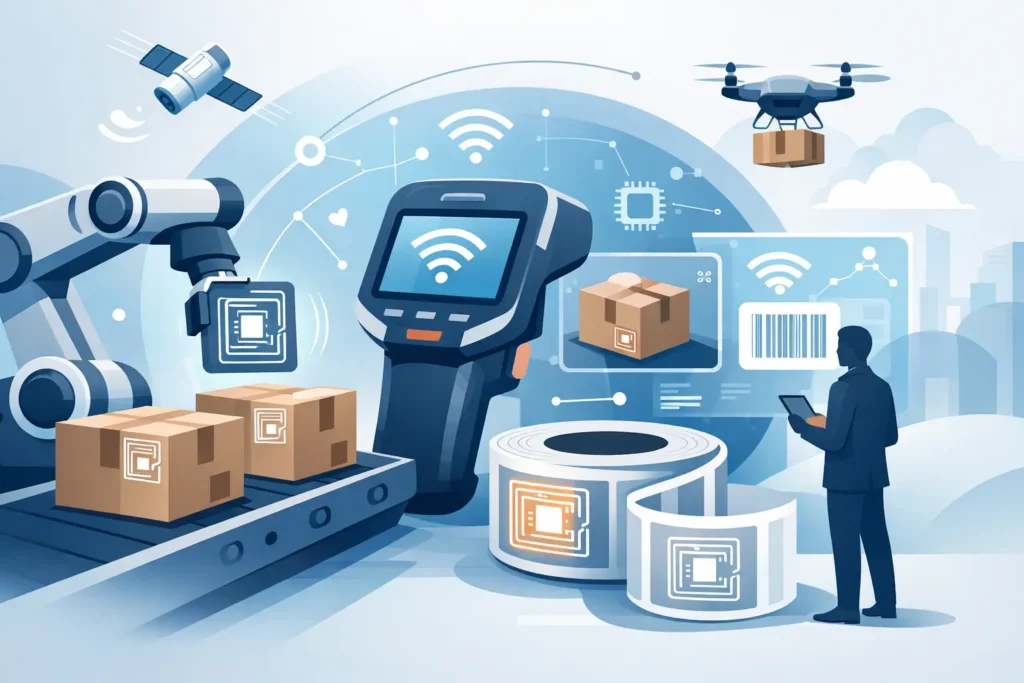
A pallet moves through a dock door, a case is diverted to the right lane, and inventory updates without anyone stopping to scan a barcode. That is the practical promise behind the future of RFID labeling – not novelty, but faster, more reliable identification in places where manual processes create delays, errors, and blind spots.
For operations teams, the real question is not whether RFID has potential. It does. The better question is where it will deliver measurable value, how quickly the technology can fit into existing workflows, and what kind of labeling infrastructure will be needed to support it over time. RFID is moving from selective use cases into broader operational planning, but adoption still depends on the environment, data requirements, read accuracy, and system compatibility.
Why the future of RFID labeling is becoming more practical
RFID has been discussed for years, but several market changes are making it more usable for day-to-day operations. More companies are under pressure to improve inventory visibility, reduce labor tied to repetitive scanning, and support traceability expectations across production, warehousing, shipping, and returns. At the same time, businesses want identification systems that work across larger facilities and faster-moving workflows.
Barcode labeling still plays a central role, and in many applications it will remain the right choice. It is cost-effective, familiar, and easy to deploy. But RFID can solve a different class of problems. It allows items to be identified without line-of-sight scanning, and that changes what is possible at chokepoints like dock doors, conveyors, storage zones, and staging areas.
That shift matters most in operations where missed scans, manual reconciliation, and delayed inventory updates affect throughput. In those settings, RFID is less about replacing every label in the building and more about applying the right technology where automation creates a clear return.
The next phase will be driven by targeted adoption
The future of RFID labeling will not arrive as a full, overnight replacement for existing label systems. Most organizations will adopt it in phases. They will start where visibility gaps are expensive or where process speed matters most.
For a warehouse operation, that may mean RFID labels on pallets, returnable containers, or high-value assets rather than every individual item. In manufacturing, it may begin with work-in-process tracking or component verification. In healthcare and life sciences, it may center on chain of custody, specimen tracking, or controlled inventory. In rental, utility, nursery, and industrial applications, RFID often makes sense when assets move frequently and manual checks are inconsistent.
This phased approach is not a compromise. It is usually the most effective strategy because RFID performance depends heavily on use case design. Label construction, tag placement, reader position, environmental interference, and the material being tagged all affect results. A metal asset, a plastic tote, a case of liquid product, and a corrugated carton may each require a different RFID label strategy.
Smarter labels will matter, but so will smarter systems
When people talk about RFID, they often focus on the tag itself. That is only part of the equation. The future of RFID labeling will depend just as much on the surrounding system – printers, encoding accuracy, software integration, reader setup, and data management.
An RFID label that is poorly encoded or inconsistently printed creates the same kind of operational headache as a barcode label that will not scan. That is why businesses evaluating RFID need to think beyond tag pricing. They need to consider printer compatibility, media specifications, ribbon performance where applicable, environmental durability, and the software rules that determine what data gets written to each label.
This is where implementation decisions become practical rather than theoretical. A company may choose RFID to automate inventory updates, but success depends on how the label is printed, encoded, applied, read, and validated. If any part of that chain is weak, the promised efficiency gains can disappear into troubleshooting.
Expect growth in hybrid barcode and RFID programs
One of the most likely outcomes over the next several years is not barcode versus RFID, but barcode plus RFID. Hybrid labeling gives organizations flexibility as they gradually expand automation.
In many environments, a single label will continue to carry both human-readable information and a barcode, while also incorporating RFID for automated reads. That approach supports mixed operations. Teams can still use handheld barcode scanning where needed, while portals, fixed readers, or mobile RFID devices capture movement in the background.
For procurement and operations leaders, this matters because it protects workflow continuity. You do not need every department, partner, or facility to transition at the same pace. Hybrid labeling also reduces risk when companies are testing RFID in one process while keeping standard barcode procedures in place as a backup.
Industry demands will shape where RFID expands fastest
Adoption will not look the same in every market. The future of RFID labeling will develop fastest where traceability, speed, or asset accountability justify the added complexity.
Retail and large distribution networks will continue to push RFID forward because inventory visibility directly affects replenishment and order accuracy. Industrial manufacturing will expand the use of RFID where work-in-process visibility and asset movement affect production control. Healthcare and lab environments will use it where item-level identification supports safety and compliance. Recycling, utilities, and field service operations may lean on RFID for container tracking, equipment identification, and long-life asset labeling.
At the same time, some industries will stay selective. If product margins are thin, item values are low, or packaging materials interfere with read reliability, RFID may be reserved for higher-level packaging or specific exceptions. That does not mean the technology is a poor fit. It means the business case has to be built around the right level of application.
Cost will improve, but performance requirements will stay high
As RFID technology matures, pricing pressure should continue to make broader adoption more realistic. But lower cost alone will not determine success. Businesses still need dependable reads, durable label materials, and equipment that can handle production volumes without constant adjustment.
That is especially true in industrial environments. Heat, moisture, abrasion, chemicals, outdoor exposure, and rough handling do not disappear just because a label contains an RFID inlay. The face stock, adhesive, print method, and application surface still matter. A low-cost RFID label that fails in storage or transit is not a savings.
There is also a data discipline issue. RFID can generate a large amount of movement information very quickly. If teams do not define which events matter, how systems should respond, and who owns data quality, then greater visibility can create more noise rather than better control.
What businesses should plan for now?
Companies do not need to wait for some future tipping point to prepare. The best time to assess RFID is when you are already reviewing labeling workflows, printer fleets, warehouse processes, or traceability requirements.
Start with the operational problem, not the technology. If your team struggles with missed scans, slow receiving, asset loss, inventory disputes, or poor location accuracy, RFID may be worth evaluating. If your current barcode system is working well and labor demands are manageable, the case may be weaker today. It depends on the cost of inaccuracy, the speed of movement, and the degree of process automation your operation needs.
It also makes sense to review infrastructure early. Can your current printers support RFID media and encoding? Will your software handle serialized data properly? Where would readers need to be placed? Which products, packaging types, or assets are realistic candidates? These are not small details. They determine whether a pilot produces useful results or misleading ones.
For many organizations, a pilot is the right next step. But a pilot should be narrow, measurable, and designed around a real workflow. Testing RFID on a limited set of pallets, returnable assets, or high-value inventory often reveals more than a broad experiment with no clear success criteria. A good partner can help align labels, hardware, software, thermal transfer ribbons and application requirements so the test reflects actual operating conditions.
PaladinID works with businesses that need such real-world alignment, especially when labeling decisions affect warehouse efficiency, compliance, and long-term system reliability.
RFID is not the answer to every identification challenge. It is one part of a broader labeling strategy, and in many operations, that strategy will remain a mix of barcode, RFID, durable materials, and application-specific hardware. But the direction is clear. As companies push for better visibility and less manual friction, RFID labeling will move closer to the center of operational design. The businesses that benefit most will be the ones that treat it as a workflow decision, not just a tag purchase.
At PaladinID, we understand that every labeling application is different.
That’s why companies across the country trust us to help them identify the right solution for their business. With over 40 years of experience and one of the industry’s largest selections of labeling products, we make it easy to find the right fit for your operation. Whether you need stock products or a custom-built solution, our team is ready to help. Visit our online catalog, Email us, or call us today at 888.972.5234.
PaladinID delivers label solutions that stick!


Got Labeling Questions? Our AI Assistant Has Answers - Chat Now!
For more information on PaladinID
Get Help With Your Next Label Project
We have over 35 years of providing exceptional service and labeling products to the world. Take the first step to an easy, stress-free solution for your label needs by contacting us.
Schedule a call below or email [email protected]
Make Your Mark
“Making companies more competitive by offering the correct label printing solution, on time, within budget, while creating unmatched value”.
About PaladinID, LLC
PaladinID develops and supports high-performance barcode labeling applications. We work with our clients to “Make Your Mark” by providing the expertise and tools necessary to create an entire product label printing solution. Located in central New Hampshire, PaladinID has been serving Massachusetts, Vermont, Maine, Connecticut, Rhode Island, New England, and beyond for over 30 years, and in 2017, became an RFID-certified company. We look forward to working with you.
You may be interested in our other services:
Product Labels
Product Labels
Labels for every type of application: Blank, Pre-printed, Variable data
Label Printers
Label Printers
We sell and support: Direct/thermal transfer, Inkjet, Laser
Printer Ribbons
Printer Ribbons
We sell ribbons for ALL barcode printers including: Zebra, Datamax, Sato, Intermec
Flexible Packaging
Flexible Packaging
We offer a wide variety of packaging containers for your products.
Label Software
Label Software
Software for all barcode printing and product labeling.
Label applicators
Label Applicators
Wide selection of applicators: Desktop/Mobile, Applicator only, Print & apply
